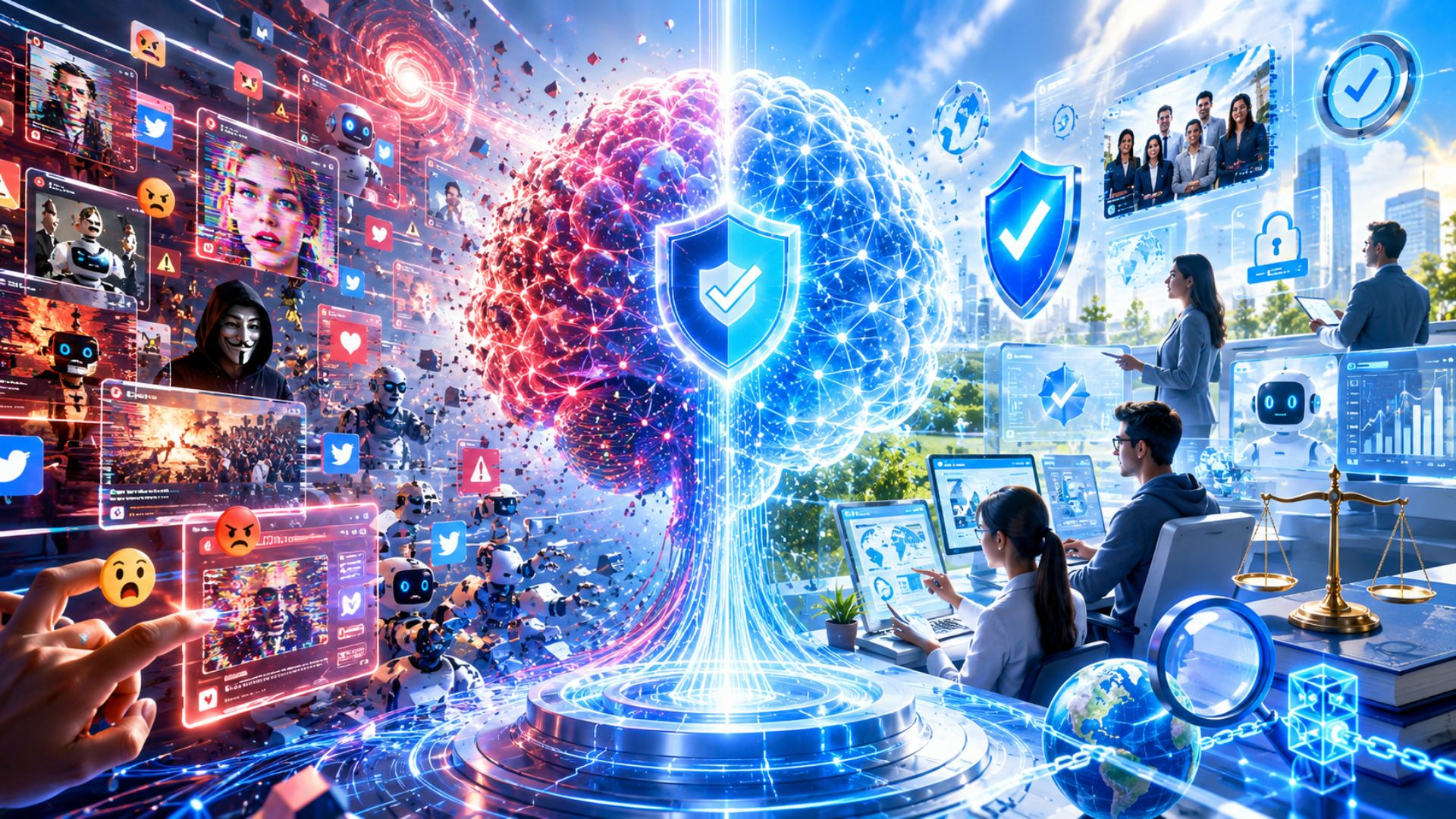
AI Image Generation: India's Innovation–Regulation Dilemma

India is working towards Viksit Bharat 2047 with the twin objectives of economic growth and emerging as a technology leader, with Artificial Intelligence (AI) a central focus. Yet a pressing question demands a definite answer: what will India's policy be towards rapidly developing AI tools? The aspiration to become a global AI hub is commendable, but AI policy must be viewed through two lenses:
- The lens of development and economic growth.
- The lens of growing misinformation and identity manipulation spread through AI platforms.
"India therefore stands at a critical crossroads at present."
A New Era of Generative AI
The recent launch of an advanced multimodal image-generation model marks a turning point:
- Modern systems can produce sophisticated, text-heavy images—rivalling a professional newspaper or a scientific research paper.
- Outputs are almost indistinguishable from authentic camera images or scanned originals.
- Such models can even pull data from the web to supply near-accurate detail.
The shift is fundamental:
- It is no longer a recreational tool for posting social-media trends.
- It now raises serious concerns of cyber-crime, theft and digital deceit.
The Verification Crisis
Social platforms like Facebook, Instagram and even LinkedIn are flooded with AI-generated content, leaving users uncertain about what they consume. The problem is amplified by how content is accessed:
- These platforms are primarily accessed via mobile phones with limited screen sizes.
- Verification becomes difficult, and users may readily accept AI-generated images as real.
Consider a concrete illustration:
THE FAKE RESEARCH PAPER
A LinkedIn post announces a new research paper, with
an image of its first page — journal name, author
credentials, all present and convincing.

  → It may be entirely fake and non-existent.
  → Verifiable only by checking the actual database.
  → Most users will never fact-check it.
Implications Across Institutions
The persuasive effect of AI content significantly amplifies the scope for misinformation and manipulation. Its reach spans several domains:
- Academics & publishing: AI can fabricate mark sheets, degree certificates and research papers, challenging institutions that strive to maintain originality.
- The "liar's dividend": Genuine photographs, videos and documents may themselves be dismissed as fabricated—damaging academics, journalism and institutional credibility.
- Identity theft: Cybercrimes related to identity theft have multiplied recently.
- Personality rights: Celebrities have approached various High Courts seeking protection against unauthorised use of their likeness—image, voice and name—via AI. Yet India has no sound legislative response.
The courtroom is not immune either:
AI IN THE COURTS
• Risks arise where evidence or pleadings are
  filed using AI platforms.
• The Supreme Court and High Courts (e.g., Bombay HC)
  have disparaged such usage.
• Costs imposed on lawyers who cited AI-generated
  arguments without verifying submissions and cases.
Way Forward
India stands at a critical crossroads. While seeking to lead globally on AI, it must build a robust legal framework addressing misinformation, identity misuse and manipulation. The task is to craft a balanced regulatory framework:
- One that encourages innovation and technological advancement.
- While ensuring accountability from platforms.
- And safeguarding the authenticity of the digital ecosystem.
Conclusion
The promise of AI and its perils are two sides of the same coin. India's ambition to be a global AI hub cannot be pursued in isolation from the threats of digital deceit that the same technology enables. The real challenge is not choosing between innovation and regulation, but harmonising them—ensuring that the march towards Viksit Bharat 2047 rests on a digital ecosystem whose authenticity citizens, institutions and courts can still trust.
Attribution
Original content sources and authors


Syllabus classification
How this article maps to GS papers
Main syllabus
GS3Science & TechnologyQuick Q&A
What are the major challenges posed by generative Artificial Intelligence (AI) to India’s digital ecosystem?
AI-generated content can manipulate public perception at an unprecedented scale. Social media platforms such as Facebook, Instagram, X and LinkedIn are increasingly flooded with AI-generated images, fake academic credentials, fabricated news reports and manipulated videos. Since most users access content through mobile devices with limited ability to verify authenticity, misinformation can spread rapidly. For example, fabricated research papers, forged certificates and fake institutional announcements may appear genuine enough to deceive ordinary users. This undermines public trust in journalism, academia and democratic discourse.
Another major concern relates to cybercrime and identity theft. AI tools can imitate voices, facial expressions and writing styles, making impersonation easier. Celebrities and public figures have already approached Indian courts seeking protection against unauthorized use of their likeness and personality rights. Deepfake technology can also be misused for financial fraud, political propaganda and reputational harm.
The judicial system itself faces new challenges. Courts have observed instances where lawyers relied upon AI-generated legal arguments containing fabricated case citations. Such incidents raise concerns regarding professional ethics and the reliability of digital evidence.
Therefore, the rise of generative AI demands a comprehensive governance response. India must develop legal safeguards, strengthen digital literacy, improve cyber forensic capabilities and create accountability mechanisms for AI platforms. A balanced approach is essential to harness innovation while protecting democratic institutions and public trust.
Why does India need a balanced regulatory framework for Artificial Intelligence instead of either complete liberalisation or excessive restriction?
However, unrestricted AI development can generate significant social and institutional harm. The article highlights growing concerns regarding misinformation, identity manipulation, cybercrime and digital deceit. AI-generated content can distort democratic discourse, weaken institutional credibility and create confusion regarding what is real and fabricated. Deepfakes, fake academic credentials and manipulated media can damage trust in public institutions and journalism. Without safeguards, AI may become a tool for fraud, propaganda and exploitation.
At the same time, excessive regulation may hinder innovation and discourage investment. Start-ups, researchers and technology firms require a supportive ecosystem to experiment and innovate. Overly restrictive laws could slow technological development and push AI talent and investment toward countries with more flexible regulatory systems. Therefore, India cannot adopt a purely prohibitory approach.
A balanced framework should focus on accountability without suppressing innovation. Such a framework may include transparency requirements for AI-generated content, mandatory disclosure mechanisms, data protection standards, grievance redressal systems and legal liability for misuse. Ethical AI guidelines and independent regulatory oversight can help ensure responsible deployment.
Ultimately, the challenge before India is not whether AI should be regulated, but how it should be regulated. A carefully designed framework can protect citizens from harm while enabling India to emerge as a trusted and innovative AI leader in the global digital economy.
How can AI-generated misinformation affect democratic institutions, academia and public trust in India?
Academia and educational institutions are also increasingly vulnerable. AI tools can fabricate mark sheets, degree certificates, research papers and academic records with remarkable sophistication. This creates challenges for universities and publishers that seek to maintain academic integrity and originality. Students may misuse AI systems to generate assignments or research content without genuine learning, thereby weakening educational standards and credibility.
Journalism and media credibility may also suffer significantly. The widespread circulation of AI-generated images and reports creates confusion regarding the authenticity of news content. Over time, citizens may begin to distrust even genuine photographs, videos or official statements. This phenomenon, often called the “liar’s dividend,” allows individuals to dismiss authentic evidence as fake.
The judicial and administrative systems face additional complications. Courts in India have already criticized lawyers for submitting AI-generated arguments containing inaccurate or fabricated case citations. If AI-generated evidence enters legal proceedings without proper verification, it may undermine judicial reliability and procedural fairness.
Therefore, safeguarding public trust requires a multi-dimensional strategy. India must strengthen digital literacy, promote independent fact-checking systems, improve cyber forensic capabilities and establish legal accountability for malicious AI-generated misinformation. Protecting institutional credibility is essential not only for governance but also for the long-term stability of democracy and the rule of law.
Critically analyse the ethical and legal implications of AI-generated identity manipulation and deepfake technology.
One major ethical concern is the violation of personality rights and individual autonomy. Celebrities, journalists and ordinary citizens may find their likeness, voice or identity used without consent. Such misuse can damage reputations, spread false narratives and invade personal privacy. Women are particularly vulnerable to malicious deepfake content involving harassment and exploitation. This raises important questions regarding consent, dignity and digital rights in the age of AI.
The legal framework in India currently remains fragmented and inadequate. Existing laws under the Information Technology Act, copyright law and privacy jurisprudence provide partial remedies, but there is no comprehensive legislation specifically addressing AI-generated identity manipulation. Courts have begun recognizing personality rights and have intervened in individual cases, yet the absence of a dedicated statutory framework creates uncertainty.
There are also concerns regarding national security and democratic stability. Deepfake videos of political leaders or military officials could be used to spread panic, influence elections or provoke communal tensions. In international conflicts, manipulated content can become a weapon of information warfare.
However, an excessively restrictive legal regime may also create challenges. Overregulation could discourage technological innovation, artistic expression and legitimate AI research. Therefore, regulation must distinguish between harmful misuse and beneficial applications.
A balanced approach should combine legal accountability, technological safeguards and public awareness. Mandatory labeling of AI-generated content, stronger consent requirements, rapid grievance redressal mechanisms and investment in deepfake detection technologies are essential. India’s response must uphold innovation while protecting privacy, dignity and democratic integrity.
Can you explain with examples how AI-generated content may create challenges in academia, journalism and legal systems?
Journalism faces a parallel challenge. AI-generated images and fabricated news reports can spread rapidly across social media platforms. Since users often consume information quickly through smartphones, they may not verify the authenticity of the content. A manipulated image of a public protest or disaster can trigger panic, communal tensions or misinformation campaigns before authorities issue clarifications. Over time, repeated exposure to such content may reduce public trust even in genuine journalism.
The legal system has also encountered problems associated with AI misuse. Indian courts, including the Supreme Court and Bombay High Court, have criticized lawyers for submitting AI-generated arguments containing incorrect or fabricated legal citations. If advocates rely blindly on AI-generated legal research without verification, it may compromise professional ethics and judicial efficiency.
These examples demonstrate that AI-generated misinformation is not merely a technological issue but an institutional challenge. It affects credibility, trust and accountability across sectors. The problem becomes more severe because AI-generated outputs increasingly resemble authentic human-generated content.
Therefore, institutional safeguards are essential. Educational institutions need plagiarism-detection and verification systems, media organizations require stronger fact-checking mechanisms, and courts may need protocols regarding the admissibility of AI-generated material. Simultaneously, digital literacy among citizens must be strengthened so that society develops the capacity to critically evaluate online information.
Suppose you are advising the Government of India on AI governance. What policy measures would you recommend to balance innovation and accountability?
A multi-layered regulatory structure would be necessary.
- Mandatory labeling and disclosure of AI-generated content
- Legal liability for malicious misuse of deepfake technology
- Data protection and privacy safeguards
- Independent AI oversight authority for grievance redressal
- Periodic audits of high-risk AI systems
Capacity-building is equally important. India must invest in AI literacy, cyber forensics and public awareness campaigns. Educational institutions, journalists, judges and law enforcement agencies should receive specialized training to identify AI-generated misinformation and manipulated evidence. Public-private partnerships can help develop indigenous AI detection technologies.
India should also promote ethical AI innovation. Research grants, startup incentives and AI sandboxes can encourage responsible experimentation. Simultaneously, India can collaborate internationally on AI standards, cybersecurity protocols and ethical governance frameworks.
Finally, the policy framework should remain flexible and adaptive. AI technologies evolve rapidly, making static regulations ineffective over time. Periodic review mechanisms, stakeholder consultations and evidence-based policymaking are essential for long-term governance success.
Such a balanced approach would allow India to emerge as both an AI innovation hub and a responsible digital democracy. The ultimate objective should be to ensure that technological progress strengthens public trust, institutional integrity and inclusive development.
Practice questions
1 question for mains preparation