Beyond One Nation One Subscription: The Quest for Knowledge Sovereignty in India

"In the knowledge economy, control over research dissemination is as important as control over research production."
Scientific research is often viewed as a public good. However, the system through which research is published, accessed and evaluated is largely controlled by a small group of international commercial publishers. As countries increasingly view knowledge as a strategic asset, many are rethinking their dependence on this publishing ecosystem and pursuing what is now called knowledge sovereignty.
Understanding the Global Scholarly Publishing Landscape
The global scholarly publishing system is the network through which scientific knowledge is reviewed, published, accessed and evaluated.
How the System Works
Step 1: Researchers conduct research
Step 2: Research paper submitted to a journal
Step 3: Peer review by experts
Step 4: Journal publishes the paper
Step 5: Universities and institutions pay to access it
Major Stakeholders
| Stakeholder | Role |
|---|---|
| Researchers | Produce knowledge |
| Universities | Fund research |
| Publishers | Publish journals |
| Governments | Finance research ecosystem |
| Readers | Consume research outputs |
Why is the Current Model Being Questioned?
A paradox exists in the system.
Public funds → Research conducted
Researchers write papers
Publishers publish papers
Universities pay again to access them
In many cases:
- Research is publicly funded.
- Peer review is performed free of cost by academics.
- Publishers charge subscription fees.
- Authors may also pay publication charges.
Examples of Leading Publishers
• Elsevier
• Springer Nature
• Wiley
• Taylor & Francis
• Sage
Prestigious journals such as Nature, Science and Cell dominate global academic visibility and influence.
Key Concepts in Scholarly Publishing
Subscription Model
Institutions pay annual fees to access journals.
Article Processing Charges (APCs)
Authors pay publishers to make articles openly accessible.
Example:
Nature Communications
Science Advances
Cell Reports

APCs often exceed $5,000 per paper.
Open Access
Research becomes freely available to all readers.
Green Open Access
Authors archive copies of papers in public repositories.
Diamond Open Access
Authors pay nothing.
Readers pay nothing.
Public institutions bear costs.
Global Shift Towards Knowledge Sovereignty
Several countries now seek to reduce dependence on commercial publishers.
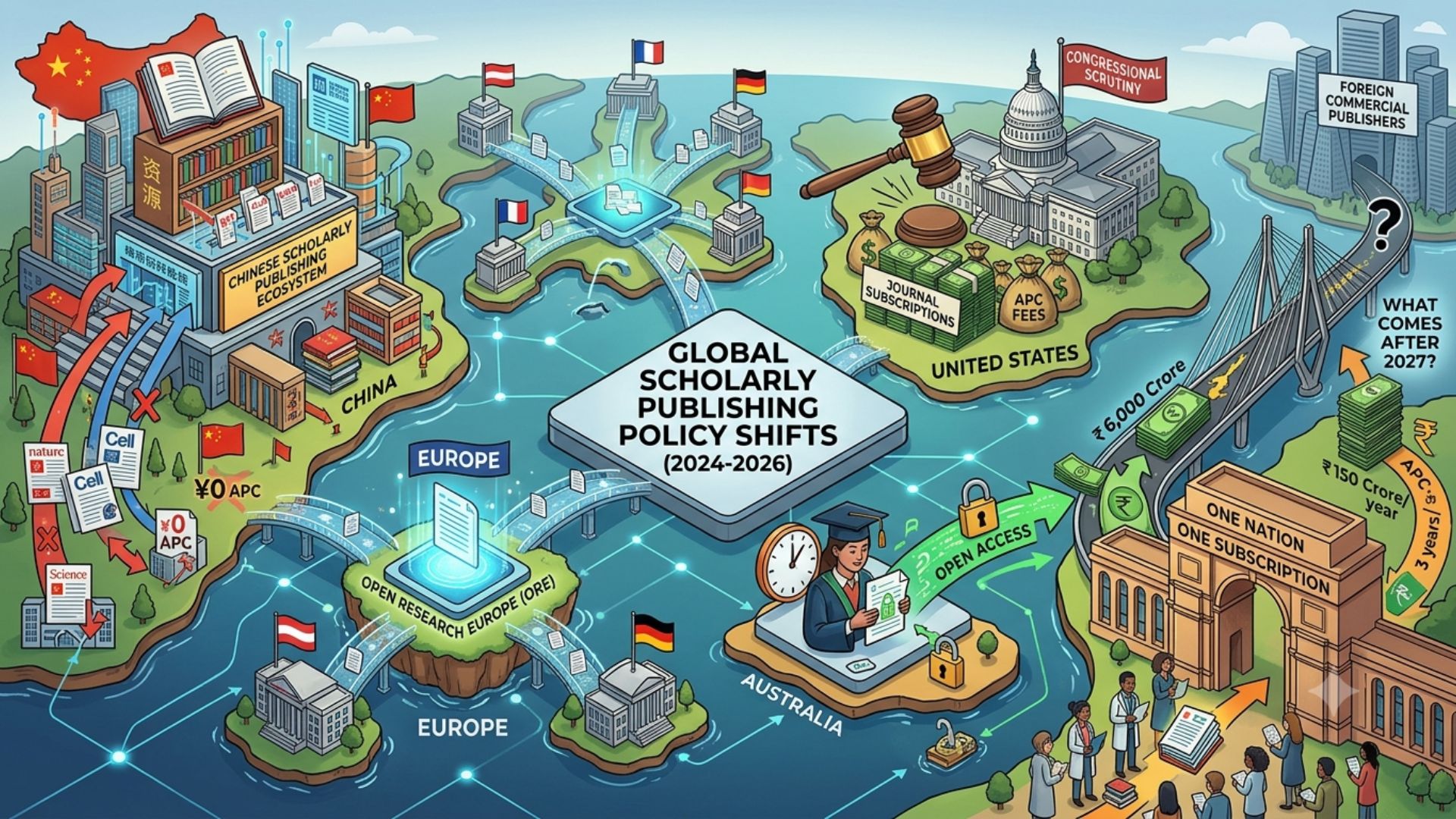
China: Building Indigenous Publishing Capacity
China views publishing infrastructure as a strategic asset.
Key initiatives include:
- Reducing emphasis on journal impact factors.
- Supporting domestic journals.
- Linking research evaluation to quality and national priorities.
- Creating over 400 globally competitive Chinese journals.
Strategic Move
The Chinese Academy of Sciences stopped paying APCs for several expensive foreign journals.
"China seeks not only to produce knowledge but also to control the platforms that distribute it."
United States: Questioning Publishing Economics
The U.S. Congress has begun examining:
- Subscription costs.
- APC expenditures.
- Publisher profit margins.
- Public return on research investments.
The debate increasingly treats publishing as a fiscal and transparency issue.
Australia: Mandatory Open Access
Australia's ARC Open Access Policy (2026) requires:
• Immediate open access
• No embargo periods
• Institutional responsibility for compliance
The objective is to ensure that publicly funded research remains publicly accessible.
Europe: Creating Public Publishing Infrastructure
Europe has adopted perhaps the most ambitious approach.
Open Research Europe
| Feature | Details |
|---|---|
| Ownership | Public |
| Funding | European Commission |
| Technical Support | CERN |
| Publication Cost | Free |
The platform seeks to reduce reliance on commercial publishers altogether.
Europe is simultaneously scaling Diamond Open Access, where neither authors nor readers pay.
India's Approach: One Nation One Subscription (ONOS)
India launched ONOS in 2025.
Key Features
| Component | Details |
|---|---|
| Budget | ₹6,000 crore |
| Duration | 2025–2027 |
| Journals Covered | 13,000+ |
| Institutions Covered | ~6,300 |
For many researchers, especially in tier-2 and tier-3 institutions, ONOS has dramatically improved access.
What ONOS Solves — and What It Does Not
Achievements
- Expanded access to scientific literature.
- Reduced institutional inequalities.
- Treated knowledge access as a public good.
Remaining Challenges
• Dependence on foreign publishers continues.
• Publishing infrastructure remains external.
• APC expenditure continues.
• Pricing transparency is limited.
• No clear post-2027 roadmap.
With over half of global research already freely accessible, critics argue that India must move beyond merely purchasing access.
"ONOS solves the reading problem but not the publishing problem."
Towards Knowledge Sovereignty
A long-term strategy could include:
- Green open-access mandates for publicly funded research.
- Rights-retention policies for researchers.
- Investment in Indian journals.
- Publicly owned publishing platforms.
- Transparent APC expenditure.
- International collaboration on community-governed publishing infrastructure.
Way Forward
- Build sovereign scholarly publishing infrastructure.
- Strengthen Indian journals and editorial ecosystems.
- Encourage open access for publicly funded research.
- Promote community-owned publishing models.
- Integrate ONOS into a broader knowledge sovereignty strategy.
- Support reforms through the Anusandhan National Research Foundation.
Conclusion
The global scholarly publishing system is undergoing a major transformation. China is building domestic capacity, Europe is creating public infrastructure, Australia is mandating open access, and the United States is questioning publishing economics. India's ONOS initiative has improved access to knowledge, but true knowledge sovereignty requires more than subscriptions. It requires control over the institutions, platforms and policies through which knowledge is created, disseminated and preserved.
Attribution
Original content sources and authors


Syllabus classification
How this article maps to GS papers
Main syllabus
GS3Science & TechnologyAlso covers
Quick Q&A
What is knowledge sovereignty in scholarly publishing and why has it emerged as a significant policy issue for major research-producing nations?
Why is the changing global landscape of scholarly publishing important for India and UPSC aspirants studying Science and Technology governance?
How have China, the United States, Europe, and Australia adopted different strategies to reform scholarly publishing systems?
What is a critical assessment of India's One Nation One Subscription scheme and its implications for scientific self-reliance?
What lessons can India learn from international case studies in open-access publishing and publicly owned research infrastructure?
What are the major reasons behind the global movement away from commercial publishing dependence towards open-access ecosystems?
Practice questions
1 question for mains preparation