GS3 Science & Technology

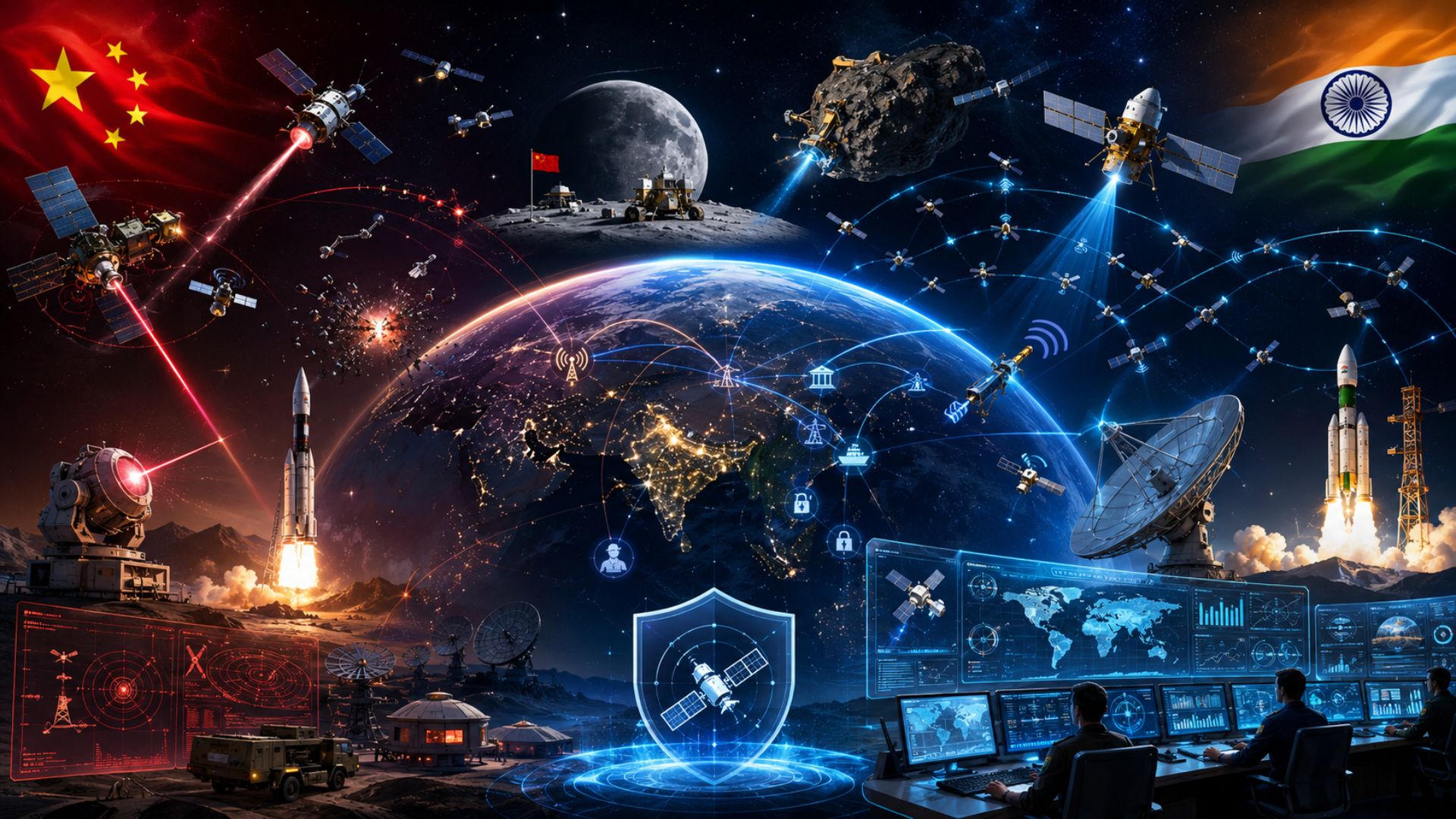
Weaponisation of Space: How China’s Counter-Space Capabilities Are Reshaping Global Security

China's Expanding Counter-Space Capabilities and India's Strategic Response

As Space Becomes a Strategic Frontier, China's Counter-Space Capabilities Present New Challenges for India
Surya Surya
4 mins read

"The incentive to influence activities on Earth by controlling outer space remains a potential trigger for future confrontation."

Outer space is increasingly emerging as a critical arena of geopolitical competition. While no war has yet been fought in space, the growing dependence of modern societies on satellites has transformed space into a strategic domain with military, economic, and technological implications.

China's rapid development of counter-space capabilities has therefore become a significant concern, particularly for countries such as India that rely heavily on space-based assets for communication, navigation, surveillance, and national security.

Understanding China's Space Ambitions

China officially promotes the peaceful use of outer space. However, several developments indicate parallel efforts to prepare for potential orbital warfare.

Notable demonstrations include:

  • Destruction of its own satellite in 2007.
  • Testing of an exo-atmospheric anti-satellite vehicle in 2015.
  • Use of a robotic spacecraft to move a defunct satellite in 2022.
  • Demonstration of an orbital "dog-fight" in 2024.

China's ambitions operate on two levels:

1. Winning the New Space Race

China seeks technological and numerical parity with leading space powers.

Current trends include:

  • Around 1,900 Chinese satellites in orbit.
  • Competition with the United States and private players.
  • Growth of commercial firms such as LandSpace, iSpace, and OneSpace.

2. Securing Strategic Advantage

China recognizes that space systems underpin:

  • Communications
  • Navigation
  • Financial networks
  • Power grids
  • Military Command-and-Control (C2)
  • Intelligence, Surveillance and Reconnaissance (ISR)

A disruption of these systems could significantly affect both civilian and military operations.

Modern Warfare = Satellites + ISR + Navigation + Communications

Disrupt Satellites → Disrupt Military Operations

China's Long-Term Vision

China's space roadmap is highly ambitious.

Key goals include:

  • Human landing on the Moon by 2036.
  • Nuclear-powered space shuttle by 2040.
  • Space-based solar power system by 2050.
  • Exploration of lunar and asteroid mining for energy and critical minerals.

Simultaneously, China plans to deploy over 36,000 Low Earth Orbit (LEO) satellites by 2030, directly competing with systems such as Starlink.

How China Seeks Space Superiority

China's strategy revolves around two objectives:

  • Protecting its own military and economic systems through space assets.
  • Achieving technological and numerical superiority over rivals.

Its counter-space arsenal is evolving in three major areas.

Kinetic Weapons

Designed to physically destroy satellites.

Examples:

  • DN-3 missile
  • SC-19 missile

Directed Energy Weapons

Laser systems capable of:

  • Dazzling satellites
  • Blinding sensors
  • Disrupting communications and navigation

Co-Orbital Systems

Satellites designed to interfere with other satellites.

Examples:

  • SJ series
  • TJS series

These capabilities could help the People's Liberation Army (PLA) degrade enemy ISR, GPS, and communication networks during the initial stages of a conflict.

Why This Matters for India

A potential Taiwan contingency offers insight into how China may employ these capabilities.

Experts suggest China may first:

  • Blind surveillance networks.
  • Jam communications.
  • Disrupt information flows.

Only later might it resort to destructive attacks.

A similar, though smaller-scale, challenge exists for India.

The Numerical Gap

India currently operates around:

  • 60 satellites

Compared to:

  • More than 400 Chinese military satellites alone.

This creates a redundancy problem.

China loses 5 satellites → Limited impact

India loses 5 satellites → Significant impact

Potential targets include:

  • CARTOSAT series
  • RISAT series
  • NavIC navigation system

China could employ:

  • Laser dazzling
  • Signal jamming
  • Temporary surveillance denial

without immediately escalating into full-scale space warfare.

Limits to China's Options

China's ability to inflict catastrophic damage is constrained.

Destroying large numbers of satellites could trigger:

  • Massive orbital debris generation.
  • Cascading collisions.
  • Kessler Syndrome, where debris makes portions of space unusable.

India's Mission Shakti strengthened deterrence, but challenges remain:

  • Limited operational experience.
  • Lack of co-orbital counter-space capabilities.
  • Need for greater resilience.

Way Forward

  • Expand India's commercial space ecosystem beyond ISRO.
  • Increase satellite production and launch capacity.
  • Shift from large satellites to resilient constellations.
  • Strengthen protection of ground-based space infrastructure.
  • Deepen data-sharing arrangements with strategic partners.
  • Develop rapid restoration mechanisms for critical services.
  • Clearly define red lines and escalation thresholds in space conflicts.

Conclusion

As space becomes central to military power, economic activity, and technological leadership, counter-space capabilities are emerging as a critical component of national security. China's growing capabilities underscore the need for India to build redundancy, resilience, and deterrence in space. Protecting national interests in the twenty-first century will increasingly depend not only on securing borders on Earth but also on safeguarding assets in orbit.

Attribution

Original content sources and authors

Harinder Singh Author Harinder Singh The Hindu Source The Hindu

Syllabus classification

How this article maps to GS papers

Main syllabus

GS3Science & Technology

Quick Q&A

What are China’s counter-space capabilities, and why are they increasingly significant in the evolving geopolitics of outer space?
China’s counter-space capabilities refer to a range of technologies and military systems designed to disrupt, degrade, disable, or destroy an adversary’s space-based assets. These capabilities include kinetic anti-satellite (ASAT) weapons such as the SC-19 and DN-3 missile systems, laser-based systems capable of dazzling or blinding satellites, electronic warfare tools including jammers, and co-orbital satellites such as the SJ and TJS series that can maneuver near other satellites and potentially interfere with their operations. The significance of these capabilities lies in the growing dependence of modern economies and militaries on satellites for communication, navigation, intelligence, surveillance, reconnaissance (ISR), financial transactions, weather forecasting, and military command-and-control systems. China’s rise as a major space power has been marked by several notable developments. In 2007, it conducted a direct-ascent ASAT test by destroying one of its own satellites, demonstrating its ability to target orbital assets. Subsequent developments, including robotic spacecraft operations and demonstrations of advanced orbital maneuvering, suggest a sustained effort to acquire both defensive and offensive space capabilities. For UPSC aspirants, the topic is relevant to GS Paper III (Science and Technology, Security) and International Relations. It highlights the growing militarization of outer space and the absence of a comprehensive global regulatory framework governing military activities in space. China’s ambitions extend beyond military objectives to economic and technological competition, including lunar exploration, asteroid mining, and deployment of large satellite constellations. Consequently, counter-space capabilities have emerged as critical instruments of strategic competition, influencing the future balance of power among major states and shaping security dynamics in Asia and beyond.
Why does China view space superiority as a strategic necessity, and what factors are driving its long-term space ambitions?
China views space superiority as a strategic necessity because control over space increasingly translates into military, economic, technological, and geopolitical influence on Earth. Modern warfare relies heavily on satellite-based systems for communication, navigation, intelligence gathering, precision targeting, and battlefield awareness. Any disruption of these systems can significantly affect military effectiveness. Consequently, China considers space an essential domain alongside land, sea, air, and cyberspace. Several factors drive China’s long-term ambitions. First, strategic competition with the United States plays a central role. While the United States currently possesses more than 8,000 satellites, China seeks to reduce this gap by rapidly expanding its own satellite networks. Plans to deploy over 36,000 Low Earth Orbit (LEO) satellites by 2030 reflect this objective. Second, economic interests are increasingly important. Future industries involving satellite internet, space-based solar power, lunar exploration, and asteroid mining could generate substantial economic benefits and provide access to critical resources. Third, technological prestige and national power considerations influence Chinese policy. Ambitious goals such as landing humans on the Moon by 2036 and developing a nuclear-powered shuttle by 2040 are intended to establish China as a leading scientific and technological power. Fourth, military planners recognize that space dominance could provide decisive advantages during crises, especially in scenarios involving Taiwan or regional conflicts. From a UPSC perspective, this issue intersects with GS Paper II (International Relations), GS Paper III (Security and Technology), and Essay topics related to emerging technologies. It also raises debates about the weaponization of space, strategic stability, and the adequacy of existing international space governance mechanisms. Understanding China’s motivations helps explain broader trends in global power competition and the emerging space race of the twenty-first century.
How could China’s evolving counter-space capabilities affect India’s national security, military preparedness, and strategic decision-making?
China’s evolving counter-space capabilities could significantly affect India’s national security because India increasingly depends on satellites for communication, navigation, surveillance, weather forecasting, disaster management, and military operations. Compared to China’s extensive satellite infrastructure, India currently possesses a relatively limited number of operational satellites, making its space architecture less redundant and potentially more vulnerable to disruption. In a conflict or border crisis, China may employ non-kinetic measures such as lasers, jammers, or cyberattacks before resorting to physical destruction of satellites. Such actions could temporarily blind surveillance satellites like the CARTOSAT or RISAT series, creating intelligence gaps along sensitive regions such as the Line of Actual Control (LAC). Similarly, interference with the NavIC navigation system could affect military operations, logistics, and precision-guided capabilities. A major concern is the asymmetry in space assets. While the loss of a few satellites may be manageable for countries with large constellations, India could face disproportionate operational challenges if several critical satellites become unavailable. This vulnerability has implications for military command-and-control, ISR networks, and battlefield awareness during the crucial initial phase of a conflict. The issue also influences strategic decision-making. India must account for the possibility that future conflicts may begin with attacks on information networks rather than conventional military targets. Consequently, space resilience becomes an essential component of deterrence. For UPSC preparation, the topic connects with GS Paper III, internal and external security, and Science and Technology. It also demonstrates the growing integration of space technology with national defense. The broader debate concerns whether space should remain a peaceful domain or become an extension of strategic competition. India’s response will shape its ability to protect critical national interests in an increasingly contested space environment.
Critically analyze the challenges posed by the weaponization of outer space and the limitations of existing international governance mechanisms.
The weaponization of outer space represents one of the most significant emerging security challenges of the twenty-first century. Although the 1967 Outer Space Treaty established foundational principles for the peaceful use of space, it was drafted in a different technological era and does not adequately address many contemporary military developments. As a result, advances in anti-satellite weapons, co-orbital systems, electronic warfare technologies, and dual-use satellites have created new strategic risks. One major challenge is the dual-use nature of space technology. Satellites used for civilian communication, navigation, or weather forecasting often have military applications. This ambiguity makes it difficult to distinguish peaceful activities from potentially hostile actions. China’s development of robotic spacecraft and co-orbital satellites illustrates how technologies intended for servicing or debris removal can also possess military utility. Another concern is escalation risk. A successful attack on satellites could disrupt communication networks, financial systems, navigation services, and military operations. Such actions may trigger broader conflicts. Furthermore, kinetic ASAT tests create large quantities of space debris, increasing the risk of Kessler Syndrome—a cascading chain reaction of collisions that could render parts of Earth’s orbit unusable. Existing governance mechanisms face significant limitations. There is no comprehensive international treaty prohibiting conventional anti-satellite weapons, nor are there universally accepted norms governing proximity operations in space. Great-power rivalry further complicates consensus-building. However, some analysts argue that space competition can drive technological innovation and encourage nations to develop resilient architectures. Others emphasize the need for confidence-building measures, transparency mechanisms, and legally binding agreements. For UPSC aspirants, this topic links with International Relations, Security Studies, Science and Technology, and Global Governance. It illustrates how emerging technologies challenge traditional legal frameworks and require new approaches to international cooperation and strategic stability.
What lessons can India draw from China’s space strategy and recent developments to strengthen its own space security architecture?
China’s rapid expansion in space capabilities offers important lessons for India in terms of technological development, strategic planning, and national security preparedness. One key lesson is the importance of redundancy. China has invested heavily in large satellite constellations and diversified space assets, reducing the vulnerability associated with the loss of individual satellites. India, by contrast, operates a comparatively smaller fleet and therefore faces greater risks from targeted disruptions. A second lesson concerns the integration of civilian, commercial, and military space capabilities. Chinese private firms such as LandSpace, iSpace, and OneSpace complement national objectives by contributing to launch capacity and technological innovation. India has begun encouraging private participation through reforms and institutions such as IN-SPACe, but further expansion is necessary to create a robust space ecosystem. Third, resilience is as important as deterrence. India’s Mission Shakti ASAT test in 2019 demonstrated technological capability and strengthened deterrence. However, deterrence alone is insufficient. India must also develop resilient satellite constellations, rapid launch capabilities, enhanced cyber protection, and alternative communication networks. Fourth, international partnerships are increasingly important. Cooperation with countries such as the United States, France, Japan, and Australia can improve data sharing, situational awareness, and access to backup systems during emergencies. Such partnerships contribute to collective resilience. Policy measures should include disaggregating large satellite systems into smaller constellations, expanding domestic manufacturing, strengthening protection of ground infrastructure, and developing clear doctrines regarding space security and escalation management. For UPSC aspirants, this case study links GS Paper III, security strategy, science and technology, and governance reforms. It demonstrates how emerging technological competition influences national security planning. The broader lesson is that India must move beyond dependence on a few critical assets and build a resilient, scalable, and strategically autonomous space architecture capable of safeguarding national interests in an increasingly contested domain.
How should India safeguard its strategic interests in outer space while balancing deterrence, resilience, and international cooperation?
India should adopt a comprehensive space security strategy that balances deterrence, resilience, technological innovation, and international cooperation. As space becomes increasingly central to economic growth, national security, and digital infrastructure, protecting space assets is no longer optional but a strategic necessity. The first priority should be expanding indigenous space capacity. Greater satellite production and launch capability would enhance redundancy, ensuring that the loss of a few satellites does not significantly affect national operations. Encouraging private-sector participation can accelerate this process and reduce dependence on a limited number of government-operated systems. Second, India should transition from reliance on a few large satellites to distributed constellations. Smaller, interconnected satellite networks are generally more survivable and difficult to neutralize. This approach has been increasingly adopted worldwide due to its resilience against both physical and electronic attacks. Third, India must strengthen protection of ground infrastructure, including control stations, communication facilities, and data centers. Since many space systems depend on terrestrial support networks, securing these assets is critical. Fourth, enhanced space situational awareness and international partnerships are essential. Cooperation with friendly countries can improve monitoring of orbital activities, facilitate intelligence sharing, and provide backup services if domestic satellites are compromised. Such arrangements can significantly reduce operational disruptions during crises. Fifth, India should clearly articulate its red lines and response options regarding hostile actions in space. Strategic ambiguity may have value in some contexts, but clear signaling can strengthen deterrence by reducing miscalculation. From a UPSC perspective, this issue connects with GS Paper III, defense modernization, science and technology, and international relations. It also raises broader questions about strategic autonomy, emerging security challenges, and the future of global governance. A balanced approach combining capability development and diplomacy offers the most sustainable path for protecting India’s long-term interests in outer space.

Practice questions

1 question for mains preparation

Space technology has become an integral component of national security in the modern era. Examine the emerging challenges posed by the weaponisation of outer space and discuss the measures India should adopt to safeguard its strategic interests.

15 marks · 250 words · 8 mins
