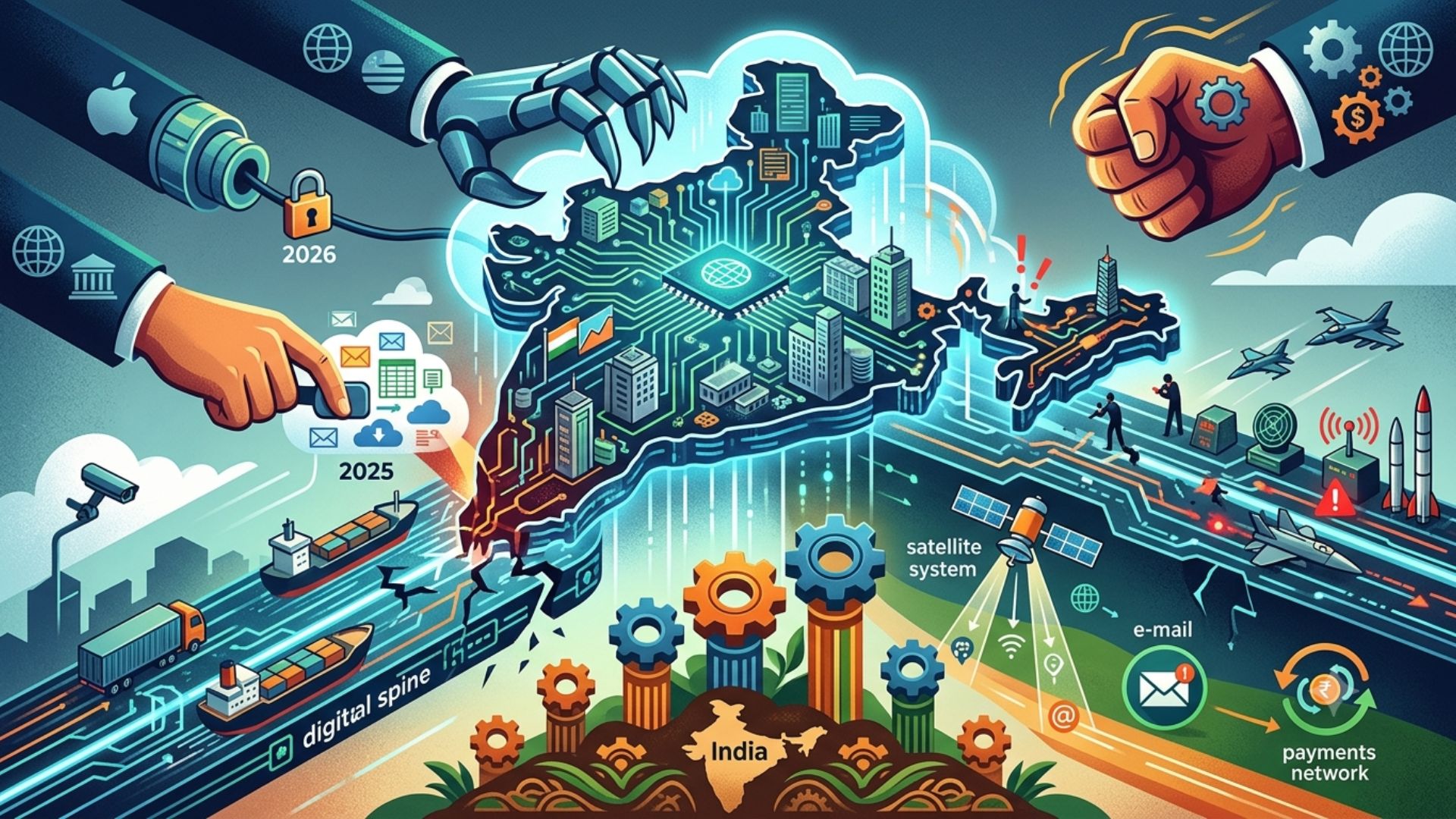
Digital Sovereignty: Why India Must Control Its Critical Technology Infrastructure

"In the digital age, control over technology infrastructure is as important as control over physical territory."
Recent incidents involving compromised CCTV networks and denial of access to critical digital services have highlighted growing concerns regarding India's digital and technological sovereignty. These developments raise important questions about the country's dependence on foreign-owned digital infrastructure and its implications for national security.
What Triggered the Concern?
Two recent incidents exposed India's technological vulnerabilities.
| Incident | Concern |
|---|---|
| Compromise of Indian CCTV networks through Chinese software platform EseeCloud | Security risk to strategic defence assets |
| Denial of access to Nayara Energy's email, cloud and collaboration tools due to EU sanctions | Dependence on foreign technology platforms |
These incidents demonstrate that access to critical digital services can potentially be influenced by foreign corporations and governments.
What is Digital Sovereignty?
Digital sovereignty refers to a nation's ability to control:
- Its digital infrastructure
- Data storage and access
- Critical software platforms
- Communication networks
- Strategic technologies
"Control over digital infrastructure determines control over governance, commerce and national security."
Why is Foreign Dependence a Risk?
Many Indian organisations rely on foreign-owned:
• Cloud infrastructure
• Authentication systems
• Productivity suites
• Email platforms
• Collaboration tools
• Data storage services
Even when data is stored within India, foreign technology companies may be legally compelled by their home governments to provide access under existing global data governance regimes.
Potential Consequences
- Disruption of government services
- Interruption of trade and commerce
- Manufacturing slowdowns
- National security vulnerabilities
- Loss of strategic autonomy
National Security Dimension
Modern warfare is increasingly software-defined.
Critical military capabilities depend on:
- Embedded software
- Navigation systems
- Radar technologies
- Battlefield intelligence platforms
A foreign manufacturer exercising software control could potentially:
• Reduce operational effectiveness
• Limit targeting accuracy
• Restrict system capabilities
• Influence intelligence flows
Historical Example
The 1999 Kargil conflict exposed India's dependence on foreign navigation systems when access to precise GPS support was restricted during a critical military operation.
Global Recognition of the Problem
Several countries are pursuing technological sovereignty.
| Country/Region | Initiative |
|---|---|
| France | Sovereign video-conferencing platform by 2027 |
| Netherlands | Exploring alternatives to U.S. software |
| Denmark | Reducing dependence on foreign platforms |
| Germany | Seeking domestic software solutions |
| European Union | Developing independent cloud infrastructure |
| Türkiye | Expanding indigenous technology capabilities |
The challenge is therefore not unique to India but part of a wider global trend.
India's Unique Strategic Context
The article places India's situation within the framework of Power Transition Theory.
Core Idea
When a rising power approaches parity with an established hegemon, the latter often seeks to constrain the former.
Examples include:
• U.S.–China technology competition
• Export controls
• Technology restrictions
• Supply-chain realignments
As India's economic and strategic influence grows, technological dependence could become a source of vulnerability.
Steps Already Taken by India
Several initiatives indicate a growing push towards technological self-reliance.
Indigenous Platforms
| Initiative | Significance |
|---|---|
| NavIC | Indigenous navigation system |
| UPI | Domestic payment infrastructure |
| RuPay | Indigenous card network |
| Zoho adoption in ministries | Local digital platforms |
| Semiconductor ecosystem initiatives | Technology manufacturing capability |
These examples demonstrate that dependence on foreign-controlled systems can be reduced.
Strengthening Defence Technology
India has traditionally relied heavily on public-sector defence production.
Key Challenge
Despite efforts since the 1980s:
- India still lacks a fully indigenous modern fighter aircraft.
Learning from the U.S. Model
Government:
• Funds research
• Assures procurement

Private Sector:
• Develops technology
• Innovates rapidly
• Enhances competitiveness
The Advanced Medium Combat Aircraft (AMCA) programme's private-sector participation reflects movement in this direction.
Building Partnerships, Not Isolation
Digital sovereignty need not imply technological isolation.
Strategic Partnerships
| Initiative | Importance |
|---|---|
| BrahMos (India-Russia) | Joint technology development |
| Micron ATMP Facility, Gujarat | India-U.S. semiconductor cooperation |
| Pax Silica Initiative | Trusted AI and supply-chain partnerships |
Such collaborations create mutual dependence and reduce the risk of unilateral technological coercion.
The R&D Challenge
A major concern remains India's low investment in research and development.
| Indicator | Value |
|---|---|
| India's R&D expenditure (2000–2020 average) | 0.74% of GDP |
| Global average | 2.07% of GDP |
This gap limits India's ability to develop critical technologies independently.
"The question is not whether India can afford technological sovereignty, but whether it can afford to forgo it."
Way Forward
- Expand indigenous cloud and digital infrastructure.
- Accelerate semiconductor manufacturing capabilities.
- Increase R&D expenditure substantially.
- Promote private-sector participation in strategic technologies.
- Develop sovereign cybersecurity and authentication systems.
- Strengthen trusted international technology partnerships.
- Reduce dependence on single-country technology ecosystems.
- Build resilient digital infrastructure for critical sectors.
Conclusion
Digital infrastructure has become a foundational pillar of economic growth, governance and national security. The recent security and technology access incidents reveal that dependence on foreign-controlled digital systems can create strategic vulnerabilities. India's experience with NavIC, UPI and RuPay demonstrates that technological self-reliance is achievable. Strengthening digital sovereignty through innovation, partnerships and greater investment in research will be essential for preserving India's strategic autonomy in an increasingly fragmented technological order.
Attribution
Original content sources and authors

Syllabus classification
How this article maps to GS papers
Main syllabus
GS3Science & TechnologyAlso covers
Quick Q&A
What is digital and technological sovereignty, and why has it emerged as a strategic imperative for India in the twenty-first century?
Why is reducing dependence on foreign digital infrastructure becoming increasingly important for India's economic competitiveness and strategic autonomy?
How can India build comprehensive technological sovereignty through indigenous innovation and trusted international partnerships?
What are the major reasons behind India's vulnerability in digital infrastructure and critical technology ecosystems?
How do the Kargil conflict, UPI ecosystem, and BrahMos programme illustrate India's journey towards technological self-reliance?
What is the critical analysis of India's approach towards self-reliance in technology and national digital missions?
Practice questions
1 question for mains preparation