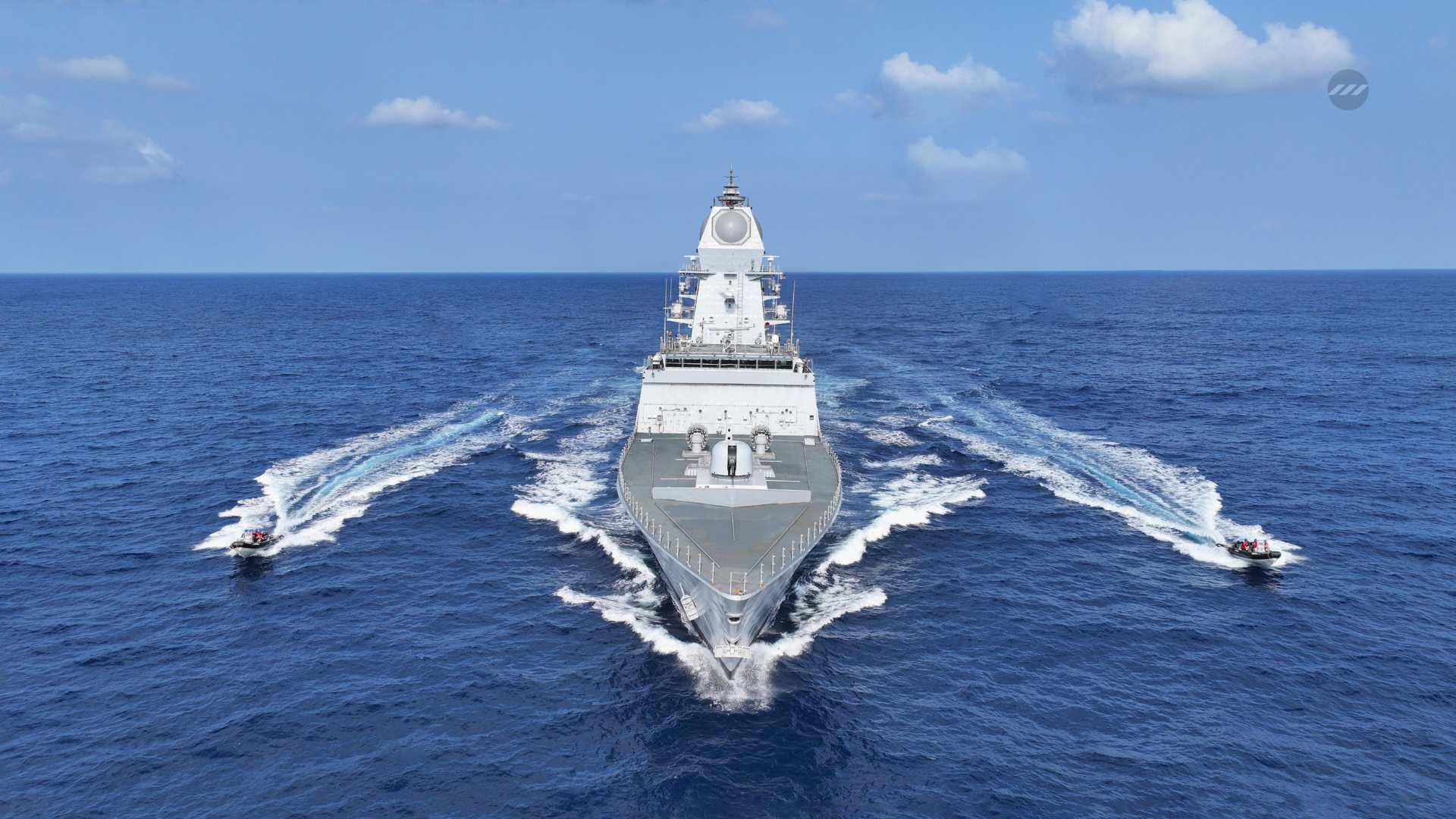
Exploring India's Project 17A: Strengthening Naval Capabilities

Introduction
"A warship delivered on paper but unprepared for combat is not a warship — it is a liability dressed in steel."
India's maritime security rests on a paradox: the Indian Ocean carries the bulk of India's energy imports and trade, yet India's naval modernisation programme remains hostage to import-dependent components, design delays, and infrastructure gaps. Project 17A — India's ₹45,000-crore, seven-frigate programme — exemplifies both the ambition and the structural fault lines of India's defence-industrial ecosystem.
| Parameter | Detail |
|---|---|
| Programme | Project 17A — Nilgiri-class Frigates |
| Cost | ₹45,000 crore |
| Number of Vessels | 7 frigates |
| Deliveries so far | 6 in 17 months (INS Mahendragiri: April 30) |
| Indigenous content | 75% by value |
| Critical gap | Engines, sensors — largely imported |
Background & Context
Evolution of India's Frigate Programme
India's surface combatant fleet has evolved through successive projects — each building on the last in capability but also inheriting structural delays:
- Shivalik-class (Project 17): First stealth frigates; established the design baseline
- Nilgiri-class (Project 17A): Advanced complement with anti-air, anti-surface, and anti-submarine warfare (AAW/ASuW/ASW) capabilities
- Project 17B: Planned next-generation successor, building on 17A lessons
The Indian Ocean Strategic Context
The Indian Ocean is not merely a trade route — it is India's strategic backyard and a contested space:
→ Carries majority of India's energy imports (45% via Strait of Hormuz)
→ Site of increasing Chinese PLA-Navy submarine deployments
→ Theatre of non-traditional threats — Houthi drone/missile activity, piracy, smuggling, post-26/11 coastal infiltration risks
Key Concepts
1. The Detect-Decide-Respond Architecture
India has built a layered maritime domain awareness (MDA) system:
| Layer | Component | Status |
|---|---|---|
| Detect | Chain of Static Sensors (post-26/11), naval satellites, underwater sensor networks | Operational; extended to Mauritius, Sri Lanka, Seychelles |
| Decide | Command & intelligence fusion centres | Functional but sensor-feed dependent |
| Respond | Surface combatants (Project 17A frigates) | Delivery ongoing; sensor integration delayed |
Critical gap: The frigates' radars and sonars — the most operationally decisive components — are precisely the most imported and most delayed elements. A respond platform without premium sensors cannot fulfil the detect function. The network transmits a fuzzy picture.
2. CAG Findings — The Paper Completion Problem
The Comptroller and Auditor General (CAG) has flagged a systemic governance failure:
→ Ships declared nominally complete to meet commissioning deadlines
→ Hulls delivered without engines and sensors — structurally present, operationally absent
→ Hundreds of design changes introduced during construction — not pre-build — inflating cost and time
→ 2025 CAG Report: Navy inducting platforms without supporting infrastructure — no co-located logistics, repair, or operational ecosystem
This is a classic case of output metrics overriding outcome metrics in defence procurement.
3. The Indigenisation Paradox
Project 17A achieves 75% indigenous content by value — a milestone for Atmanirbhar Bharat in defence. Yet:
→ The remaining 25% — engines and sensors — are the most critical by capability
→ Without these, final systems integration is withheld
→ India can build the body of a warship; it cannot yet build its nervous system
This mirrors the broader critical mineral/technology dependency seen in India's energy and semiconductor sectors.
Implications & Challenges
1. Threat-Capability Mismatch
| Threat | Ideal Response | Current Platform |
|---|---|---|
| PLA-N submarine presence | High-end ASW frigates with premium sonars | Nilgiri-class — sonars delayed/imported |
| Houthi drone/missile activity | Multi-role surface combatants | Justified — but overkill for lower threats |
| Piracy & smuggling | Coast Guard, patrol vessels | Nilgiri-class is strategic overkill |
| 26/11-type coastal infiltration | Coastal surveillance + Coast Guard | Chain of Static Sensors + Coast Guard adequate |
The core strategic question: Are high-end frigates the right answer to the actual threat mix?
2. Industry vs. Threat Environment
One rationale for expanding the frigate fleet is sustaining domestic shipyard capacity (Mazagon Dock, GRSE) and absorbing imported technologies for future localisation. This is a legitimate industrial policy goal — but it risks:
→ Allowing shipyard interests to define procurement priorities
→ Building platforms for industrial absorption rather than operational necessity
→ Perpetuating import dependence under the label of indigenisation
3. Sensor Grid Incompleteness
The Chain of Static Sensors — expanded post-26/11 with radar hardware — still relies on imported components. Extension to Mauritius, Sri Lanka, and Seychelles improves geographic coverage but does not resolve the quality of the picture being transmitted. Adding frigates as mobile sensors to an incomplete grid does not multiply capability — it multiplies receivers of an unclear signal.
Case Study: CAG's Audit Trail
The 2025 CAG report on naval acquisitions represents one of the most pointed institutional critiques of India's defence procurement cycle:
→ Design changes during construction — not at design stage — indicate poor front-end planning
→ Component-level import dependency creates single points of failure in delivery timelines
→ Commissioning on paper while operational readiness lags creates a false order of battle — ships counted in fleet strength that cannot deploy
This is directly relevant to GS4 (Ethics in Governance) — institutional accountability, audit effectiveness, and the gap between stated and real performance.
Comparison: Naval Indigenisation Models
| Country | Approach | Key Lesson for India |
|---|---|---|
| China | Complete system indigenisation before scaling | Sensor-first, then hull |
| South Korea | Technology transfer → full domestic absorption over 3 generations | Patient industrial policy |
| France | Export-linked production to sustain yards | Commercial viability funds capability |
| India | Hull-first, sensor-import dependent | Risk: capability gap persists despite delivery numbers |
Way Forward
→ Sensor-first procurement doctrine — no frigate should be commissioned without its full sensor suite; split commissioning distorts fleet readiness data
→ Front-end design freeze — lock design before steel is cut; CAG-flagged mid-construction changes must be made a disqualifying condition in future contracts
→ DRDO-industry partnership for sonar/radar localisation — critical sensors must be the next indigenisation frontier, not merely hull plating
→ Threat-based procurement review — independent strategic audit to align platform mix with actual Indian Ocean threat taxonomy
→ Infrastructure co-development — platforms and their logistics/maintenance ecosystems must be commissioned together, not sequentially
Conclusion
-
Project 17A's progress — six frigates delivered in 17 months — is a genuine manufacturing achievement and a marker of India's growing shipbuilding confidence. But delivery is not the same as capability, and indigenisation of the hull is not the same as indigenisation of combat effectiveness.
-
India currently possesses a response fleet facing delays, a sensor grid with incomplete coverage, and investments misaligned with threats. The deeper governance challenge is structural: procurement driven by industrial sustenance and commissioning optics rather than operational doctrine.
-
India's naval modernisation will come of age not when it can launch a hull — but when it can launch a hull that sees, decides, and strikes independently.
Attribution
Original content sources and authors


Syllabus classification
How this article maps to GS papers
Main syllabus
GS3Science & TechnologyQuick Q&A
What is Project 17A and how does it fit into India’s broader naval modernization strategy?
The strategic rationale behind Project 17A lies in enhancing India’s ability to secure its maritime interests in the Indian Ocean Region (IOR), which is vital for energy imports and trade routes. With increasing Chinese naval presence and evolving non-traditional threats such as piracy and drone attacks, these frigates are expected to function as both combat platforms and mobile surveillance nodes within a broader maritime security architecture.
However, the project also reflects deeper structural issues. Despite achieving around 75% indigenous content by value, critical components like radars, sonars, and propulsion systems are still imported. This limits India’s control over timelines and operational readiness. Thus, while Project 17A represents technological progress, it also highlights the gap between platform creation and system integration in India’s defense ecosystem.
Why do delays and import dependence in critical components undermine India’s naval preparedness?
The reliance on imports—especially for high-end technologies like sonar and radar—introduces vulnerabilities in supply chains. Geopolitical tensions, export restrictions, or logistical disruptions can delay deliveries, as seen in Project 17A. Consequently, India’s ability to deploy these assets in a timely manner is compromised. This is particularly critical in the Indian Ocean Region, where rapid response capability is essential to counter emerging threats.
Moreover, such dependence affects India’s long-term goal of defense indigenization. While domestic shipyards can construct hulls, the lack of indigenous capability in key subsystems prevents full-spectrum self-reliance. This creates a paradox where India appears technologically capable but remains strategically constrained. Addressing this requires not just manufacturing capacity, but also investment in R&D, technology transfer, and ecosystem development.
How does the detect-decide-respond framework operate in India’s maritime security architecture?
The ‘decide’ phase involves processing and analyzing data collected from these sensors to assess threats and determine appropriate responses. This requires robust command-and-control systems, real-time data integration, and inter-agency coordination. The effectiveness of this stage depends heavily on the quality and reliability of sensor inputs, which are currently constrained by delays in procuring advanced radar and sonar systems.
Finally, the ‘respond’ component includes naval platforms such as frigates, patrol vessels, and aircraft that act upon the decisions made. However, if these platforms lack fully integrated sensors—as seen in Project 17A—they cannot function effectively as mobile detection and response units. Thus, the entire framework becomes कमजोर (weak) if any one layer, particularly the sensor network, is underdeveloped or delayed.
Critically analyse whether expanding India’s fleet of high-end frigates aligns with its current maritime threat environment.
However, a critical analysis reveals potential misalignment. Many of the immediate threats India faces—such as piracy, smuggling, and drone attacks—do not require such high-end platforms. These challenges can often be addressed more efficiently through enhanced surveillance, Coast Guard operations, and smaller patrol vessels. Deploying expensive frigates for low-intensity threats may lead to suboptimal resource utilization.
Additionally, the effectiveness of these frigates is limited by delays in integrating advanced sensors. Without these, the ships cannot fully perform their intended roles, especially in countering submarine threats. There is also a concern that industrial considerations—such as sustaining shipyards—may be influencing procurement decisions. Therefore, while expanding the frigate fleet has strategic merit, it must be balanced with threat-specific planning and capability development.
Provide examples to illustrate the gap between platform readiness and combat readiness in India’s naval projects.
Another example is the delay in integrating imported sensor systems. Frigates are designed to act as mobile nodes within a surveillance network, but without fully functional sensors, they cannot contribute to the detect-decide-respond framework. This creates a situation where India has increased the number of platforms, but not necessarily its operational capability.
This gap is further highlighted by the need for naval escorts under operations like Operation Sankalp, where logistical and security challenges persist despite the presence of advanced ships. These examples underscore the importance of focusing not just on shipbuilding, but on complete system integration and lifecycle readiness to ensure true combat effectiveness.
Analyse the development of the Chain of Static Sensors as a case study in India’s maritime security preparedness.
As a case study, the initiative demonstrates the importance of network-centric warfare, where information sharing and real-time data integration are critical. The sensor chain forms the ‘detect’ layer of the maritime security framework, feeding data into command centers for analysis and decision-making. This has improved India’s ability to identify and respond to threats such as unauthorized vessel movement and potential infiltration attempts.
However, the case study also reveals limitations. Much of the hardware used in the sensor chain relies on imported components, leading to delays and maintenance challenges. Additionally, the effectiveness of the system is constrained by gaps in coverage and the lack of fully integrated response platforms. Thus, while the Chain of Static Sensors is a valuable asset, it highlights the need for greater indigenization, integration, and technological upgradation to achieve comprehensive maritime security.
What are the key structural challenges in India’s defense industrial ecosystem as highlighted by Project 17A?
Another challenge is the fragmentation of the defense manufacturing ecosystem. The absence of a fully integrated supply chain leads to coordination issues between different stakeholders, including public sector shipyards, private vendors, and foreign suppliers. This often results in delays, cost overruns, and inefficiencies, as highlighted by the CAG’s observations on multiple design changes and incomplete deliveries.
Finally, there is a concern that industrial policy may sometimes prioritize capacity utilization over strategic necessity. For instance, expanding shipbuilding programmes to sustain domestic yards may not always align with the actual threat environment. Addressing these challenges requires a holistic approach, including technology development, private sector participation, and better project management practices, to ensure that India’s defense ecosystem is both efficient and strategically aligned.
Practice questions
2 questions for mains preparation