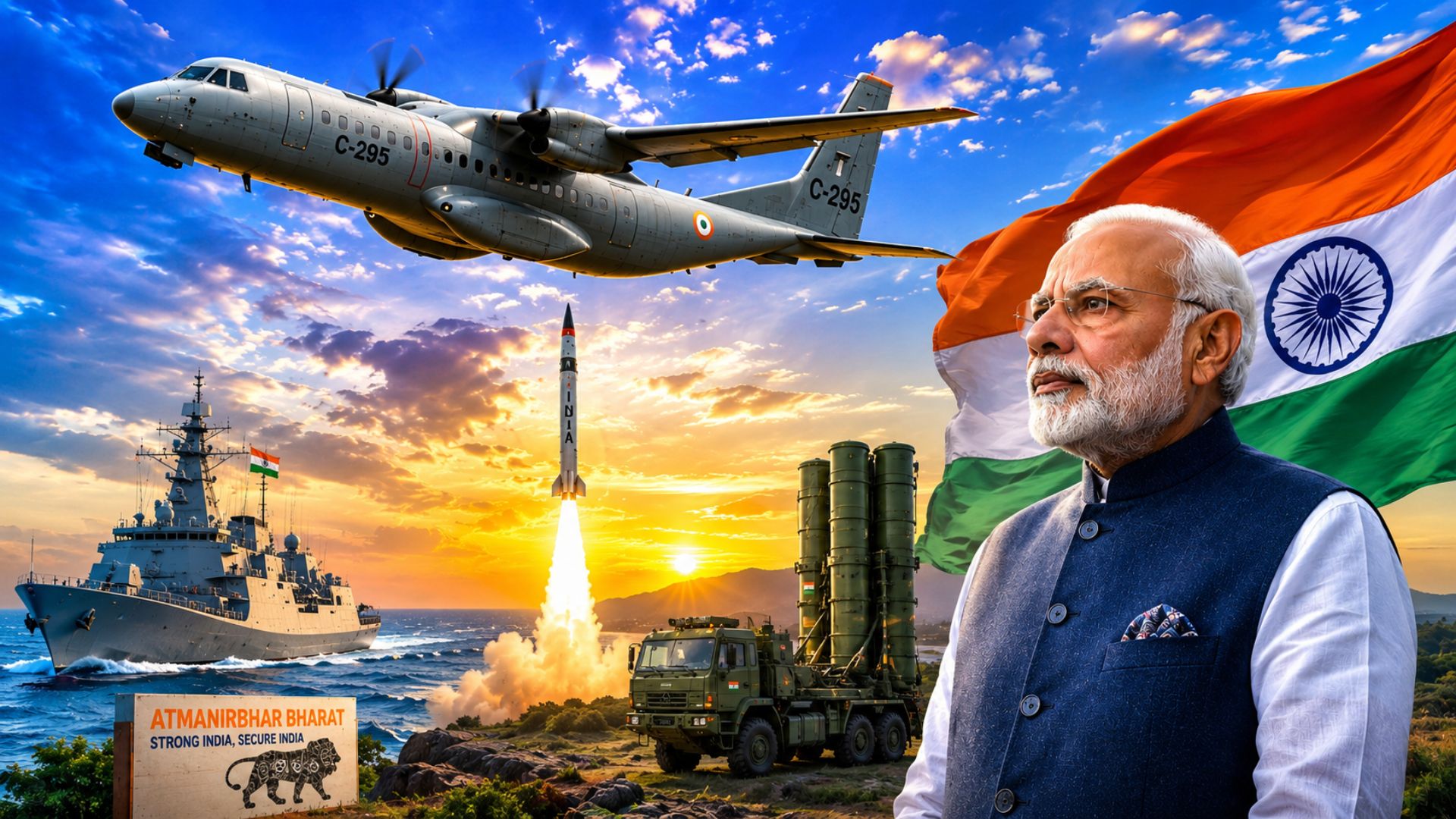
India's Journey to Defence Self-Reliance Under PM Modi

"Self-reliance is not isolation; it is the capacity to build, innovate and contribute with confidence."
During the June 2026 edition of Mann Ki Baat, Prime Minister Narendra Modi highlighted India's progress in defence indigenisation, environmental conservation, sustainable lifestyles and community participation. The developments reflect the broader vision of Atmanirbhar Bharat, where technological capability, local manufacturing and citizen responsibility together strengthen national resilience.
India's growing self-reliance in defence
June 2026 marked significant milestones in India's defence manufacturing ecosystem.
| Development | Significance |
|---|---|
| Maiden flight of India's first indigenous C-295 transport aircraft | Strengthens domestic aerospace manufacturing |
| Successful test of Long-Range Land-Attack Cruise Missile (LRLACM) | Demonstrates indigenous missile capability |
| Induction of INS Dunagiri, INS Shanshak and INS Agrya | Expands India's indigenous naval strength |
"From the seas to the skies, India is becoming increasingly secure and self-reliant."
These achievements reflect India's emphasis on reducing import dependence while strengthening strategic autonomy.
C-295 programme: Building an aerospace ecosystem
The Indian Air Force is procuring 56 C-295 transport aircraft, of which 40 are being manufactured in India.
The project is executed through:
- Tata Advanced Systems Limited (TASL)
- Airbus partnership
- Manufacturing facility at Vadodara
Major benefits include:
- Growth of domestic aerospace manufacturing.
- Employment generation.
- Strengthening MSMEs through supply-chain participation.
- Development of advanced manufacturing capabilities.
Defence Manufacturing
         ↓
Technology Transfer
         ↓
MSME Participation
         ↓
Employment Generation
         ↓
Strategic Self-Reliance
Indigenous missile capability
The successful test of the Long-Range Land-Attack Cruise Missile (LRLACM) demonstrates India's expanding indigenous defence research.
Key features:
- Developed by DRDO.
- Long-range precision strike capability.
- Major subsystems designed and developed within India.
The programme strengthens India's deterrence capability while reducing reliance on imported strategic technologies.
Indigenous naval capability
India also inducted three indigenously designed and built naval platforms:
- INS Dunagiri
- INS Shanshak
- INS Agrya
These additions reinforce India's commitment to:
- Maritime security.
- Indigenous shipbuilding.
- Blue-water naval capability.
Citizen participation during the West Asia crisis
The Prime Minister appreciated citizens for voluntarily adopting resource-conserving practices during the West Asia crisis.
Examples include:
- Carpooling.
- Increased use of public transport.
- Postponing non-essential foreign travel.
- Greater adoption of natural fertilizers.
- Recycling old gold instead of purchasing new jewellery for weddings.
Citizen Participation
        ↓
Resource Conservation
        ↓
Reduced Import Dependence
        ↓
Economic Stability
Environmental conservation through community action
Several grassroots initiatives demonstrate how local communities contribute to conservation.
| Initiative | Contribution |
|---|---|
| Purnima Devi Barman (Assam) | Conservation of the Greater Adjutant (Hargila) bird through community awareness |
| Living Root Bridges (Meghalaya) | Traditional ecological heritage for which India has sought UNESCO World Heritage recognition |
| Rajgarh, Madhya Pradesh | Women converting plastic waste into eco-bricks for public beautification |
These examples illustrate the role of community participation in sustainable development.
Promoting sports and local livelihoods
The Prime Minister also highlighted:
- Nagaland's "Baby League", encouraging football among children aged 5–12 years.
- Promotion of locally made clay Ganesh idols, urging citizens to verify both the material used and the country of manufacture before purchase.
These initiatives simultaneously promote:
- Grassroots sports development.
- Local artisans.
- Sustainable consumption.
- Cultural preservation.
Broader significance
The initiatives collectively strengthen multiple national objectives:
- Defence self-reliance.
- Industrial development.
- Employment generation.
- Environmental sustainability.
- Citizen-led behavioural change.
- Promotion of local manufacturing.
- Preservation of biodiversity and cultural heritage.
Way Forward
- Accelerate indigenous defence manufacturing through greater public-private partnerships.
- Strengthen MSME integration into defence and aerospace supply chains.
- Increase investments in indigenous defence research and advanced technologies.
- Encourage sustainable lifestyles through community-driven campaigns.
- Expand conservation initiatives combining traditional knowledge with scientific management.
- Promote "Vocal for Local" by supporting artisans, eco-friendly products and domestic manufacturing.
Conclusion
India's progress in defence manufacturing, environmental stewardship and citizen participation reflects a holistic vision of Atmanirbhar Bharat. Self-reliance extends beyond producing military platforms; it encompasses responsible consumption, community participation, innovation and sustainable development. Continued collaboration between the government, industry and citizens will be essential to transform self-reliance into long-term national resilience and inclusive growth.
Attribution
Original content sources and authors


Syllabus classification
How this article maps to GS papers
Main syllabus
GS3Science & TechnologyQuick Q&A
What is defence indigenisation in India, and why has it become a central pillar of the country's strategic and technological development?
How does indigenous defence manufacturing contribute to India's national security, technological advancement, and economic development in the long term?
Critically analyse the strategic significance of the C-295 transport aircraft programme and its implications for India's aerospace manufacturing ecosystem.
Why are indigenous missile development programmes such as the Long-Range Land-Attack Cruise Missile important for India's strategic deterrence and defence preparedness?
What practical examples demonstrate India's growing self-reliance in defence technologies, and what lessons do they offer for future strategic capability building?
Practice questions
2 questions for mains preparation