GS3 Science & Technology

Strengthening India's Missile Deterrence

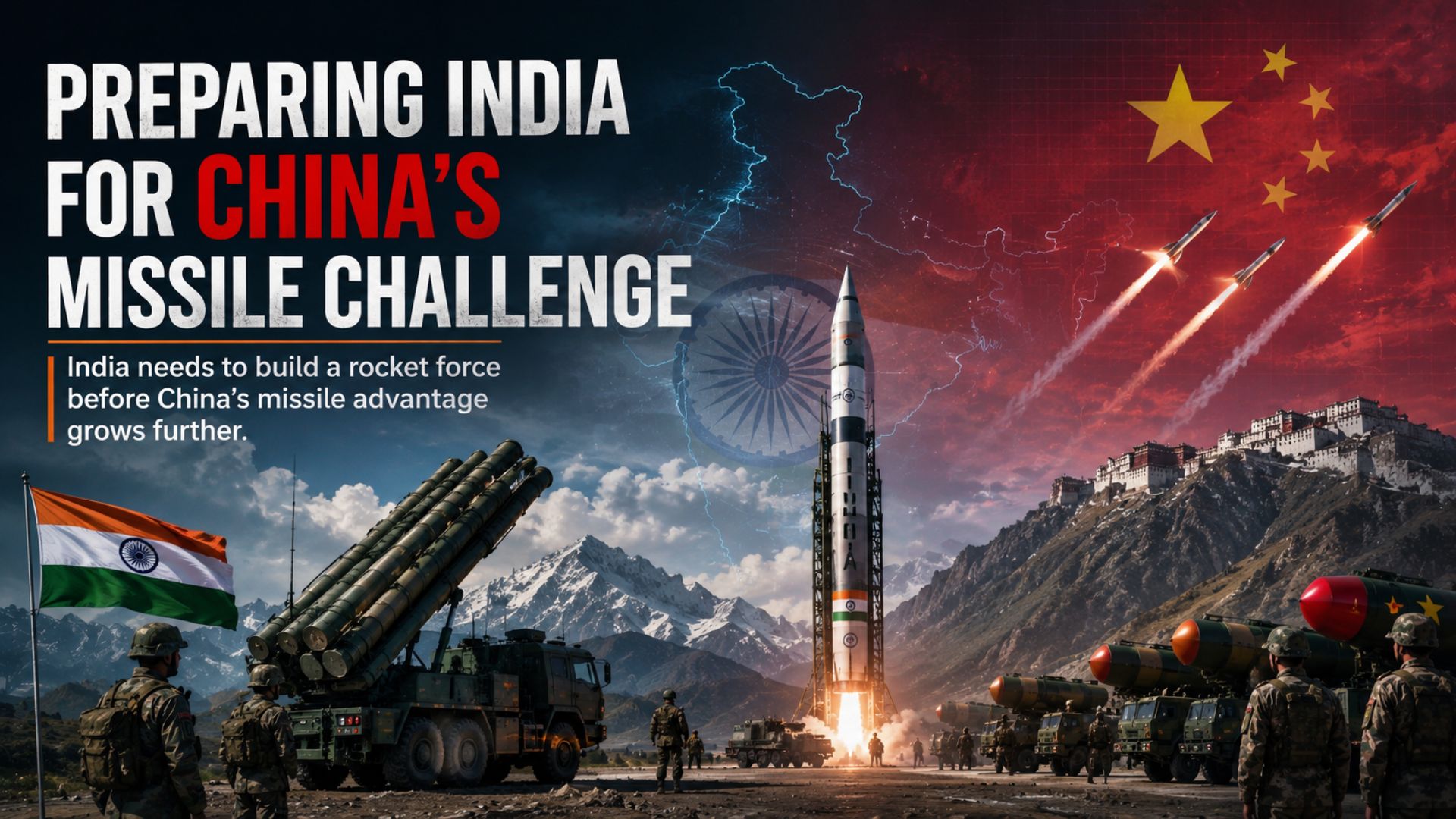
Missile Warfare and India's Conventional Deterrence: Why a Rocket Force Matters

India must strengthen its missile capabilities to counter China's growing military advantage and maintain regional security.
Gopi Gopi
4 mins read

"Deterrence is not about winning wars; it is about convincing the adversary that war will not achieve its objectives."

Modern warfare is increasingly being shaped by conventional missiles, making conflicts faster, less expensive and politically coercive. A limited missile campaign can cripple critical infrastructure, disrupt command systems and weaken an adversary without escalating to nuclear war. With China deploying over 200 conventional missile launchers opposite India, strengthening India's conventional missile deterrence has become an important national security priority.


Changing Nature of Warfare

Unlike traditional wars, missile campaigns can achieve strategic objectives without prolonged military engagements.

Emerging characteristics

  • Precision strikes on critical infrastructure.
  • Political coercion below the nuclear threshold.
  • Simultaneous battlefield and hinterland attacks.
  • Faster decision cycles and reduced warning time.
  • Greater reliance on long-range precision weapons.

China's Conventional Missile Advantage

China employs conventional missiles not only for deterrence but also as instruments of war-fighting and coercive diplomacy.

MissilePrimary Role
DF-15BBorder military targets
DF-16Tactical military targets
DF-21COperational strikes
DF-26Deep strategic targets (dual-role)
DF-100 & CJ-1000Hypersonic deep-strike capability

The Korla and Kunming missile bases provide China the ability to target both frontline forces and strategic infrastructure inside India.


Why is this a challenge for India?

Several structural factors reduce India's strategic advantage.

  • Himalayas no longer guarantee strategic depth.
  • China launches missiles from the Tibetan Plateau, while India must fire across mountainous terrain.
  • Reduced missile detection and response time.
  • Hypersonic missiles provide virtually no launch warning.
  • India's hypersonic capability remains under development.

These developments increase India's vulnerability during the opening phase of any future conflict.


India's Existing Limitations

CapabilityCurrent Challenge
Missile inventoryLimited range and diversity
Long-range systemsAgni, LR-LACM (Nirbhay), BrahMos yet to be fully integrated
Real-time targetingLimited capability
Missile stockpilesFinite inventory
Hypersonic weaponsStill under development
Rocket ForceConceptual stage

Without a dedicated rocket force, India may have to absorb an initial missile strike before responding effectively.


Why is a Rocket Force important?

A conventional rocket force creates mutual vulnerability, strengthening deterrence.

Illustration

China launches
100 conventional missiles

โ†“

India possesses
credible rocket force

โ†“

Strategic & military targets
inside Tibet/Xinjiang threatened

โ†“

Mutual costs increase

โ†“

Deterrence strengthened

The objective is not numerical parity, but the ability to inflict comparable strategic effects.


Expected Role of India's Rocket Force

An integrated Rocket Force should perform three levels of operations.

LevelObjective
StrategicHold the PLA Western Theatre Command and targets in Tibet & Xinjiang at risk
OperationalDisrupt roads, railways, logistics hubs and airbases
TacticalStrike troop camps, artillery positions and ammunition depots

A unified command would enable coordinated engagement of strategic, operational and tactical targets.


Key Reforms Required

1. Doctrinal Reforms

  • Expand conventional missile doctrine.
  • Develop unified national target lists.
  • Enable pre-designated precautionary strikes during conflict.
  • Avoid fragmented service-specific targeting.

2. Structural Reforms

  • Place the Rocket Force under the Chief of Defence Staff (CDS).
  • Expand Medium-Range and Intermediate-Range Ballistic Missile inventories.
  • Accelerate development of hypersonic missile systems.
  • Increase reciprocal deterrence against Chinese missile bases.

3. Technological Reforms

  • Expand private sector participation alongside DRDO.

  • Improve indigenous capabilities in:

    • Advanced propulsion
    • Semiconductors
    • High-grade materials
  • Reduce dependence on imported critical technologies.

  • Increase investment in defence R&D.


Interim Measures

Since developing a Rocket Force will require time, several immediate measures are suggested.

Short-term Priorities

โœ“ Harden and disperse IAF airbases

โœ“ Strengthen air-defence deployment

โœ“ Expand long-range conventional strike capability

โœ“ Enhance satellite surveillance

โœ“ Improve detection of mobile launchers

These measures increase survivability while raising the operational costs for any adversary.


Key Challenges

  • China's expanding conventional missile superiority.
  • Growing deployment of hypersonic weapons.
  • Limited indigenous missile production capacity.
  • Dependence on imported high-end defence technologies.
  • Organisational challenges in establishing a Rocket Force.
  • Need for integrated command-and-control systems.

Way Forward

  • Establish an integrated Rocket Force under the CDS.
  • Expand conventional long-range missile inventories.
  • Accelerate indigenous hypersonic weapon development.
  • Strengthen private sector participation in missile manufacturing.
  • Increase investment in defence R&D and strategic technologies.
  • Improve space-based surveillance, targeting and early warning systems.
  • Develop an integrated conventional deterrence strategy below the nuclear threshold.

Conclusion

The growing role of conventional missiles is transforming the character of modern warfare by compressing decision time and increasing the importance of precision long-range strikes. As China's missile capabilities continue to expand, India must strengthen its conventional deterrence through doctrinal reforms, indigenous technological development, integrated command structures and a credible Rocket Force. Building such capabilities would enhance strategic stability by ensuring that any future conflict carries unacceptable costs for the adversary while preserving deterrence below the nuclear threshold.

Attribution

Original content sources and authors

Harinder Singh Author Harinder Singh The Hindu Source The Hindu

Syllabus classification

How this article maps to GS papers

Main syllabus

GS3Science & Technology

Quick Q&A

What is a conventional rocket force, and why is it increasingly considered essential for India's deterrence strategy against China's expanding missile capabilities?
A conventional rocket force is a dedicated military command responsible for deploying and operating long-range conventional ballistic missiles, cruise missiles, hypersonic weapons, and long-range precision strike systems below the nuclear threshold. Unlike strategic nuclear forces whose primary objective is nuclear deterrence, a conventional rocket force focuses on precision strikes against military infrastructure, logistics hubs, command centres, airbases, transportation networks, and strategic assets during conventional conflicts. The article argues that China's People's Liberation Army (PLA) Rocket Force possesses a significant advantage, with over 200 conventional missile launchers deployed opposite India and missile systems such as the DF-15B, DF-16, DF-21C, DF-26, and hypersonic DF-100 capable of striking targets across the Himalayas. These developments reduce the traditional strategic advantage that India's mountainous terrain once provided. India's missile inventory, including Agni variants, BrahMos, Nirbhay, and the Long-Range Land Attack Cruise Missile (LR-LACM), is expanding but remains less integrated and lacks a unified rocket force structure. A dedicated rocket force would allow India to conduct strategic, operational, and tactical strikes under a single command, thereby creating reciprocal vulnerability that strengthens conventional deterrence. Such a force could target the PLA Western Theatre Command, logistics networks in Tibet and Xinjiang, and tactical military formations along the Line of Actual Control. For UPSC aspirants, this issue is relevant to GS Paper III (Internal Security, Science and Technology, Defence), GS Paper II (National Security Institutions), and International Relations. It illustrates evolving military doctrines, technological transformation in warfare, civil-military integration, and the importance of credible deterrence below the nuclear threshold.
Why has China's growing conventional missile arsenal fundamentally altered the strategic balance and security calculations along the India-China border?
China's expanding conventional missile arsenal has significantly transformed the strategic environment because it enables Beijing to pursue political coercion and military objectives without necessarily crossing the nuclear threshold. Unlike traditional border conflicts limited by terrain and logistics, modern missile warfare allows long-range precision strikes against critical infrastructure, military bases, logistics centres, communication networks, and economic assets deep inside an adversary's territory. According to the article, China has deployed missile systems including the DF-15B, DF-16, DF-21C, DF-26, and hypersonic DF-100 opposite India. The DF-26 possesses dual conventional and nuclear capability, increasing escalation risks, while hypersonic missiles reduce warning time and complicate interception. These capabilities reduce the strategic value historically provided by the Himalayas as a natural defensive barrier. India could therefore face simultaneous challenges: defending border positions while protecting critical infrastructure from deep missile strikes. China's missile superiority also creates psychological and political pressure by threatening rapid disruption before ground operations intensify. India's current limitations include finite missile inventories, evolving long-range strike capabilities, underdeveloped hypersonic technology, and the absence of a fully operational rocket force. Consequently, deterrence increasingly depends not merely on troop deployment but on the ability to impose comparable costs through conventional precision strikes. For UPSC, this topic is directly linked to GS Paper III covering defence modernization, border management, emerging technologies, and internal security. It also relates to International Relations, India's defence reforms, theatre commands, and strategic studies. Understanding these developments helps explain why military modernization today extends beyond manpower toward integrated precision-strike capabilities, surveillance systems, and technology-driven deterrence.
How should India redesign its military doctrine, organisational structure, and technological capabilities to establish a credible conventional missile deterrence architecture?
The article proposes a comprehensive transformation of India's conventional missile posture through doctrinal, organisational, and technological reforms. At the doctrinal level, India should move beyond a narrowly defensive approach and incorporate conventional counter-value and counter-force options capable of imposing significant costs on an adversary. This requires creating unified target lists covering strategic, operational, and tactical objectives rather than fragmented service-specific planning. Pre-designated precautionary strike authority would also be necessary to respond rapidly during the initial stages of conflict. Structurally, the proposed rocket force should function under the Chief of Defence Staff (CDS) to ensure jointness among the Army, Navy, and Air Force. A unified command would improve coordination, targeting, logistics, and resource allocation while avoiding duplication among individual services. India must simultaneously expand its medium-range and intermediate-range ballistic missile inventory, integrate Agni variants, BrahMos, Nirbhay, and future long-range cruise missiles, and accelerate hypersonic weapon development. Technologically, the defence industrial ecosystem requires greater private-sector participation alongside DRDO to overcome delays, cost overruns, and dependence on imported semiconductors, propulsion systems, and advanced materials. Investments in indigenous manufacturing, satellite surveillance, artificial intelligence-enabled targeting, secure communication networks, and resilient command-and-control systems are equally important. These reforms should complement theatre command integration and broader defence modernization initiatives. From a UPSC perspective, this issue links defence reforms with the Atmanirbhar Bharat initiative, Make in India, science and technology policy, defence procurement, and national security governance under GS Paper III. It also demonstrates how organisational restructuring and technological innovation are becoming central to contemporary military effectiveness.
Critically analyse the proposition that India must develop credible conventional counter-value strike capabilities below the nuclear threshold to strengthen deterrence against China.
The proposal to develop conventional counter-value strike capabilities represents a significant evolution in India's strategic thinking. Traditionally, India's military doctrine has emphasised restraint, defensive deterrence, and avoidance of unnecessary escalation. However, the growing sophistication of China's missile forces has prompted arguments that deterrence today requires the ability to threaten valuable military and strategic assets through conventional precision strikes. Supporters argue that if China believes it can launch conventional missile attacks with limited retaliation, deterrence weakens considerably. A credible rocket force capable of striking logistics hubs, airbases, transportation infrastructure, command centres, and critical economic assets would create reciprocal vulnerability, thereby discouraging missile coercion. Such capabilities could also reduce dependence on nuclear deterrence by providing flexible response options below the nuclear threshold. However, critics caution that expanding conventional counter-value doctrines may increase escalation risks, blur distinctions between conventional and nuclear signalling, and intensify regional arms competition. Dual-capable missile systems such as the DF-26 further complicate crisis management because adversaries may misinterpret conventional launches as nuclear attacks. Additionally, building a sophisticated rocket force requires substantial financial investment, technological expertise, and institutional reforms. India must therefore balance deterrence requirements with strategic stability, diplomatic engagement, confidence-building measures, and adherence to international norms. Civilian oversight, transparent command-and-control arrangements, and robust crisis communication mechanisms remain essential. For UPSC candidates, this debate is highly relevant to GS Paper III (Security Challenges), GS Paper II (Governance and National Security Institutions), Ethics regarding responsible use of military power, and International Relations involving strategic stability in Asia. A balanced answer should recognise both the necessity of credible deterrence and the importance of preventing unintended escalation.
What immediate and long-term policy measures should India adopt to address missile vulnerabilities while developing an integrated conventional rocket force for future conflicts?
The article presents a practical case study of how India can strengthen its missile deterrence through a combination of immediate operational measures and long-term structural reforms. Since establishing a dedicated rocket force will require considerable time, the first priority should be reducing vulnerability to potential missile strikes. This includes dispersing Indian Air Force assets across multiple locations, hardening airbases with reinforced infrastructure, and improving survivability through camouflage and redundancy. Optimising layered air-defence systems can compel adversaries to expend missiles against defensive assets rather than high-value civilian or military targets. Strengthening long-range conventional strike capabilities using systems such as BrahMos, Agni variants, Nirbhay, and future cruise missiles would create reciprocal vulnerability against military targets in Tibet and Xinjiang. Expanding satellite surveillance, space-based intelligence, and persistent monitoring of mobile missile launchers such as the DF-26 would improve early warning and targeting. Over the longer term, India should institutionalise a joint rocket force under the Chief of Defence Staff, integrate strategic targeting across services, increase indigenous missile production, and accelerate research into hypersonic technologies, advanced propulsion, semiconductors, and high-grade materials. Greater collaboration between DRDO, private industry, startups, academia, and international technology partners can strengthen self-reliance while reducing dependence on imported components. These measures should complement ongoing reforms such as theatre commands, defence industrial corridors, and the Atmanirbhar Bharat initiative. For UPSC, this case illustrates the integration of military strategy, technological innovation, industrial policy, space capabilities, and governance reforms. It also demonstrates how effective national security requires simultaneous investments in infrastructure resilience, indigenous manufacturing, scientific research, and institutional coordination.

Practice questions

3 questions for mains preparation

Discuss the evolution of missile technology in modern warfare. What are the challenges India faces in developing its missile arsenal against its adversaries?

10 marks ยท 150 words ยท 8 mins

Conventional deterrence has become an increasingly important component of national security in the era of precision-guided and hypersonic weapons. Analyse the significance of credible conventional deterrence in safeguarding India's national security.

10 marks ยท 150 words ยท 8 mins

Critically evaluate the strategic depth offered by the Himalayas in India's defense policy. How does China's missile deployment change the dynamics of this geographical advantage?

10 marks ยท 150 words ยท 8 mins
