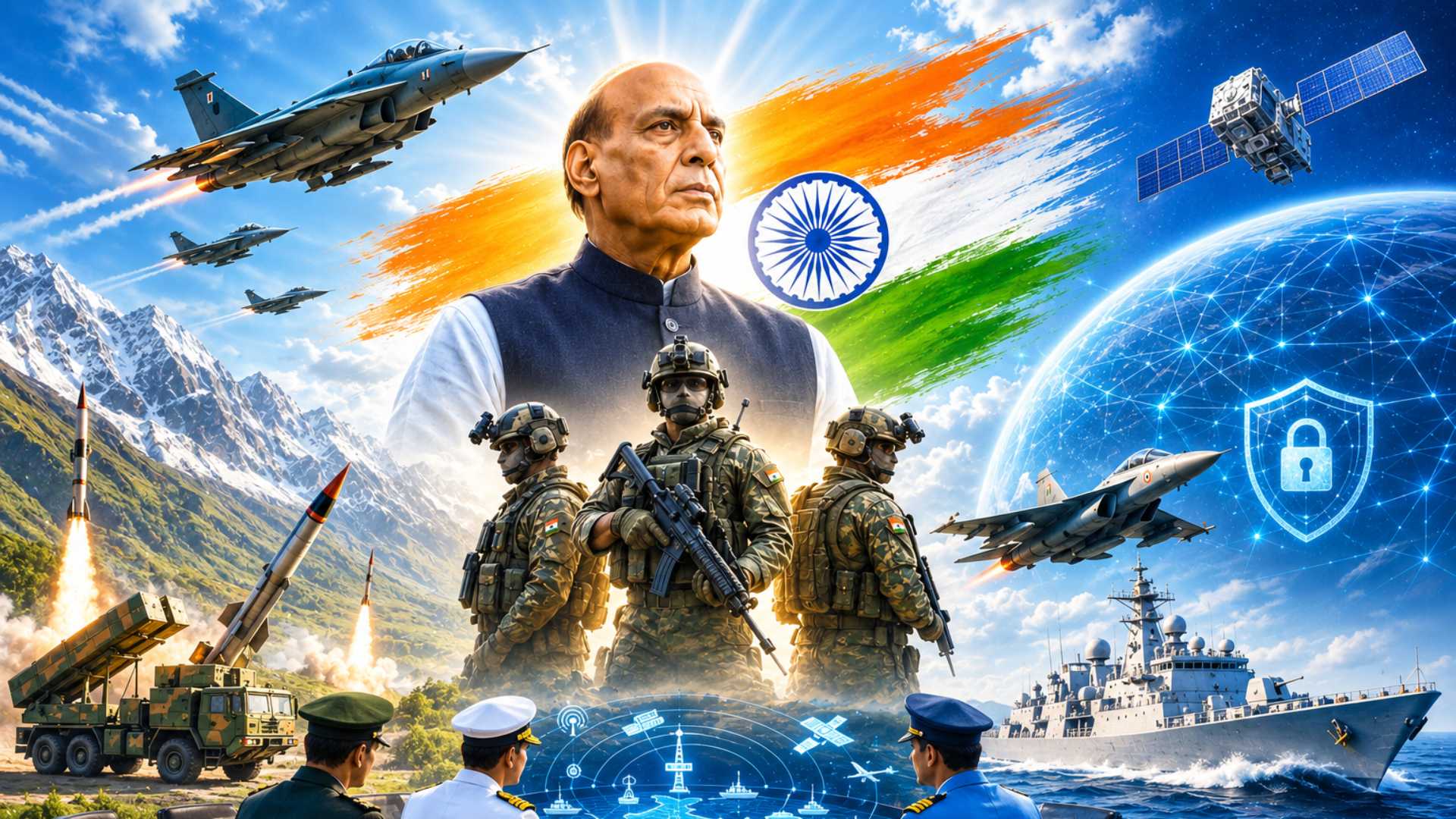
Operation Sindoor: A New Era in India's Military Response

On May 8, 2026, Defence Minister Rajnath Singh used the second edition of the Joint Commanders' Conference in Jaipur to send a clear signal — India's military doctrine is evolving, and Operation Sindoor is its defining proof of concept.
Operation Sindoor: What It Demonstrated
Rajnath Singh described the operation in precise doctrinal language:
"Short-duration, deep-penetration, high-intensity, and high-impact operation"
This four-part characterisation is significant — each word reflects a distinct military capability:
Short-duration     → speed of decision-making and execution
Deep-penetration   → reach beyond conventional strike range
High-intensity     → scale and firepower deployed
High-impact        → strategic and psychological outcome achieved
The Defence Minister went further, asserting that the operation had demonstrated India's ability to compel its adversary to surrender — the clearest articulation yet of India's willingness to use calibrated force as a coercive instrument, not merely a defensive one.
He termed it a "symbol of India's new military ethos" — a phrase that signals a doctrinal shift from reactive posture to swift, joint, and decisive response.
The Conference: Theme and Focus
The conference was held under the theme 'Military Capability in New Domains' — a deliberate framing that acknowledges warfare has moved well beyond land, sea, and air.
Key domains discussed:
- Cyber resilience — protecting critical military and civilian infrastructure
- Artificial Intelligence — for surveillance, targeting, and decision support
- Autonomous systems — unmanned platforms across domains
- Data analytics — real-time battlefield intelligence
- Secure communication networks — ensuring operational continuity under electronic attack
- Space and electromagnetic domains — contested frontiers in modern conflict
- Cognitive domain — information warfare and narrative control
The Doctrine of Future Wars
Rajnath Singh's address was effectively a doctrine statement. Three core arguments stood out:
1. Hybrid Threats are the New Normal Future conflicts will not be clean, declared wars. They will involve simultaneous pressure across cyber, space, electromagnetic, and cognitive domains — often below the threshold of conventional conflict.
2. Synergy Over Firepower
"Future wars will not be won solely through weaponry, but through innovative thinking and enhanced synergy."
This directly makes the case for theatre commands and jointness — the Army, Navy, and Air Force operating as one integrated force rather than three parallel institutions.
3. The Element of Surprise Singh urged commanders to cultivate unpredictability — remaining impossible to anticipate for adversaries while being fully prepared against enemy actions. This is the classic asymmetric warfare principle applied to a conventional military context.
Key Outputs from the Conference
Three significant documents/products were released:
- Documentary film on Operation Sindoor — institutionalising the operation's lessons
- Hindi version of Vision 2047 — signalling long-term defence planning with linguistic accessibility
- Joint Doctrine for Integrated Communication Architecture — a framework for enhancing interoperability and integrated communications across all three services
The last document is particularly significant — communication architecture failures have historically been India's Achilles heel in joint operations. A formal doctrine here signals serious intent.
Way Forward & Conclusion
The Joint Commanders' Conference and Operation Sindoor together mark a inflection point in India's defence posture. Several priorities now follow logically:
- Complete the Theatre Command restructuring — Singh's emphasis on jointness is hollow without institutional integration of the three services under unified commands
- Accelerate indigenous capability — AI, autonomous systems, and secure communications must be built domestically to avoid strategic dependence
- Formalise the cognitive and cyber doctrines — identifying domains is not enough; India needs published, operationalised doctrines for each
- Institutionalise lessons from Sindoor — the documentary is a start, but operational debriefs must feed into training, procurement, and doctrine revision systematically
Operation Sindoor is being positioned not just as a military success but as a template — for speed, jointness, precision, and compellence. Whether India's defence establishment can systematically replicate that template across future contingencies depends on how seriously the reforms discussed at Jaipur are actually implemented. Doctrine stated is not doctrine delivered.
Attribution
Original content sources and authors


Syllabus classification
How this article maps to GS papers
Main syllabus
GS3Science & TechnologyQuick Q&A
What is meant by multidomain warfare, and how does Operation Sindoor reflect this evolving military doctrine?
Operation Sindoor, as described by Defence Minister Rajnath Singh, represents a practical example of this evolving doctrine. The operation was termed a “short-duration, deep-penetration, high-intensity, and high-impact operation”, indicating the use of precision-based and integrated military strategies. Such operations require real-time intelligence sharing, seamless communication among the Army, Navy, and Air Force, cyber resilience, and rapid decision-making systems supported by technology.
Key characteristics of multidomain warfare include:
- Simultaneous operations across physical and digital battlefields
- Integration of cyber and space assets for intelligence and communication
- Information warfare to shape narratives and perceptions
- Use of AI and autonomous systems for surveillance and precision strikes
Globally, conflicts such as the Russia-Ukraine war have demonstrated how cyber attacks, drones, satellite intelligence, and information campaigns can significantly influence military outcomes. India’s emphasis on multidomain capability reflects recognition that future wars will not be confined to conventional battlefields alone.
Strategically, Operation Sindoor signals India’s transition toward a modernized military doctrine focused on interoperability, technological integration, and rapid-force projection. It also highlights India’s intent to build credible deterrence against adversaries through precision operations and enhanced jointness among the armed forces.
Why is jointness and integration among the Army, Navy, and Air Force considered crucial for future warfare?
Defence Minister Rajnath Singh emphasized that future wars will not be won solely through superior weaponry but through “innovative thinking and enhanced synergy”. This reflects the understanding that integrated operations improve response speed, reduce duplication of resources, and allow better coordination during crises. For example, an air strike may require naval surveillance support, cyber intelligence, and ground-force coordination simultaneously.
Importance of jointness includes:
- Enhanced interoperability: Seamless coordination between services improves mission effectiveness
- Efficient resource utilization: Shared infrastructure and intelligence reduce operational costs
- Faster decision-making: Integrated command structures ensure rapid responses
- Improved deterrence: Unified military capability strengthens strategic credibility
India has been gradually moving toward greater integration through initiatives such as the appointment of the Chief of Defence Staff (CDS), creation of the Department of Military Affairs, and discussions regarding integrated theatre commands. Operation Sindoor and the Joint Commanders’ Conference further reinforce this direction.
Globally, countries like the United States and China have adopted integrated command systems to manage complex military operations effectively. For India, jointness is particularly important due to its diverse security challenges ranging from conventional threats to cyber warfare and maritime competition in the Indo-Pacific.
Ultimately, integration strengthens India’s preparedness for hybrid and multidomain warfare while enabling quicker adaptation to evolving geopolitical and technological realities.
How are artificial intelligence and emerging technologies transforming the nature of modern warfare?
During the Joint Commanders’ Conference, significant attention was given to artificial intelligence, cyber resilience, autonomous systems, and secure communication architecture. AI enables militaries to process vast amounts of data rapidly, identify threats in real time, and support predictive analysis for battlefield decisions. Autonomous drones, robotic systems, and machine-learning algorithms are already reshaping combat scenarios globally.
Major technological transformations include:
- AI-enabled intelligence analysis for faster threat assessment
- Autonomous drones and unmanned systems for surveillance and targeted operations
- Cyber warfare capabilities to disrupt enemy infrastructure
- Secure communication networks for integrated command and control
The Russia-Ukraine conflict demonstrated the importance of drones, satellite imagery, electronic warfare, and cyber operations in modern battlefields. Similarly, countries such as the United States and China are heavily investing in AI-based military modernization programs to gain technological superiority.
For India, the integration of emerging technologies is crucial due to the complex nature of its security environment, including border tensions, maritime competition, and hybrid warfare threats. However, technological transformation also raises ethical and strategic concerns such as algorithmic bias, autonomous weapon accountability, cyber vulnerabilities, and the risk of escalation.
Therefore, India must adopt a balanced approach that combines technological innovation with strong regulatory frameworks, indigenous research and development, and capacity building. Investment in AI and digital warfare capabilities will be essential for maintaining operational superiority in future conflicts.
Critically analyze the significance of ‘future-ready’ armed forces in the context of India’s national security challenges.
India faces a complex security environment involving conventional military threats, cross-border terrorism, cyber attacks, maritime competition, and information warfare. Future conflicts are likely to involve hybrid warfare tactics that combine military operations with cyber disruptions, propaganda campaigns, and economic coercion. Therefore, preparedness requires not only advanced weapon systems but also institutional flexibility and technological integration.
Advantages of future-ready armed forces include:
- Improved deterrence capability against adversaries
- Rapid adaptation to technological and strategic shifts
- Enhanced cyber and space security
- Greater interoperability among military branches
However, there are significant challenges in achieving this transformation. Defence modernization requires substantial financial investment, indigenous technological capacity, and organizational reforms. India continues to depend heavily on imported defence equipment in several sectors, which can create strategic vulnerabilities. Additionally, integrating AI and autonomous systems raises ethical, operational, and cybersecurity concerns.
The emphasis on future warfare also highlights the importance of human capital. Skilled personnel trained in cyber operations, data analytics, and electronic warfare will become as important as traditional combat soldiers. Therefore, military education and strategic culture must evolve alongside technological upgrades.
In conclusion, future readiness is no longer optional but essential for safeguarding India’s national interests. A balanced approach involving modernization, self-reliance under initiatives like Atmanirbhar Bharat, and strategic partnerships will be critical for building resilient and adaptable armed forces.
Why are cyber resilience and information dominance becoming central to contemporary military strategy?
Defence Minister Rajnath Singh highlighted that future conflicts would involve operations across cyber, electromagnetic, and cognitive domains. This reflects the understanding that controlling information and protecting digital infrastructure can significantly influence military outcomes. Cyber attacks can disrupt banking systems, power grids, communication networks, and military command structures without direct physical confrontation.
Importance of cyber resilience includes:
- Protection of critical infrastructure from cyber attacks
- Secure military communication networks during conflict
- Prevention of misinformation campaigns
- Operational continuity in digitally dependent warfare environments
The Russia-Ukraine conflict offers a major example of cyber and information warfare. Both sides engaged in cyber operations, digital propaganda, and narrative-building campaigns alongside conventional military operations. Similarly, concerns regarding cyber espionage and digital surveillance have intensified globally due to growing geopolitical competition.
For India, cyber resilience is especially important because of increasing digitization, strategic rivalry in Asia, and threats from state and non-state actors. Initiatives such as strengthening CERT-In, improving defence cyber agencies, and developing indigenous communication technologies are steps toward securing digital sovereignty.
Information dominance also shapes public perception and international opinion during conflicts. Therefore, military success in the 21st century depends not only on battlefield victories but also on controlling narratives, ensuring cyber security, and maintaining trust in national institutions.
Using Operation Sindoor as a case study, discuss how India is adapting its defence doctrine to emerging geopolitical and technological realities.
The operation reflects a broader doctrinal shift from reactive defence toward proactive deterrence and integrated military capability. India’s strategic environment has become increasingly complex due to border tensions, maritime competition in the Indo-Pacific, cyber threats, and the growing role of emerging technologies in warfare. Consequently, India is emphasizing rapid-force mobilization, technological modernization, and multidomain operational readiness.
Key doctrinal shifts reflected in Operation Sindoor include:
- Joint operations: Greater coordination among Army, Navy, and Air Force
- Technology-driven warfare: Focus on AI, secure communication, and cyber resilience
- Precision-based operations: Reduced reliance on prolonged conventional conflict
- Strategic deterrence: Demonstrating capability and resolve to adversaries
The release of the Joint Doctrine for Integrated Communication Architecture during the conference further indicates efforts to improve interoperability and communication across military branches. Such reforms align with broader initiatives including theatre command discussions, defence indigenization, and the modernization goals outlined in Vision 2047.
However, adapting to future warfare also requires addressing challenges such as technological dependence, budgetary constraints, and the need for indigenous innovation. India must strengthen domestic defence manufacturing, invest in research and development, and enhance strategic partnerships with technologically advanced nations.
Overall, Operation Sindoor symbolizes India’s transition toward a more agile, technology-oriented, and integrated defence posture aimed at ensuring preparedness in an increasingly uncertain global security environment.
Practice questions
2 questions for mains preparation