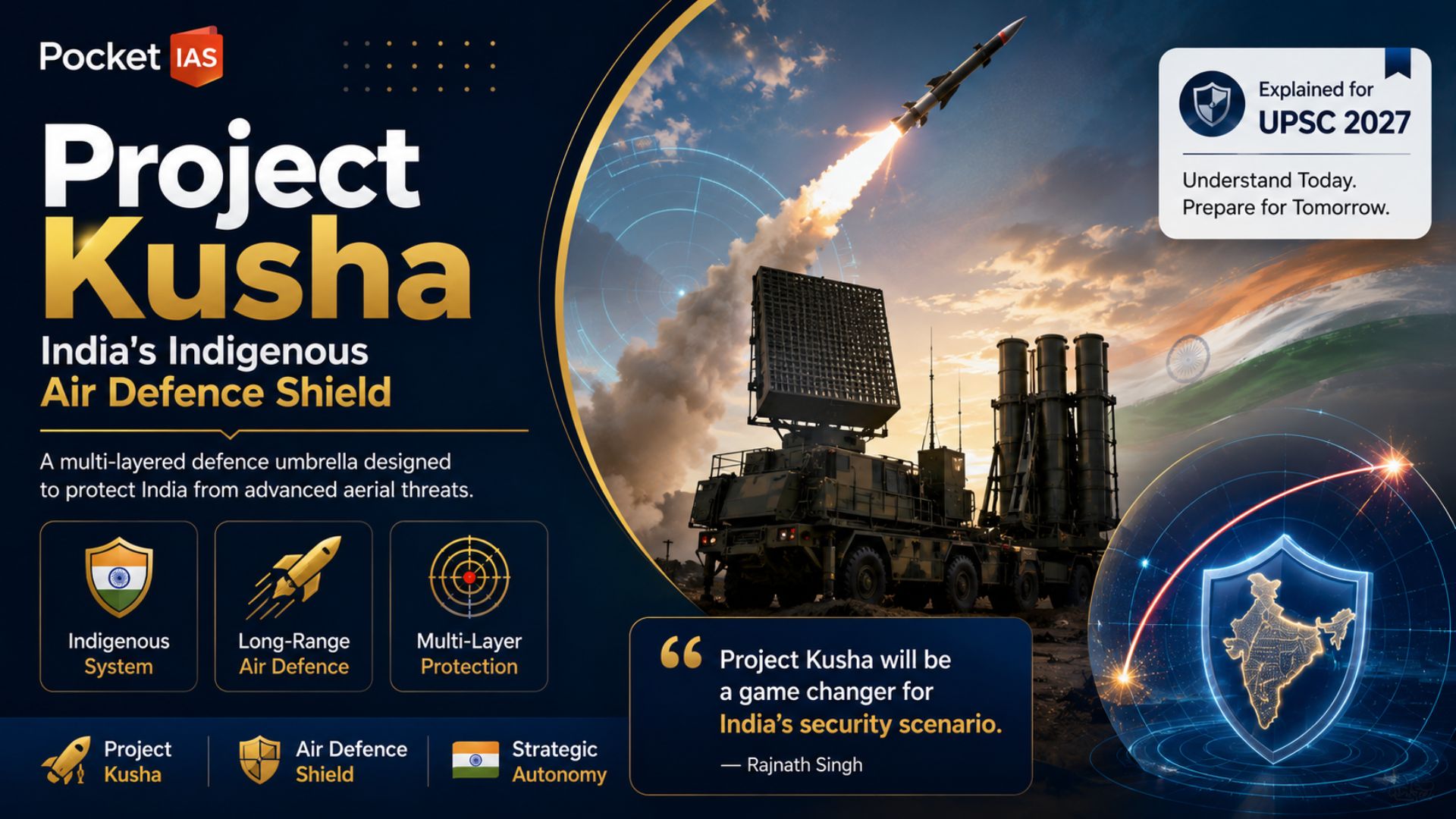
Project Kusha: A Game Changer for India's Air Defence

India's defence preparedness is increasingly centred on indigenous technologies capable of addressing emerging aerial threats. In this context, Project Kusha, a long-range indigenous air defence missile system under development by DRDO, is being projected as a major pillar of India's future security architecture.
"Project Kusha will be a game changer for India's security scenario." — Defence Minister Rajnath Singh
Why Air Defence Matters
Modern warfare is no longer confined to conventional military engagements.
Emerging Threats
- Ballistic missiles
- Cruise missiles
- Armed drones
- Hypersonic weapons
- Precision-guided munitions
- Electronic warfare systems
Emerging Aerial Threats
          ↓
Need for Detection
          ↓
Interception
          ↓
Layered Air Defence
          ↓
National Security
The growing sophistication of threats requires integrated and multi-layered defensive systems.
What is Project Kusha?
Project Kusha is an indigenous long-range air defence missile system being developed by DRDO.
Key Objective
To provide a comprehensive shield against multiple aerial threats through long-range interception capabilities.
| Feature | Purpose |
|---|---|
| Long-range interception | Neutralise threats before impact |
| Indigenous development | Strategic autonomy |
| Multi-threat capability | Protection from diverse aerial systems |
| Integrated architecture | Layered national defence |
The system is expected to strengthen India's ability to protect military installations, critical infrastructure and population centres.
Lessons from Operation Sindoor
According to the Defence Minister, indigenous air defence systems demonstrated their effectiveness during Operation Sindoor.
Role of Indigenous Systems
- Countered enemy intentions
- Enhanced defensive resilience
- Demonstrated operational readiness
- Validated indigenous technological capabilities
"Our air defence system provided a protective umbrella." — Rajnath Singh
The experience reinforced the importance of self-reliant defence technologies.
Building on Existing Indigenous Successes
Project Kusha is part of a broader ecosystem of indigenous missile systems.
Notable Examples
| System | Role |
|---|---|
| Akash | Surface-to-air air defence |
| BrahMos | Supersonic cruise missile |
| Project Kusha | Long-range air defence |
These programmes demonstrate India's increasing capability in advanced defence technologies.
Mission Sudarshan Chakra: Towards a Multi-Layered Shield
The government's broader vision includes Mission Sudarshan Chakra, announced in 2025.
Proposed Objectives
- Multi-layered missile defence network
- Protection of military assets
- Safeguarding critical infrastructure
- Security for civilian establishments
Outer Layer
      ↓
Long-Range Interceptors
      ↓
Medium-Range Defence
      ↓
Short-Range Defence
      ↓
Critical Asset Protection
The concept mirrors global trends where multiple interception layers create higher defence effectiveness.
Changing Nature of Warfare
The Defence Minister highlighted that modern battlefields are being transformed by technology.
Key Technologies Reshaping Warfare
- Precision-strike systems
- Integrated air defence networks
- Hypersonic weapons
- Artificial Intelligence (AI)
- Autonomous platforms
- Electronic warfare systems
| Traditional Warfare | Modern Warfare |
|---|---|
| Platform-centric | Network-centric |
| Human-dominated | AI-assisted |
| Conventional weapons | Precision systems |
| Limited domains | Multi-domain operations |
In such an environment, resilience and deterrence become equally important.
Importance of Defence Self-Reliance
Project Kusha aligns with India's broader objective of Aatmanirbhar Bharat in Defence.
Strategic Benefits
- Reduced import dependence
- Technological sovereignty
- Indigenous manufacturing ecosystem
- Greater operational flexibility
- Enhanced export potential
Indigenous defence capability strengthens both national security and strategic autonomy.
Challenges Ahead
For indigenous systems to achieve their full potential, several bottlenecks must be addressed.
Key Areas Requiring Attention
- Faster induction into armed forces
- Reduced development-to-production timelines
- Increased indigenous content
- Expansion of industrial participation
- Enhanced mass-production capabilities
Research
   ↓
Development
   ↓
Testing
   ↓
Production
   ↓
Military Induction
Delays at any stage can affect operational preparedness.
Way Forward
- Accelerate Project Kusha development and deployment.
- Strengthen collaboration among DRDO, armed forces and industry.
- Expand domestic defence manufacturing capacity.
- Invest in AI-enabled and network-centric defence systems.
- Improve indigenous component sourcing.
- Develop integrated multi-layered missile defence architecture.
- Enhance research in hypersonic and next-generation interception technologies.
Conclusion
Project Kusha represents India's transition from a defence importer to a technology-driven defence power. Combined with Mission Sudarshan Chakra and existing indigenous missile systems, it can significantly strengthen India's air defence architecture. Its success, however, will depend not only on technological development but also on rapid production, seamless integration and sustained investment in indigenous innovation.
Attribution
Original content sources and authors


Syllabus classification
How this article maps to GS papers
Main syllabus
GS3Science & TechnologyQuick Q&A
What is Project Kusha and how does it strengthen India’s evolving air defence architecture in the context of modern warfare?
Why is indigenous air defence capability becoming increasingly important for India’s strategic autonomy and national security objectives?
How do integrated and multi-layered missile defence systems function, and what role can Mission Sudarshan Chakra play in India’s security framework?
What are the major technological and strategic factors driving the transformation of warfare in the twenty-first century?
Critically analyse the significance of defence indigenisation in India, highlighting both its achievements and continuing challenges.
How can Operation Sindoor and India’s recent missile development initiatives be examined as case studies of evolving national security preparedness?
Practice questions
1 question for mains preparation