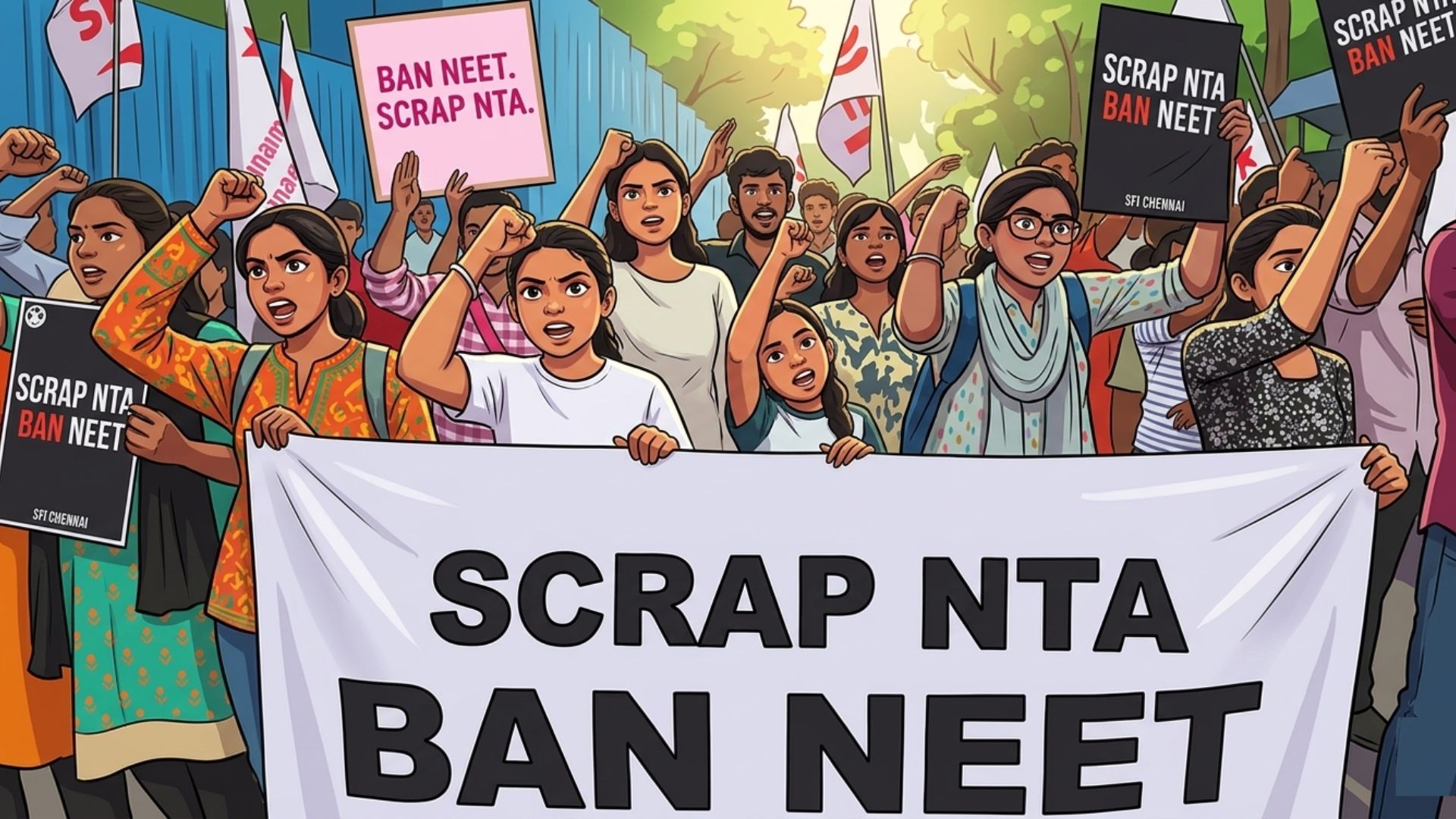
Decentralising NEET: A Solution for Fair Medical Admissions?

Context: A System Under Stress
The National Eligibility cum Entrance Test (NEET-UG) was introduced in 2013 with a reformist mandate — to replace a chaotic landscape of multiple state and institutional medical entrance exams with a single, uniform, transparent process. For a generation of medical aspirants, it promised simplicity and fairness.
Twelve years later, the cancellation and retest of NEET-UG 2026 — following fresh allegations of paper leaks and NTA lapses — has forced a hard question: has the cure become worse than the disease?
The Structural Problem: Scale Meets Desperation
NEET's vulnerability to corruption is not incidental. It is architectural.
NEET 2026: The Numbers Behind the Crisis
─────────────────────────────────────────────────
Students writing NEET          ~22 lakh
Total medical seats available  ~1.37 lakh
Ratio                          16 aspirants per seat
Students who are repeaters     Over 50%
Current qualifying cutoff      ~120–140/720 (50th percentile)
─────────────────────────────────────────────────
With over 16 aspirants competing for every seat, desperation is structurally baked in. Repeaters — some attempting the exam for years — become willing to pay up to ₹30 lakh for a guess paper. As Balaji Sampath puts it: "This corruption is driven by money power and desperation." The exam's high-stakes, single-day, single-shift format ensures that one bad day — or one leaked paper — can erase years of preparation.
The Equity Trap: Who Does NEET Actually Serve?
NEET was designed to level the playing field. In practice, it has tilted it:
- Rural, poor, and government school students remain disadvantaged due to unequal access to coaching
- Private coaching dependency has become a parallel economy, with fees often beyond the reach of aspirants NEET was meant to help
- Management quota manipulation: the 50th percentile qualifying cutoff (~130 marks) allows wealthy students scoring as low as 130 to purchase management seats, while meritorious students scoring 400 cannot afford them
- Mop-up and stray counselling by private colleges and deemed universities opens the door to direct malpractice, bypassing merit entirely
Dr. G.R. Ravindranath identifies the root of private sector inequity: under the National Medical Commission Act, fee regulation applies to only 50% of seats — the remaining half are priced freely, making medical education structurally inaccessible to deserving students.
The Radhakrishnan Committee: Recommendations Ignored
After the 2024 NEET paper leak, the government constituted the K. Radhakrishnan Committee, which identified clear security failures and proposed concrete reforms. Its key recommendations:
- Two-stage exam: Prelims to filter 5 lakh from 22 lakh candidates, followed by a tightly monitored Main exam — dramatically reducing the incentive and opportunity for paper leaks
- Limit number of attempts — to reduce the repeater population driving corruption; with additional attempts for SC/ST and BPL students to protect equity
- Computer-based testing — to eliminate physical paper logistics as a vulnerability
- Register and regulate coaching centres — cap fees, mandate transparency
The NTA implemented none of the third and most critical category of recommendations — those addressing the high-stakes nature of NEET itself.
The Decentralisation Debate
The crisis has reignited the demand for states to conduct their own medical entrance exams. The case for measured decentralisation is credible:
- Tamil Nadu's 7.5% reservation for government school students in NEET-based admissions offers a proven equity model
- States should be allowed to use Plus Two marks, state-level tests, or a combination for state quota seats
- However, NEET must continue for All-India Quota seats, AIIMS, JIPMER, deemed universities, and management quota seats — where students from across the country, including NRIs and foreign nationals, compete
The consensus position: not abolition, but restructuring — NEET retained for national seats, state autonomy restored for state seats.
Way Forward
- Implement the two-stage NEET system without further delay — prelims as a genuine filter, mains as the high-security final round
- Raise the qualifying cutoff significantly — 50th percentile at 130/720 is indefensible when seats are scarce
- Extend fee regulation to 100% of private medical college seats under the NMC Act
- Ban direct admissions by private institutions — all government and state-controlled seats must be filled through government authorities alone
- Amend the NMC Act to grant willing states autonomy over state quota admissions
- Regulate coaching centres — mandatory registration, fee caps, and anti-exploitation safeguards
- Strengthen NTA's institutional capacity — reduce contractual staffing, upgrade CCTV infrastructure, and overhaul paper transport security
Conclusion
NEET was conceived as a democratic reform — one exam, equal opportunity, no capitation. What it has become is a single point of failure in a system under enormous pressure. When 22 lakh students funnel through one exam for 1.37 lakh seats, corruption does not need ingenuity — it only needs opportunity. The Radhakrishnan Committee handed the government a roadmap. Ignoring it was a choice. The distress of lakhs of families in 2026 is the consequence of that choice. Reform is not optional anymore; it is overdue.
Attribution
Original content sources and authors


Syllabus classification
How this article maps to GS papers
Main syllabus
GS2EducationQuick Q&A
What are the major structural issues in the NEET examination system that have led to repeated controversies and public distrust?
One of the key structural problems is the high-stakes nature of the examination. Around 22 lakh students compete for approximately 1.37 lakh medical seats, making the exam intensely competitive. Since NEET is conducted only once a year in a single shift, students perceive it as a “one-shot opportunity,” creating immense psychological pressure. This has encouraged the growth of a large coaching industry and increased the desperation among repeat candidates, thereby creating fertile ground for paper leaks and malpractice.
Another issue is inequality in access to preparation resources. Students from urban, affluent, and English-medium backgrounds often enjoy advantages such as expensive coaching, digital access, and academic guidance. In contrast, rural and government school students face socio-economic disadvantages. Although policies such as Tamil Nadu’s 7.5% reservation for government school students aim to improve equity, systemic disparities continue to persist.
The article also highlights governance failures within the NTA, including inadequate CCTV surveillance, overreliance on contractual staff, and weak examination logistics. The K. Radhakrishnan Committee identified several vulnerabilities after the 2024 paper leak controversy, but many recommendations remain unimplemented.
Additionally, the role of private medical colleges has raised concerns about commercialization. Students with lower marks but greater financial resources can secure management quota seats, while meritorious middle-class students often remain excluded due to unaffordable fees. Weak enforcement of anti-capitation laws further undermines meritocracy.
Overall, the NEET controversy reflects broader challenges in India’s education governance system:
- Excessive centralisation of examinations
- Unequal educational opportunities
- Commercialisation of professional education
- Weak institutional accountability
- Mental health pressures on students
Therefore, reforms must focus not only on exam security but also on equity, transparency, and institutional trust.
Critically analyse the debate on decentralising NEET and granting States greater autonomy in medical admissions.
Arguments in favour of decentralisation include:
- States can design admission systems suited to local educational realities and linguistic contexts.
- Rural and government school students may benefit from admissions linked to State boards or regional entrance tests.
- It reduces dependence on expensive coaching institutions concentrated in urban centres.
- States can better align admissions with local healthcare needs and reservation policies.
Tamil Nadu’s advocacy for alternative admission mechanisms is often cited as an example. Critics argue that NEET disproportionately favours CBSE students and coaching-driven preparation models, thereby disadvantaging students from State boards.
However, decentralisation also carries important challenges. Before NEET, students often had to appear for multiple entrance examinations conducted by different States and private colleges, leading to financial and logistical burdens. There were also widespread allegations of capitation fees and opaque admissions processes in private medical institutions.
Supporters of NEET argue that a common examination:
- Creates a uniform national standard for medical admissions.
- Reduces multiple examinations and student stress.
- Improves transparency and central oversight.
- Facilitates mobility of students across States.
The article suggests a middle path rather than complete abolition of NEET. Some experts propose that States willing to opt out should be allowed to use a combination of Plus Two marks and State-level entrance exams, while NEET may continue for all-India quota seats, AIIMS, JIPMER, deemed universities, and NRI admissions.
Critical evaluation: Complete centralisation risks ignoring local inequities, while complete decentralisation may revive corruption and fragmented standards. Therefore, India may require a hybrid framework that combines national benchmarks with State-level flexibility. Cooperative federalism, stronger regulation of private colleges, and targeted support for disadvantaged students can create a more balanced and equitable admission system.
Why has NEET become highly vulnerable to paper leaks and corruption despite being a national-level examination?
With nearly 22 lakh aspirants competing for around 1.37 lakh seats, the examination creates enormous pressure on students and families. Many students spend years preparing through coaching institutes, and a large proportion of candidates are repeaters. This desperation increases the willingness of some individuals to pay huge sums for leaked question papers or unfair advantages.
The article highlights several structural factors contributing to corruption:
- Large-scale dependence on coaching centres and commercial preparation ecosystems.
- Weak security infrastructure such as poor CCTV monitoring and insecure paper transportation.
- Overreliance on contractual staff in the NTA.
- Lack of effective regulation of private medical colleges and management quota admissions.
The commercialization of medical education further aggravates the problem. Students with financial resources can purchase management seats even with low qualifying marks, while economically weaker but academically deserving students struggle to secure admissions. This creates perceptions of injustice and fuels unethical practices.
Another issue is the single-stage nature of the examination. Since one exam determines admission outcomes for lakhs of students, any leak or malpractice has nationwide consequences. The K. Radhakrishnan Committee therefore recommended a two-stage examination process, where a preliminary test filters candidates before a more secure main examination.
Case-study perspective: Similar vulnerabilities have been observed in other high-stakes exams in India, including recruitment examinations conducted by State Public Service Commissions. These incidents indicate broader governance challenges involving digital security, institutional capacity, and accountability.
Way forward: Reforms should include computer-based testing, stricter cybersecurity protocols, better monitoring systems, regulation of coaching centres, and stronger enforcement of anti-corruption laws. Reducing the extreme pressure associated with medical admissions through increased seat availability and multiple examination opportunities may also reduce incentives for malpractice.
How can the recommendations of the K. Radhakrishnan Committee help improve the integrity and fairness of NEET?
One of the Committee’s most important recommendations was the introduction of a two-stage examination system. Under this model, a preliminary examination would first shortlist around five lakh candidates from the total applicant pool. These shortlisted candidates would then appear for a highly monitored main examination. This approach could significantly reduce logistical complexity and lower the possibility of paper leaks affecting lakhs of students simultaneously.
The Committee also recommended limiting the number of attempts for candidates. According to the article, repeaters constitute a large proportion of NEET aspirants, and prolonged preparation cycles often increase emotional stress and desperation. Limiting attempts, while providing additional opportunities for disadvantaged groups such as SC/ST and Below Poverty Line students, could reduce unhealthy competition while preserving social justice.
Security-related reforms proposed by the Committee include:
- Improved CCTV surveillance at examination centres.
- Safer transportation and storage of question papers.
- Reduced dependence on contractual staff.
- Computer-based testing systems.
- Greater accountability within the NTA.
The Committee also highlighted the need to regulate coaching centres across India. Excessive commercialization of coaching has widened socio-economic inequalities and transformed medical admissions into a highly monetised process.
Critical evaluation: While these recommendations can improve transparency and security, implementation challenges remain significant. Conducting computer-based tests at a national scale requires digital infrastructure, reliable internet access, and cybersecurity safeguards. Similarly, limiting attempts may disadvantage some students unless accompanied by adequate educational support systems.
Overall significance: The Committee’s recommendations recognise that examination reform cannot focus solely on technical security measures. It must also address deeper structural issues such as excessive competition, commercialization, and unequal educational access. If implemented effectively, these reforms could restore public trust in national examinations and strengthen the credibility of India’s higher education admission system.
Why does the commercialization of medical education pose a challenge to merit-based admissions in India?
Under the current system, NEET functions both as an entrance examination for government medical seats and as an eligibility criterion for management quota seats in private institutions. Since qualifying marks are relatively low, students with modest scores but substantial financial resources can secure admissions by paying high fees or capitation charges. Meanwhile, many deserving middle-class and economically weaker students who score significantly higher are unable to afford such seats.
This creates multiple distortions:
- Meritocracy is undermined when financial power influences admissions.
- Social inequality increases because poorer students are excluded despite strong academic performance.
- Medical education becomes concentrated among economically privileged groups.
- The coaching and capitation ecosystem encourages corruption and malpractice.
The article points out that fee regulation under the National Medical Commission Act applies only to 50% of seats, allowing private institutions to charge exorbitant fees for the remaining seats. Weak enforcement of anti-capitation laws further aggravates the problem.
Broader implications for society are significant. When medical education becomes commercialised, healthcare itself risks becoming profit-oriented rather than service-oriented. Excessive educational debt may also influence future doctors to prioritise high-paying specialisations or urban practice over rural healthcare service.
Example: Several States have witnessed controversies involving opaque “stray vacancy” admissions and management quota allocations, where seats allegedly went to candidates with lower scores but greater financial capacity.
Way forward: Stronger regulation of private medical colleges, transparent counselling systems, stricter fee controls, and expansion of public medical colleges are necessary. Government authorities rather than private institutions should manage admissions to ensure transparency and accountability. Increasing affordable medical seats can also reduce excessive competition and dependence on commercialised private education.
Ultimately, medical education must balance quality, accessibility, and social justice. If commercialization remains unchecked, it may weaken public confidence in both the education system and the healthcare sector.
Suppose you are appointed as an advisor to reform India’s medical entrance examination system after the NEET-UG 2026 controversy. What reforms would you recommend?
First, examination reforms are essential.
- Introduce a two-stage NEET system consisting of prelims and mains, as recommended by the K. Radhakrishnan Committee.
- Gradually shift towards computer-based testing with strong cybersecurity measures.
- Strengthen CCTV monitoring, biometric verification, and secure transportation of examination materials.
- Reduce dependence on temporary or contractual staff in examination management.
Second, the system must become more equitable for disadvantaged students. Government school students, rural aspirants, and economically weaker sections require targeted support through:
- Free coaching and digital learning platforms.
- Scholarships and examination fee waivers.
- Special reservations similar to Tamil Nadu’s 7.5% government school quota.
- Regional language accessibility in examinations.
Third, reforms must tackle the commercialization of medical education. Admissions to all seats, including private and management quota seats, should be conducted through transparent centralised counselling. Strict regulation of fees and stronger anti-capitation enforcement are necessary to preserve meritocracy.
A balanced federal approach is also important. States may be granted flexibility to combine NEET with State-level criteria such as Plus Two marks, while maintaining national standards for all-India quota institutions like AIIMS and JIPMER.
Mental health support must also become a policy priority. The intense pressure associated with NEET has caused severe emotional distress among students and families. Counselling services, multiple testing opportunities, and academic support systems should therefore be institutionalised.
Critical perspective: Examination reform alone cannot solve the crisis unless India also expands affordable medical education capacity. Increasing government medical colleges and healthcare infrastructure would reduce excessive competition and lower dependence on private institutions.
In conclusion, the NEET controversy offers an opportunity to rethink the philosophy of educational assessment in India. A successful system must combine merit with social justice, transparency with accessibility, and national standards with federal flexibility.
Practice questions
3 questions for mains preparation