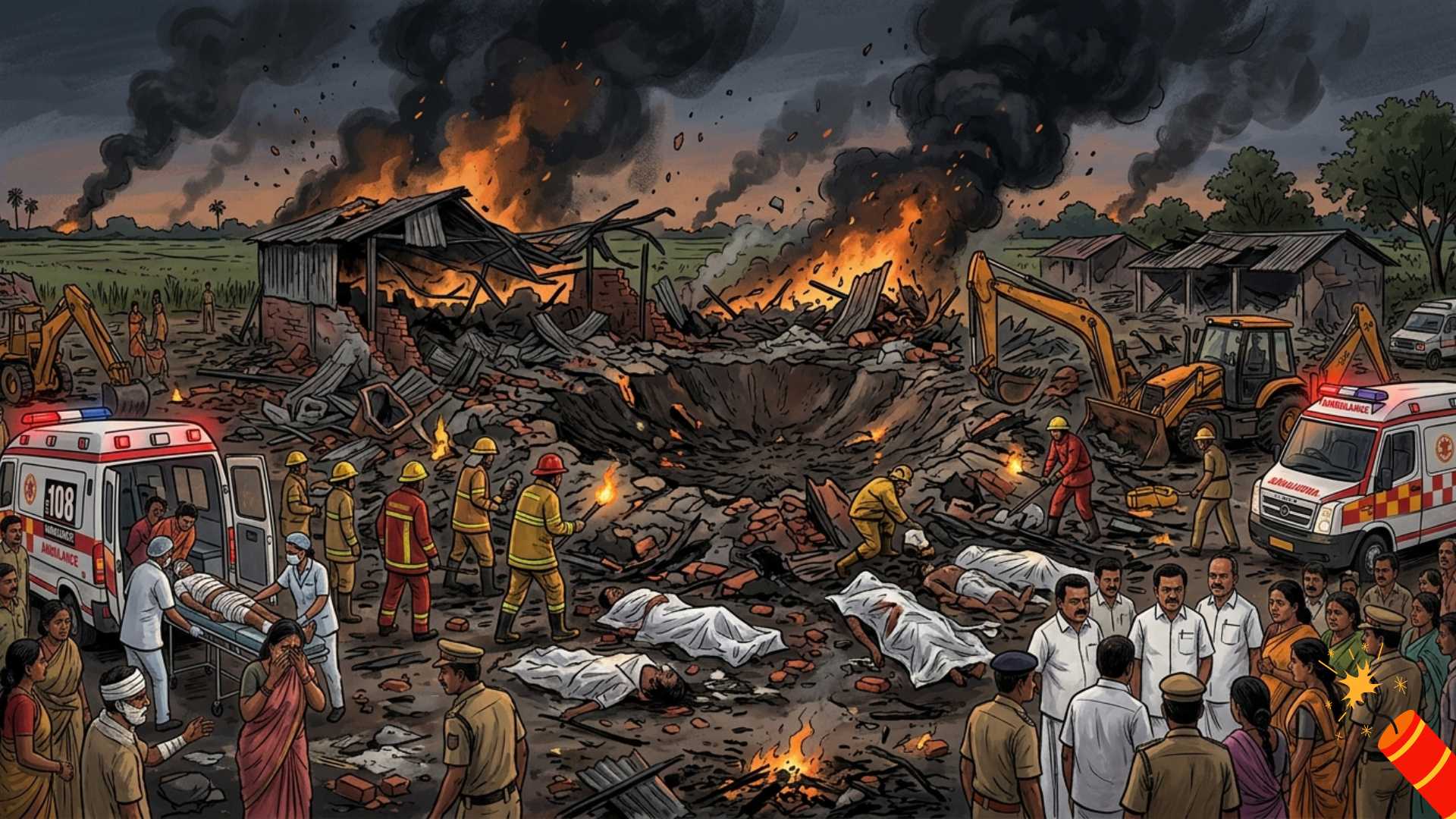
Fireworks Industry Safety and Regulatory Failures in India

"Had these workers followed primary safety norms, the toll could have been minimal." — District Official, Virudhunagar
India's fireworks industry, concentrated in Tamil Nadu's Virudhunagar–Sivakasi belt, accounts for nearly 50% of national output and employs an estimated 8–10 lakh workers. Yet recurring mass-casualty explosions — the April 2026 Kattanarpatti blast killing 23 workers being the latest — expose a chronic failure of industrial safety governance, regulatory enforcement, and worker protection in one of India's most hazardous small-scale industries.
| Indicator | Data |
|---|---|
| Industry size | ₹6,000+ crore annually |
| Workforce | ~8–10 lakh workers |
| Worker limit per licensed unit | 11–12 workers |
| Workers per shed (safety norm) | Maximum 4 |
| Kattanarpatti unit (actual) | ~40 workers present |
| Child Labour Act applicability | Prohibited in hazardous industries (2016 Amendment) |
Background & Context
The Sivakasi–Virudhunagar fireworks cluster operates under a dual structure: a few large licensed units alongside a vast ecosystem of small, often under-regulated establishments. The industry employs predominantly women, migrants, and marginalised communities — workers with minimal bargaining power and no formal safety training.
Accidents here are not aberrations. They follow a predictable pattern of overcrowding, chemical mixing violations, and absent inspection — pointing to structural rather than incidental failure.
| Year | Location | Deaths | Primary Cause |
|---|---|---|---|
| 2012 | Sivakasi | 40+ | Illegal storage, overcrowding |
| 2018 | Sivakasi | 5 | Chemical mixing violation |
| 2021 | Virudhunagar | 19 | Safety norm violations |
| 2026 | Kattanarpatti | 23 | Illegal operation, overcrowding |
Key Regulatory Framework
1. Explosives Act, 1884 & Explosives Rules, 2008 Governs manufacture, storage, and transport of fireworks chemicals. Licensing handled by PESO (Petroleum and Explosives Safety Organisation) under the Ministry of Commerce.
2. Factories Act, 1948 Mandates worker limits per shed, inter-shed spacing, and inspection regimes for hazardous industries. Enforcement rests with State Factory Inspectorates.
3. District Revenue Officer (DRO) Licensing Local-level licensing with specific conditions — worker caps, shed distances, chemical storage norms. In practice, these conditions are routinely violated without consequence.
4. Child Labour (Prohibition and Regulation) Amendment Act, 2016 Prohibits employment of children in hazardous industries including fireworks. Presence of a child among the injured in the 2026 blast signals persistent non-compliance.
Structural Failures
Regulatory and Licensing Gaps
Units operate beyond licensed conditions — on holidays, with multiple times the permitted workforce, without adequate approach roads — suggesting either inspection failure or regulatory capture at the district level. The question of how a unit without a motorable road received a licence at all points to pre-licensing infrastructure checks being routinely skipped.
Informalisation of Hazardous Work
Like the broader labour market, the fireworks industry relies heavily on contract and casual workers with no written contracts, ESI coverage, or safety training. Workers are economically compelled to accept unsafe conditions — the alternative being no work at all.
Inter-Agency Coordination Failure
Three separate agencies — PESO, State Factory Inspectorate, and DRO — govern different aspects of the same unit, with no unified compliance framework. Violations fall through jurisdictional gaps.
Post-Disaster Protocol Absence
Standard hazardous industry emergency protocol requires chemical neutralisation assessment before debris clearance. Absence of this protocol leads to secondary explosions injuring rescuers — a recurring feature in Virudhunagar accidents.
Child Labour Persistence
Despite the 2016 Amendment, children continue to work in fireworks units — reflecting weak ground-level enforcement and economic desperation of families.
Policy and Governance Gaps
| Gap | Consequence |
|---|---|
| No mandatory third-party safety audits | Violations undetected between inspections |
| Infrastructure not verified before licensing | Units licensed without road or water access |
| No compulsory worker accident insurance | Families left without recourse post-accident |
| PESO–Inspectorate–DRO coordination absent | Violations fall through jurisdictional gaps |
| Post-blast site clearance protocol absent | Secondary explosions injure rescuers |
| Child labour monitoring inadequate | Children present in prohibited hazardous settings |
Way Forward
- Mandatory geo-tagged inspection records through state factory inspectorate portals — preventing falsification and ensuring accountability
- Infrastructure pre-condition for licensing — no licence without verified approach roads and firefighting water access
- Compulsory group accident insurance for all hazardous industry workers, funded jointly by employer and state
- Cluster-level unified safety authority for the Sivakasi–Virudhunagar belt — consolidating PESO, Factory Inspectorate, and DRO functions
- Strict child labour enforcement through surprise inspections linked to Aadhaar-based worker registration
- Post-blast neutralisation protocol — mandatory chemical assessment before any debris clearance in hazardous industry accidents
Conclusion
Recurring fireworks tragedies in India are not accidents of fate — they are predictable outcomes of a governance system that licenses hazardous units without adequate safeguards, inspects them infrequently, and protects workers inadequately. The workers who die are predominantly poor, female, and informal — communities with the least power to demand accountability. India's constitutional commitment under Article 21 (right to life) and Article 42 (just and humane conditions of work) demands that industrial safety be treated not as a bureaucratic checkbox but as a non-negotiable obligation of the state.
Attribution
Original content sources and authors


Syllabus classification
How this article maps to GS papers
Main syllabus
GS2Government PoliciesQuick Q&A
What are the key regulatory and safety norms governing the fireworks industry in India, and how were they violated in this incident?
- Limiting the number of workers per shed (typically 3–4 workers)
- Maintaining safe distances between sheds to localize explosions
- Restricting the total workforce in a licensed unit
- Ensuring proper training and use of protective equipment
Violations in the Incident: The Virudhunagar accident highlights multiple violations. Around 40 workers were present, far exceeding permissible limits. Workers were operating near a chemical mixing shed, violating spatial safety norms. Additionally, the unit was reportedly functioning on a Sunday without permission, indicating regulatory evasion.
Implications: Such violations demonstrate systemic lapses in enforcement and compliance. They underscore the gap between de jure regulations and de facto practices, particularly in informal or semi-regulated industrial clusters like Sivakasi. Strengthening inspections, accountability mechanisms, and worker awareness is critical to prevent recurrence.
Why do industrial accidents like fireworks factory explosions continue to occur despite existing safety regulations?
Governance and Enforcement Gaps: Weak enforcement remains a critical issue. Regulatory bodies often face manpower shortages, limiting frequent inspections. Corruption and informal practices further dilute compliance. In this case, the factory reportedly operated without permission on a non-working day, highlighting regulatory oversight failures.
Worker Vulnerability: Workers in such industries are often from economically weaker sections, with limited bargaining power and awareness of safety rights. Low unionization and informal employment exacerbate risks. Similar incidents in Sivakasi and other clusters indicate a pattern of neglect.
Conclusion: Addressing these accidents requires not just stricter laws, but improved enforcement, technological upgrades, and social protection for workers. A multi-stakeholder approach involving government, industry, and civil society is essential.
How can disaster management mechanisms be strengthened to effectively respond to industrial accidents like this one?
Institutional Framework: India’s disaster response is guided by the Disaster Management Act, 2005, with roles defined for district and state authorities. Strengthening district disaster management plans with industry-specific risk assessments is crucial. Regular mock drills, coordination between agencies, and availability of specialized equipment can improve preparedness.
Capacity Building: Training for first responders and workers in handling hazardous materials is essential. Hospitals must also be equipped for burn care and trauma management, as seen with the mobilization of medical teams in this incident.
Way Forward: Integrating technology such as GIS mapping of industrial units, real-time monitoring systems, and early warning mechanisms can significantly enhance response efficiency. Community awareness and participation should also be strengthened to ensure quicker local response.
Critically analyze the role of governance and accountability in preventing industrial disasters in India.
Accountability Issues: The Virudhunagar incident raises questions about licensing procedures, inspection frequency, and local administrative oversight. Allegations regarding inadequate infrastructure (such as lack of proper road access) suggest lapses in due diligence. Furthermore, the tendency for ‘knee-jerk’ regulatory crackdowns post-accident often penalizes compliant units while systemic issues remain unaddressed.
Balancing Regulation and Livelihoods: Over-regulation can harm small industries, while under-regulation endangers lives. A balanced approach is needed, combining strict enforcement with support for compliance, such as subsidies for safety equipment and training.
Conclusion: Governance must shift from reactive to proactive. Transparent inspections, digital tracking of licenses, and community monitoring can improve accountability. Ultimately, a culture of safety must be institutionalized across all levels.
Can you cite examples of similar industrial accidents in India and discuss the lessons learned?
Key Lessons:
- Strict enforcement: Laws must be implemented consistently, not just after disasters.
- Risk assessment: Hazard identification and mitigation should be integral to industrial operations.
- Community awareness: Local populations must be educated on emergency response.
- Technological upgrades: Adoption of safer production technologies can reduce risks.
Relevance to Current Incident: The Virudhunagar explosion reflects similar issues—overcrowding, unsafe practices, and regulatory failure. Despite repeated accidents, systemic reforms have been slow.
Conclusion: Learning from past incidents requires institutional memory and policy continuity. Establishing independent safety audits and integrating global best practices can help prevent future tragedies.
As a district administrator, how would you respond to and prevent such industrial accidents in your jurisdiction?
Short-Term Measures: Conduct a comprehensive inspection of all fireworks units in the district. Suspend operations of non-compliant units and initiate legal action where necessary. Provide compensation to victims and ensure accountability through thorough investigation.
Long-Term Prevention:
- Strengthen licensing procedures with digital tracking and periodic audits
- Conduct regular safety drills and training for workers
- Promote mechanization to reduce manual handling of hazardous materials
- Improve infrastructure, including road access and emergency services
Community and Stakeholder Engagement: Engage with industry associations, worker unions, and local communities to build a culture of safety. Awareness campaigns and grievance redressal mechanisms can empower workers to report violations.
Conclusion: A proactive, multi-dimensional approach combining enforcement, capacity building, and stakeholder participation is essential to prevent such tragedies and ensure sustainable industrial growth.
Practice questions
1 question for mains preparation