Jabalpur Cruise Tragedy: Disaster Management, Tourism Safety & Governance Accountability

Introduction
-
India's adventure and water tourism sector has grown rapidly with minimal regulatory standardisation — a dangerous gap that the Jabalpur cruise tragedy (April 30, 2026) has once again exposed.
-
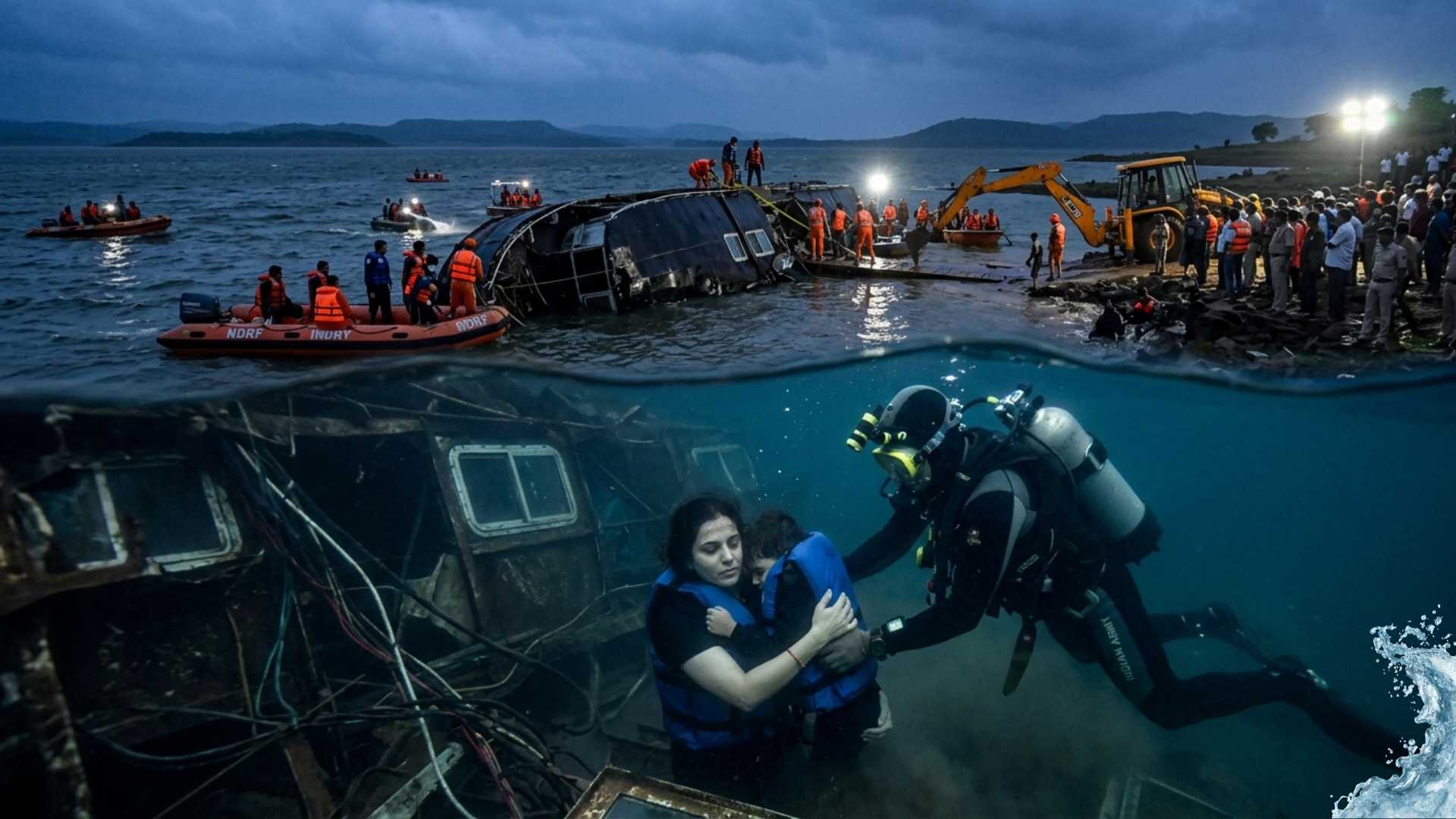
When an MP Tourism Department cruise overturned in the Bargi dam reservoir on the Narmada River carrying 41 people, 13 lives were lost (9 recovered, 4 missing) — not merely to a storm, but to a cascade of preventable governance failures: absent life jackets, ignored weather alerts, and crew negligence.
"Disasters are not natural — they are the result of human failure to manage risk." — Kofi Annan, former UN Secretary-General
Incident Data
| Parameter | Detail |
|---|---|
| Date | April 30, 2026 |
| Location | Bargi Dam Reservoir, Narmada River, Jabalpur |
| Vessel operator | MP Tourism (MPT) Department |
| Passengers | 39 tourists + 2 crew = 41 total |
| Survivors | 28 |
| Deaths confirmed | 9 (including children) |
| Still missing | 4 (including 3 children) |
| Vessel weight | 18 tonnes; stuck 20–25 feet underwater |
| Ex-gratia (Centre) | ₹2 lakh/deceased; ₹50,000/injured (PMNRF) |
| Rescuer reward | ₹51,000 each |
Sequence of Failures — Analytical Breakdown
Pre-incident failures:
- Meteorology department alert allegedly issued — cruise operated regardless
- Life jackets not distributed to passengers before departure
- No safety briefing conducted by crew
During incident:
- Crew ignored passenger requests to return to shore
- Pilot allegedly steered vessel further into the dam instead of toward shore
- Life jacket lockers were locked — passengers had to break them open themselves
- Crew did not assist passengers after capsize
Post-incident response:
- First responders were private construction workers nearby — not trained rescue personnel
- NDRF, SDERF, police arrived after darkness had fallen, compounding rescue difficulty
- Army divers from Hyderabad and Agra called in — indicating absence of local specialised capacity
- Vessel extraction took 7 hours using excavators and ramps
Key Concepts
NDRF vs SDRF
- NDRF (National Disaster Response Force) — central paramilitary force under MHA; deployed for major disasters
- SDRF (State Disaster Response Force) — state-level counterpart; first responder in most incidents
- Gap exposed: Neither was positioned for rapid water rescue at a government-operated tourist site
Standard Operating Procedure (SOP) A pre-defined set of step-by-step instructions for routine or emergency operations. The CM's announcement of a new SOP post-tragedy confirms that no binding SOP existed for MP Tourism's cruise operations — a fundamental regulatory omission for a government-run service.
Ex-Gratia vs Compensation Ex-gratia is a discretionary goodwill payment — not an admission of liability. The ₹2 lakh PMNRF payment does not substitute for legal compensation under tort law or consumer protection, which victims' families may separately pursue.
Governance & Accountability Response
| Action | Authority | Nature |
|---|---|---|
| Crew termination (pilot, helper, ticket counter) | CM | Punitive |
| Resort manager suspended | CM | Administrative |
| Regional manager attached to HQ | CM | Punitive |
| High-level probe committee formed | CM | Investigative |
| New SOP announced | CM | Preventive |
| Ex-gratia ₹2 lakh/deceased | PM (PMNRF) | Relief |
| Ex-gratia from State government | CM | Relief |
Critical observation: All accountability measures were reactive and post-facto. No pre-existing independent safety audit mechanism existed for government-run water tourism operations.
Systemic Failures in Water Tourism Regulation
Absent national framework: India has no unified national water tourism safety law. Regulations are fragmented across:
- Inland Vessels Act, 2021 (central)
- State maritime/waterway boards
- Tourism department SOPs (discretionary)
- Adventure tourism guidelines (advisory, not binding)
Government as both operator and regulator: MP Tourism simultaneously operated the cruise and regulated its safety standards — a structural conflict of interest. When the State is both service provider and safety enforcer, accountability is inherently compromised.
Weather alert non-compliance: Operating a vessel against meteorological warnings — if proven — constitutes criminal negligence. The Tourism Minister's claim of being "unaware" of any warning points to a broken internal communication chain between departments.
Disaster Response — Lessons
- Golden hour failure: Darkness and bad weather delayed official response — first lives were saved by untrained civilian workers
- Local capacity gap: Army divers had to be flown in from Hyderabad and Agra — no trained water rescue unit was locally available at a major tourism site
- Equipment adequacy: 18-tonne submerged vessel required excavators and 7 hours — standard NDRF water rescue equipment was insufficient
Way Forward
- Mandatory third-party safety audit for all government-operated water tourism vessels — annual, independent, publicly disclosed
- Pre-departure safety protocol — life jacket fitting, weather clearance certificate, and crew briefing made mandatory before every departure
- Real-time weather integration — tourism operators must receive and acknowledge IMD alerts; departure prohibited above threshold wind/wave conditions
- Dedicated water rescue units at all major water tourism sites — not dependent on distant Army or NDRF deployment
- Separate operator and regulator roles — government tourism departments should not self-regulate safety
- National Water Tourism Safety Act — unified binding framework replacing fragmented state-level advisories
Conclusion
-
The Jabalpur tragedy is not an act of God — it is an act of institutional negligence compounded by regulatory vacuum.
-
A government department operating tourist cruises without binding SOPs, weather-linked departure protocols, or pre-positioned rescue capacity represents a complete collapse of the duty of care that the State owes its citizens.
-
Post-tragedy punishments and ex-gratia payments cannot substitute for the systemic reform needed to ensure that India's growing water tourism sector does not continue to trade lives for revenue. Accountability must precede the next tragedy — not follow it.
Attribution
Original content sources and authors


Syllabus classification
How this article maps to GS papers
Main syllabus
GS2Government PoliciesQuick Q&A
What were the key factors that led to the Jabalpur cruise tragedy, and how can it be understood in terms of disaster management failure?
From a disaster management perspective, the incident reveals multiple lapses. Firstly, there was a failure of preparedness, as life jackets were reportedly not distributed in advance, violating basic safety protocols. Secondly, lack of real-time risk assessment meant that weather conditions were not adequately factored into operational decisions. Thirdly, the absence of a clear Standard Operating Procedure (SOP) or its improper implementation contributed to chaos during the emergency.
This tragedy can be compared to similar incidents like the 2018 Godavari boat tragedy, where overcrowding and lack of safety compliance led to fatalities. In both cases, the core issue lies in weak enforcement of regulations. Thus, the Jabalpur incident underscores the need for integrated disaster risk reduction strategies, including strict adherence to safety norms, trained personnel, and early warning systems.
Why is strict enforcement of safety protocols critical in inland water transport systems like cruise operations?
The importance of enforcement lies not only in having rules but ensuring compliance. Protocols such as mandatory life jackets, passenger limits, trained crew, and weather advisories are designed to minimize risk and enhance survivability. Without enforcement, these rules remain ineffective. For instance, in developed countries, strict maritime safety audits and penalties have significantly reduced such accidents.
Moreover, safety protocols build public trust and accountability. Tourism-based cruise operations depend heavily on perceptions of safety. Incidents like this can damage the credibility of public institutions like the Madhya Pradesh Tourism Department. Therefore, robust regulatory mechanisms, regular inspections, and accountability frameworks are indispensable to prevent recurrence.
How do rescue operations in such water-based disasters demonstrate the role of coordination among multiple agencies?
Subsequently, specialized agencies such as the NDRF, SDRF, local police, and home guards took over. The involvement of the Indian Army’s diving teams further strengthened the operation, particularly in retrieving bodies trapped in submerged sections of the vessel. The use of heavy equipment like excavators to bring the vessel ashore demonstrates the need for logistical and technical coordination.
However, the challenges faced—such as darkness, bad weather, and depth—also reveal limitations. Effective disaster response requires predefined coordination protocols, real-time communication systems, and joint training exercises. The Jabalpur case can be seen alongside the Kerala floods (2018), where coordinated efforts between the military, local administration, and citizens significantly reduced casualties. Thus, multi-agency synergy is both a strength and a necessity in disaster management.
What were the major challenges faced during the rescue operation, and what do they reveal about disaster preparedness?
Additionally, adverse weather conditions continued to hamper operations, while the structural complexity of the submerged cruise created obstacles in retrieving trapped victims. The need to construct a ramp and use excavators to pull the vessel ashore indicates the absence of ready-to-deploy specialized equipment for such scenarios.
These challenges point to gaps in disaster preparedness and infrastructure. Ideally, high-risk tourist locations should have dedicated emergency response units, night-vision equipment, and rapid deployment systems. The lack of such preparedness increases dependency on external agencies, causing delays. Therefore, the incident underscores the need for capacity building, infrastructure investment, and scenario-based planning in disaster-prone areas.
Critically analyze the role of governance and accountability in preventing such tragedies.
From a critical perspective, the incident exposes systemic weaknesses. There appears to be a lack of regular safety audits, enforcement of protocols, and monitoring mechanisms. If allegations of ignoring weather warnings are true, it points to a failure in institutional accountability and decision-making. Moreover, tourism departments often face a conflict between revenue generation and safety compliance, which can lead to compromised standards.
However, the formation of a high-level committee and the proposal to create a comprehensive SOP are positive steps. For long-term improvement, governance must shift towards a proactive and preventive model. This includes independent regulatory bodies, strict penalties for violations, and citizen participation in monitoring. Ultimately, accountability should be institutionalized rather than event-driven.
Can you cite examples from this incident that highlight human resilience and societal response during disasters?
Another significant example is the role played by local construction workers, who acted immediately without waiting for official rescue teams. Their quick thinking and courage helped save multiple lives, demonstrating the importance of community participation in disaster response. Such actions align with the concept of ‘first responders’, who are often ordinary citizens.
Additionally, the coordinated efforts of various agencies and the recognition of rescuers through monetary rewards highlight societal appreciation and institutional support. Similar examples can be seen during the Chennai floods (2015), where local communities played a crucial role in rescue and relief. These instances underline that while institutional mechanisms are vital, human solidarity and resilience remain equally महत्वपूर्ण in mitigating disaster impacts.
As a district administrator, what measures would you implement to prevent such incidents in the future?
Secondly, I would strengthen institutional capacity by setting up dedicated emergency response units at major tourist sites. नियमित inspections, surprise audits, and the use of technology such as GPS tracking of vessels would enhance monitoring. Training programs for crew members in disaster response and first aid would also be prioritized.
Finally, public awareness campaigns would be launched to educate tourists about safety protocols and their rights. Collaboration with local communities would be encouraged to build a resilient first-response network. Drawing lessons from global best practices, such as strict maritime safety laws in Europe, the focus would be on preventive governance rather than reactive measures.
Practice questions
2 questions for mains preparation