
"Monetary policy works with long and variable lags — and in emerging economies like India, those lags are longer and more variable than anywhere else." — Milton Friedman (adapted); echoed in RBI Annual Report 2023-24
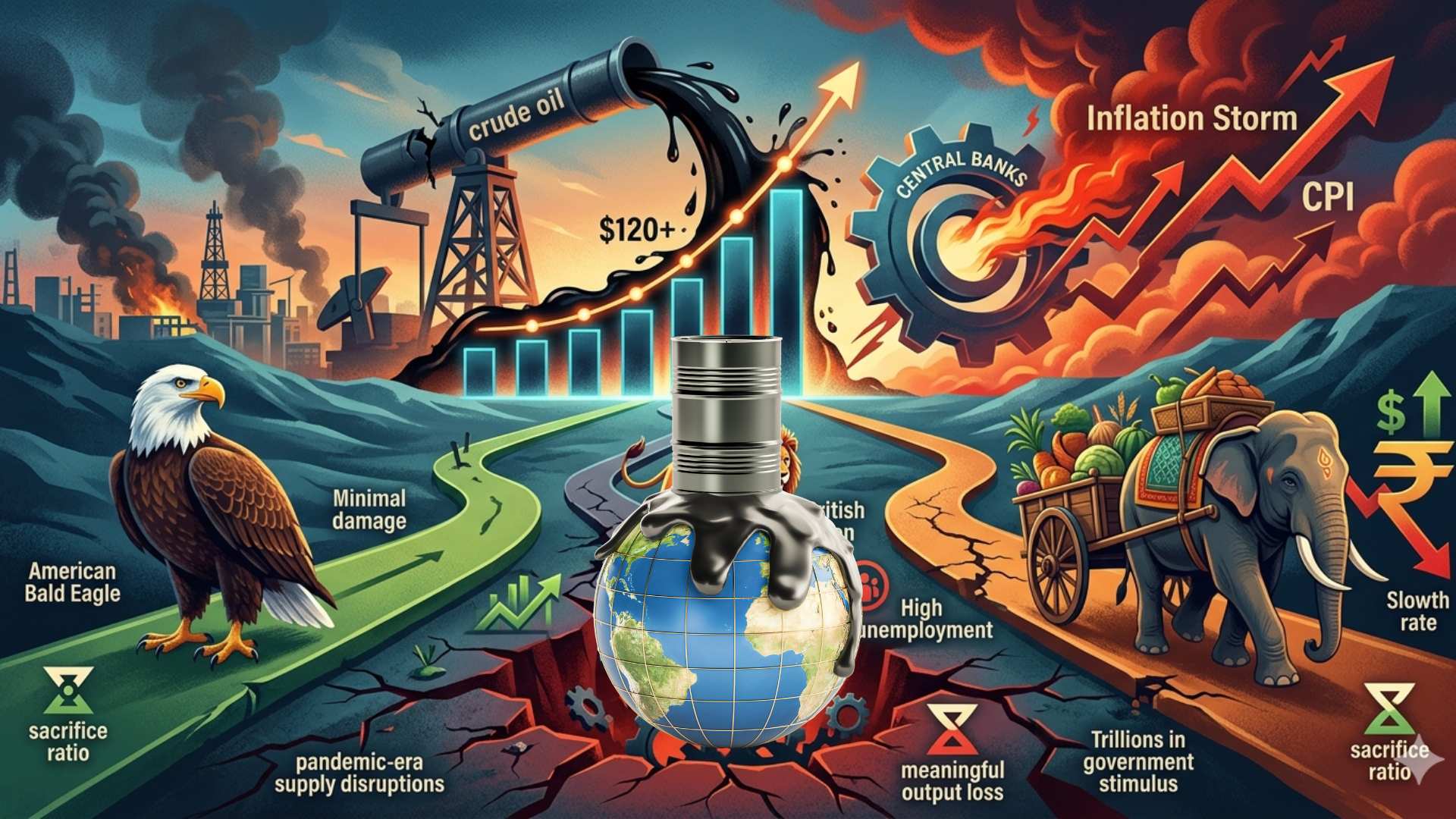
Crude oil crossing $120/barrel following the West Asia conflict has reignited inflationary fears across global economies still recovering from the 2022 price surge — when U.S. inflation peaked at 9.1%, UK at 11.1%, and India at 7.8%. Central banks that just completed their most aggressive tightening cycles in four decades now face a dangerous dilemma: fight inflation again or protect slowing growth.
Background / Context
The 2021–23 global inflation episode was driven by pandemic supply disruptions, trillions in government stimulus, and Russia's Ukraine invasion pushing energy prices sharply higher. All three major central banks — the U.S. Fed, Bank of England (BoE), and RBI — responded with aggressive rate hikes. By 2025, inflation had broadly retreated. Now, a fresh energy shock threatens to undo that progress.
Key Concepts / Definitions
Sacrifice Ratio Measures the loss in economic output (GDP) for every percentage point of inflation reduced through monetary tightening. A lower ratio = less economic pain per unit of inflation controlled.
Repo Rate Rate at which RBI lends to commercial banks. Primary monetary policy tool in India. Raised from 4% → 6.5% (May 2022–Feb 2023); cut to 5.25% by April 2026 before pause.
Consumer Price Index (CPI) Measures retail inflation. In India, food = ~46% of CPI basket — far higher than U.S. or UK — making RBI rate hikes less effective against India's primary inflation driver.
Comparative Data — Three Economies
| Parameter | USA | UK | India |
|---|---|---|---|
| Inflation Peak | 9.1% (Jun 2022) | 11.1% (Oct 2022) | 7.8% (Apr 2022) |
| Rate Hike Start | Mar 2022 | Dec 2021 | May 2022 |
| Peak Rate | 5.25–5.50% | 5.25% | 6.50% |
| Sacrifice Ratio | ~Zero | High (recession) | Low (no contraction) |
| Recession? | No | Yes (late 2023) | No |
| Inflation (Feb 2026) | Near target | 3.0% (above 2% target) | 2.1% (mid-2025) |
| Current Challenge | Oil shock | Oil + above-target CPI | Rupee + oil + growth ↓ |
Analysis — Three Central Bank Outcomes
USA — The Soft Landing
Fed hiked rates 11 times to 5.25–5.50% yet avoided recession. Supply chains normalised faster than expected, energy prices fell, demand stayed robust. Sacrifice ratio ≈ near-zero — a historically rare outcome. However, permanent price level increases in groceries, rent, and fuel remain — rate cuts cannot reverse price levels, only the rate of increase.
UK — The Costly Fight
BoE moved earliest (Dec 2021) yet achieved least. Heavy dependence on imported energy + Ukraine war gas shock + labour shortages driving wage-push inflation = rate hikes inadequate against structural drivers. Economy tipped into recession (late 2023), unemployment rose from 3.8% → 5.2%, and CPI still sits at 3.0% — 1 percentage point above target. New West Asia shock projected to push it to 3.0–3.5%.
India — Structural Bind
RBI's rate transmission is slower due to India's economic structure. Food = 46% of CPI → driven by monsoon patterns and MSP, not interest rates. Rate hikes dampened urban demand but had limited reach over rural and food-driven inflation. Growth slowed from 8%+ → 6.5% without contraction. Now faces a trilemma:
INDIA'S MONETARY TRILEMMA — APRIL 2026
━━━━━━━━━━━━━━━━━━━━━━━━━━━━━━━━━━━━━━━━━━

Oil ↑ ($120/barrel)
→ Import bill ↑ → Current Account Deficit ↑
→ Rupee ↓ (record low: ₹95.22/$, Mar 30 2026)
→ Import-driven inflation ↑ (second-round effects)

OPTION 1: Cut rates further
→ Stimulate slowing economy ✓
≠ Rupee depreciates faster → inflation ↑↑

OPTION 2: Hike rates
→ Defend rupee + fight inflation ✓
≠ Strangles already-slowing economy ↓

OPTION 3: PAUSE (RBI's April 2026 choice)
→ Buy time + signal caution ✓
≠ Resolves neither growth nor currency pressure
= Holding position until external shock clarity
Challenges / Issues
- Food Weight in CPI → 46% of India's basket ≠ rate-sensitive → monetary policy structurally limited in India
- Rupee Vulnerability → Record low ₹95.22/$ → makes oil imports costlier → feeds inflation independently of rate decisions
- Transmission Lag → RBI acknowledged rate changes take longer to filter through India's economy → blunt instrument
- Growth-Inflation Trade-off → Growth already slowed to 6.5% → further tightening risks deeper slowdown
- External Dependence → 88.6% crude import dependence → global price shocks bypass domestic monetary tools entirely
- UK Structural Problem → Wage-push + energy import dependence = supply-side inflation ≠ solvable by demand-side rate hikes alone
Government / Institutional Framework
| Institution | Tool | India Context |
|---|---|---|
| RBI – MPC | Repo rate, CRR, SLR | 6-member MPC; inflation target 4% ±2% |
| Ministry of Finance | Fiscal policy coordination | Supply-side measures — fuel tax cuts, food subsidies |
| SEBI | Capital flow management | Rupee defence via FPI monitoring |
| RBI | Forex intervention | Sells USD reserves to defend rupee |
Way Forward
SHORT-TERM  → RBI: Maintain pause; use forex reserves to stabilise rupee
              Government: Fiscal buffer via fuel tax modulation
              ≠ Premature rate cuts = rupee risk ↑↑

MEDIUM-TERM → Reduce food weight volatility in CPI
              = Better supply chain + buffer stock management
              + Agricultural market reforms → MSP ≠ only price anchor

LONG-TERM   → Reduce crude import dependence (EVs, CBG, Green Hydrogen)
              = Structural insulation from oil shock transmission
              + Deepen domestic gas production → fertilizer + energy security

STRUCTURAL  → Improve monetary transmission in rural economy
              = Financial inclusion + formal credit deepening
              → Rate changes reach rural demand more effectively
India's monetary policy challenge is not one of tool design but of structural economic composition — a food-heavy CPI, import-dependent energy, and a currency under pressure mean the RBI is fighting a supply-side war with demand-side weapons. Long-term insulation requires structural reform, not just interest rate calibration.
Attribution
Original content sources and authors

Syllabus classification
How this article maps to GS papers
Main syllabus
GS3BankingQuick Q&A
What is the sacrifice ratio and how is it used to assess monetary policy outcomes?
In practical terms, central banks use this concept to evaluate the effectiveness and cost of their monetary tightening policies. For instance, during the post-pandemic inflation surge (2021–2023), the U.S. Federal Reserve managed to bring inflation down with a near-zero sacrifice ratio, meaning inflation declined without a major contraction in output. This was largely due to easing supply chains, falling energy prices, and resilient demand.
In contrast, the United Kingdom experienced a high sacrifice ratio, where aggressive rate hikes led to a recession and rising unemployment, yet inflation remained above target. India, meanwhile, exhibited a relatively low sacrifice ratio, as growth slowed but did not collapse. However, structural factors like the dominance of food inflation limited the effectiveness of interest rate policies. Thus, the sacrifice ratio helps policymakers and analysts compare cross-country experiences and refine future monetary strategies.
Why does a surge in crude oil prices create an inflationary challenge for central banks?
Additionally, oil price shocks tend to have second-round effects. For example, rising fuel costs can increase food prices due to higher transportation and logistics expenses. In countries like India, where food constitutes nearly 46% of the consumer price index (CPI), this amplifies inflationary pressures. Moreover, higher oil import bills can weaken the domestic currency, making imports more expensive and further aggravating inflation.
Central banks face a dilemma in such situations. Raising interest rates can help control inflation by reducing demand, but it may also slow economic growth. Conversely, keeping rates low to support growth risks allowing inflation to spiral. The recent West Asian conflict pushing oil above $120 per barrel exemplifies this dilemma, forcing central banks like the RBI to pause rate cuts despite slowing growth. Thus, oil price shocks complicate monetary policy by creating a trade-off between inflation control and economic stability.
How did the monetary policy responses of the U.S., U.K., and India differ during the post-pandemic inflation surge?
The Bank of England (BoE), on the other hand, started tightening earlier in December 2021. However, the U.K. economy was more vulnerable due to its heavy dependence on imported energy and labor shortages. Despite raising rates rapidly to 5.25%, the country entered a recession in late 2023, and inflation remained above target. This highlights how structural vulnerabilities can limit the effectiveness of monetary policy.
India’s Reserve Bank of India (RBI) adopted a more calibrated approach, raising the repo rate from 4% to 6.5% between May 2022 and February 2023. While inflation declined significantly, growth slowed but did not contract. However, the transmission of monetary policy in India is slower, and food inflation—largely outside RBI control—plays a dominant role. These differences illustrate how economic structure, external dependencies, and policy transmission mechanisms shape the effectiveness of central bank actions.
What structural factors explain the differing inflation outcomes in India compared to advanced economies?
Another factor is the slower transmission of monetary policy. Changes in interest rates take longer to affect borrowing, investment, and consumption in India due to structural issues in the banking sector and financial markets. This means that the impact of rate hikes on inflation is delayed compared to advanced economies like the U.S., where financial markets are more responsive.
Additionally, India’s economy is less energy-intensive than some developed economies but remains highly dependent on oil imports. This exposes it to external shocks such as rising crude prices and currency depreciation. For example, the weakening of the rupee to record lows increases import costs and fuels inflation. These structural characteristics explain why India managed to avoid a recession but still faces persistent inflationary pressures, highlighting the need for a multi-pronged policy approach beyond just monetary tools.
Critically analyse the effectiveness of aggressive interest rate hikes in controlling inflation across different economies.
However, the U.K. case highlights the limitations of this approach. Despite early and rapid rate hikes, inflation remained persistent due to external factors like high energy import dependence and labor shortages. The economy eventually entered a recession, indicating a high economic cost of monetary tightening. This suggests that rate hikes alone may be insufficient when inflation is driven by supply-side shocks.
In India, the effectiveness of rate hikes is further constrained by structural factors such as the dominance of food inflation and slower policy transmission. While inflation declined, the role of monetary policy was partial. Critical evaluation suggests that aggressive rate hikes are most effective when inflation is demand-driven, but less so when driven by supply shocks. Therefore, a balanced approach combining monetary, fiscal, and supply-side measures is essential for sustainable inflation control.
How does the recent rupee depreciation illustrate the policy dilemma faced by the RBI in the context of global shocks?
The RBI faces a difficult choice. On one hand, it could raise interest rates to stabilize the currency and control inflation by attracting foreign capital. However, this risks slowing down economic growth, which has already moderated from over 8% to around 6.5%. On the other hand, cutting rates to support growth could accelerate capital outflows and further weaken the rupee, worsening inflation.
This situation highlights the trilemma of monetary policy in an open economy: maintaining exchange rate stability, controlling inflation, and supporting growth simultaneously is challenging. The RBI’s decision to pause rate cuts in April 2026 reflects a cautious balancing act. This case underscores the importance of coordinated policy measures, including foreign exchange interventions and fiscal strategies, to navigate external shocks effectively.
Practice questions
1 question for mains preparation