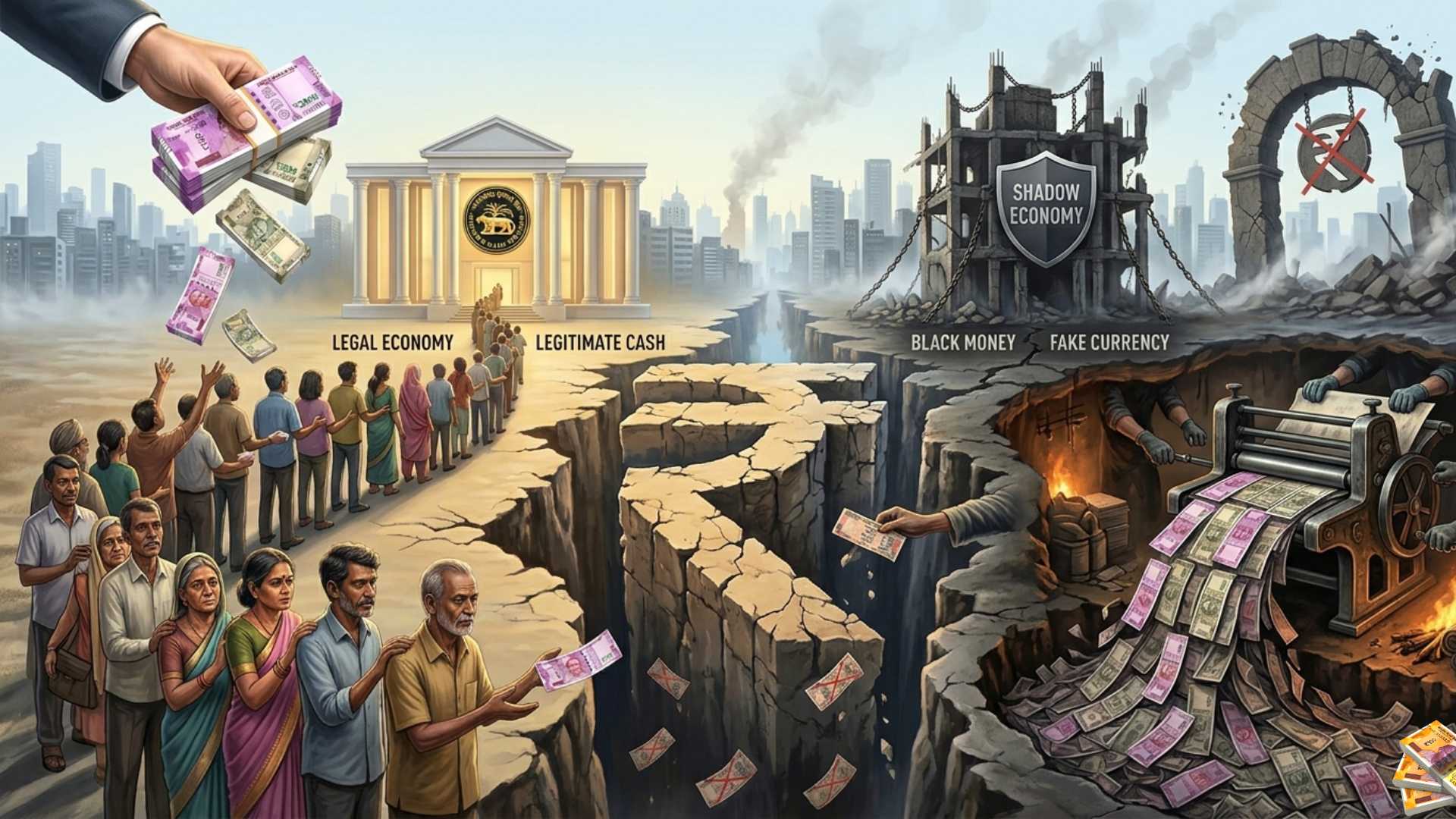

A Decade After Demonetisation: The Counterfeit Currency Problem Persists
"The move would serve as a major assault on black money, counterfeit currencies, and corruption." — Prime Minister Narendra Modi, November 8, 2016
The Announcement and Its Stated Goals
On November 8, 2016, the Government of India demonetised ₹500 and ₹1,000 notes with immediate effect. The exercise had three stated objectives:
- Eradication of black money
- Elimination of counterfeit currency
- Reducing cash transactions in the economy
The immediate aftermath saw public panic, long ATM queues, and severe economic disruption — particularly in the MSME sector, which runs heavily on cash. Nearly a decade later, the NCRB's Crime in India 2024 report provides a data-backed assessment of how far these goals have been achieved.
What the Data Shows: Fake Currency Still Thriving
Seizure data — law enforcement (NCRB 2024):
Total fake currency seized in 2024        →  ₹54.61 crore
Fake ₹500 notes seized (2024)            →  ~6 lakh notes
Fake ₹2,000 notes seized (2024)          →  >1 lakh notes
Total seized since 2017                  →  ₹638 crore
2024 seizure rank (since 2016)           →  3rd highest
Trend highlights:
- In 2020 (COVID year), seizures stood at ₹92 crore — lower due to reduced economic activity and enforcement mobility
- In 2022, post-pandemic surge saw seizures spike to a staggering ₹382.6 crore — the highest on record
- Fake ₹500 notes seized in 2024 were nearly four times the number seized in 2016
- Fake ₹2,000 notes — introduced after demonetisation — have doubled since 2017
New Currency, New Counterfeits
A critical finding: demonetisation did not solve the counterfeiting problem — it merely shifted it to new denominations.
New ₹500 notes (post-demonetisation series)  →  >4 lakh detected in banks
                                                  = 37% of all bank-detected fakes
₹100 notes                                   →  ~3 lakh detected
                                                  = 26% of all bank-detected fakes
₹200 notes (newly introduced)                →  Also being counterfeited
Banking system data (Parliament, 2020–21 to 2024–25):
- Over 11 lakh counterfeit notes detected after entering the banking system
- Total value: ₹40.26 crore over five years
- Average: roughly 2 lakh fake notes per year slipping past initial checks into banks
State-wise Distribution: Gujarat Leads
Gujarat       →  ₹355.72 crore seized (2017–2024)
                  = More than 50% of national total
Maharashtra   →  ₹100 crore
Karnataka     →  ₹50 crore
Gujarat's dominance in seizure value raises questions about both the source networks operating through western India and the effectiveness of inter-state intelligence sharing.
The Cash Circulation Paradox
One of demonetisation's stated aims was to reduce cash dependency in the economy. RBI data tells a different story:
Currency in circulation (November 2016)   →  ₹17.74 lakh crore
Currency in circulation (May 2026)        →  ₹42.12 lakh crore
                                              (174 billion notes)
Increase                                  →  ~137%
Far from contracting, cash in circulation has grown by over 137% since demonetisation — indicating that the objective of transitioning India to a less-cash economy has not produced the desired structural shift.
Way Forward
- Advanced currency security features — continuous upgradation of note design, paper quality, and embedded security threads to stay ahead of counterfeiters
- Strengthening the Fake Indian Currency Note (FICN) network tracking — better inter-agency coordination between RBI, state police, NIA, and border security forces
- Enhanced bank-level detection infrastructure — currency verification machines and trained staff at all bank branches, particularly in rural areas
- State-level intelligence sharing — Gujarat's disproportionate share points to the need for coordinated western corridor anti-counterfeiting operations
- Digital payment deepening — not through coercive demonetisation but through incentive-driven UPI and CBDC (Central Bank Digital Currency) adoption, reducing the role of physical cash organically
Conclusion
The NCRB 2024 data does not indict demonetisation alone — counterfeit currency is a global challenge that no single policy event can permanently resolve. But it does demand honest accounting. When fake ₹500 notes in circulation are four times their 2016 levels, when new denominations introduced after demonetisation are already being counterfeited, and when total currency in circulation has grown by 137%, the data suggests that the structural problem of fake currency requires continuous institutional vigilance — not one-time shock therapy. The fight against counterfeit currency is not an event. It is a system.
Attribution
Original content sources and authors

Syllabus classification
How this article maps to GS papers
Main syllabus
GS3BankingQuick Q&A
What were the major objectives of the 2016 demonetisation exercise, and to what extent have these objectives been achieved?
In the immediate aftermath, demonetisation had significant economic and social consequences. Long queues outside banks and ATMs disrupted daily life, while cash-dependent sectors such as micro, small and medium enterprises (MSMEs), agriculture, and informal labour markets suffered severe liquidity shortages. Since a large part of India’s informal economy operated through cash, the sudden withdrawal created temporary contraction in consumption, production, and employment.
Nearly a decade later, evidence suggests that the objectives were only partially achieved. According to NCRB data, counterfeit currency seizures continue at high levels, with over ₹54.61 crore worth of fake currency seized in 2024 alone. Newer denominations such as ₹500 and ₹2,000 notes have also been counterfeited extensively. Moreover, the Reserve Bank of India data shows that currency in circulation has risen sharply to more than ₹42 lakh crore, indicating that cash dependency remains high.
However, some positive outcomes were visible. Digital payments expanded significantly through UPI, mobile banking, and fintech innovations. Tax compliance and formal financial inclusion also improved to some extent as more individuals entered the banking system. Nevertheless, critics argue that these outcomes may have occurred gradually even without demonetisation due to technological advancement and policy reforms.
Thus, demonetisation remains a debated policy intervention. While it accelerated digitisation and formalisation trends, its effectiveness in eliminating black money and counterfeit currency appears limited based on available evidence.
Why does counterfeit currency continue to remain a major challenge for India despite demonetisation?
One major reason is the sophistication of counterfeit networks. Organised criminal syndicates and hostile external actors often possess advanced printing technologies capable of imitating security features. Fake currency is sometimes linked to terror financing, smuggling, and illegal trade networks operating across borders. Therefore, replacing notes alone cannot permanently solve the issue unless accompanied by stronger intelligence coordination and border security mechanisms.
Another factor is India’s large cash-dependent economy. Despite the rise of digital payments, millions of transactions in rural and informal sectors still rely heavily on cash. A vast circulation of physical currency creates opportunities for counterfeit notes to enter markets unnoticed. RBI data shows that currency in circulation has increased significantly since 2016, suggesting that cash continues to dominate many sectors.
Institutional challenges also persist. Detection capabilities among banks, local law enforcement agencies, and businesses are uneven. While over 11 lakh counterfeit notes were detected by banks between 2020 and 2025, many fake notes may still remain undetected. Public awareness regarding identification of counterfeit currency is also limited in certain areas.
Furthermore, counterfeiters continuously evolve with technological advancements. As newer security features are introduced, counterfeit networks attempt to replicate them using high-quality scanners, printers, and digital tools. Therefore, combating fake currency requires a dynamic and integrated strategy involving:
- Advanced security features in banknotes
- Stronger intelligence and policing networks
- Cross-border cooperation
- Public awareness campaigns
- Expansion of secure digital payment systems
Thus, counterfeit currency remains a structural challenge requiring long-term institutional responses rather than one-time monetary interventions.
Critically analyse the economic and social impact of demonetisation on India’s informal economy and MSME sector.
In the short term, demonetisation disrupted production, consumption, and employment. MSMEs faced difficulties in paying wages, purchasing raw materials, and maintaining operations. Daily wage labourers, street vendors, transport operators, and small traders experienced a sudden decline in income. Agricultural markets were also disrupted because farmers and traders often depended on cash for transactions. Several studies indicated temporary declines in GDP growth and consumer demand following the announcement.
The social impact was equally significant. Long queues outside banks and ATMs created hardship for ordinary citizens, particularly senior citizens, rural populations, and migrant workers. In many regions, the lack of banking infrastructure intensified difficulties. Critics argued that while the policy targeted black money holders, the immediate burden fell disproportionately on lower-income groups dependent on cash-based livelihoods.
However, supporters of demonetisation point to certain long-term benefits. The policy accelerated digital payment adoption through UPI, mobile wallets, and online banking. It also encouraged greater formalisation of businesses, improved tax compliance, and increased banking penetration. Some economists argue that the transition pushed enterprises toward greater transparency and financial inclusion.
Nevertheless, the extent to which these gains outweighed the economic costs remains contested. Many MSMEs struggled to recover fully, especially smaller enterprises lacking technological adaptation capacity. Since counterfeit currency and black money problems persist, critics question whether the disruption generated proportionate benefits.
Therefore, demonetisation highlights the complexity of balancing anti-corruption measures with economic stability. Any future monetary reform must carefully consider the vulnerabilities of informal sectors while ensuring adequate institutional preparedness and gradual implementation.
How can India strengthen its strategy to combat counterfeit currency and financial fraud in the future?
The first priority should be enhancing the security features of banknotes. Advanced technologies such as polymer notes, holographic features, microprinting, colour-shifting ink, and machine-readable security markers can make counterfeiting more difficult. Countries like Australia and Canada have successfully reduced fake currency circulation through technologically sophisticated polymer currency systems.
Second, institutional capacity must be improved. Law enforcement agencies, intelligence networks, customs authorities, and banks need real-time coordination for detecting and tracing counterfeit operations. Artificial intelligence and data analytics can help identify suspicious transaction patterns and counterfeit distribution networks. Border management systems also need strengthening because fake currency circulation is often linked to cross-border smuggling.
Expanding digital payments is another important strategy. Digital transactions reduce dependence on physical cash and limit opportunities for counterfeit currency circulation. India’s success with Unified Payments Interface (UPI) demonstrates how technology can increase transaction transparency. However, digital infrastructure must also address cybersecurity concerns and ensure accessibility for rural populations.
Public awareness campaigns are equally important. Citizens, shopkeepers, and small businesses should be trained to identify counterfeit notes using simple verification techniques. Banks should regularly conduct awareness drives and improve counterfeit detection technologies at branches and ATMs.
Finally, legal and regulatory frameworks need continuous updating. Stronger penalties, faster investigation mechanisms, and international cooperation with agencies such as Interpol can improve enforcement outcomes. Thus, India’s future strategy should focus on preventive systems, technological resilience, and institutional coordination rather than relying solely on sudden monetary interventions.
What explains the continued rise in currency circulation in India despite policy efforts to promote digital payments?
One major reason is the dominance of the informal sector. A substantial proportion of India’s workforce is employed in informal occupations where wages and transactions are conducted primarily in cash. Small traders, agricultural markets, construction workers, and street vendors often lack access to digital infrastructure or prefer cash for convenience and flexibility. In rural areas, limited internet connectivity and digital literacy also constrain the adoption of cashless systems.
Cultural and behavioural factors further explain the preference for cash. Many individuals perceive physical currency as more reliable, immediate, and universally accepted compared to digital transactions. Concerns regarding cybersecurity, transaction failures, and privacy also discourage complete dependence on digital systems.
Another factor is economic expansion itself. As India’s economy grows, the demand for transaction money naturally increases. Rising consumption, urbanisation, and financial inclusion have expanded the overall volume of transactions, contributing to higher currency circulation even alongside digital growth.
At the same time, India has witnessed extraordinary progress in digital payments through UPI, Aadhaar-enabled systems, and fintech innovations. Digital transactions have become common in urban centres and increasingly accessible in rural regions. However, rather than replacing cash entirely, digital systems currently coexist with traditional payment methods.
This suggests that India is moving toward a hybrid financial ecosystem rather than a purely cashless economy. Policymakers must therefore focus on improving digital infrastructure, strengthening cybersecurity, enhancing financial literacy, and ensuring inclusive access to banking services. The goal should be reducing excessive cash dependency gradually rather than expecting immediate elimination of physical currency.
As a policymaker, what lessons would you draw from demonetisation for designing future large-scale economic reforms?
The first lesson is the importance of institutional capacity and preparedness. During demonetisation, banks, ATMs, and currency distribution systems struggled to manage the sudden surge in demand. This created liquidity shortages and public inconvenience. Future reforms must therefore ensure adequate logistical preparation, technological readiness, and coordination between government agencies, financial institutions, and local administrations before implementation.
Second, policymakers must consider the socio-economic diversity of India. Reforms affecting cash flows or financial systems disproportionately impact vulnerable groups such as informal workers, farmers, small traders, and rural populations. A phased transition strategy with targeted safeguards can reduce hardship and maintain economic stability.
Third, evidence-based policymaking is essential. Policies should be supported by robust data, impact assessments, and clearly measurable objectives. In the case of demonetisation, debates continue regarding whether the economic costs justified the benefits in terms of black money reduction and counterfeit currency control. Future reforms should include transparent evaluation mechanisms and periodic public reporting.
Another lesson relates to communication and public trust. Economic reforms succeed when citizens understand the objectives, expected outcomes, and implementation process. Transparent communication can reduce panic, misinformation, and uncertainty.
Finally, structural problems require structural solutions. Black money, corruption, and counterfeit currency cannot be eliminated solely through currency replacement. Comprehensive approaches involving tax reforms, institutional accountability, digital governance, financial transparency, and strong enforcement mechanisms are necessary.
Thus, demonetisation highlights that successful economic reforms must balance bold vision with administrative realism, social sensitivity, and long-term institutional strengthening.
Practice questions
2 questions for mains preparation