Introduction
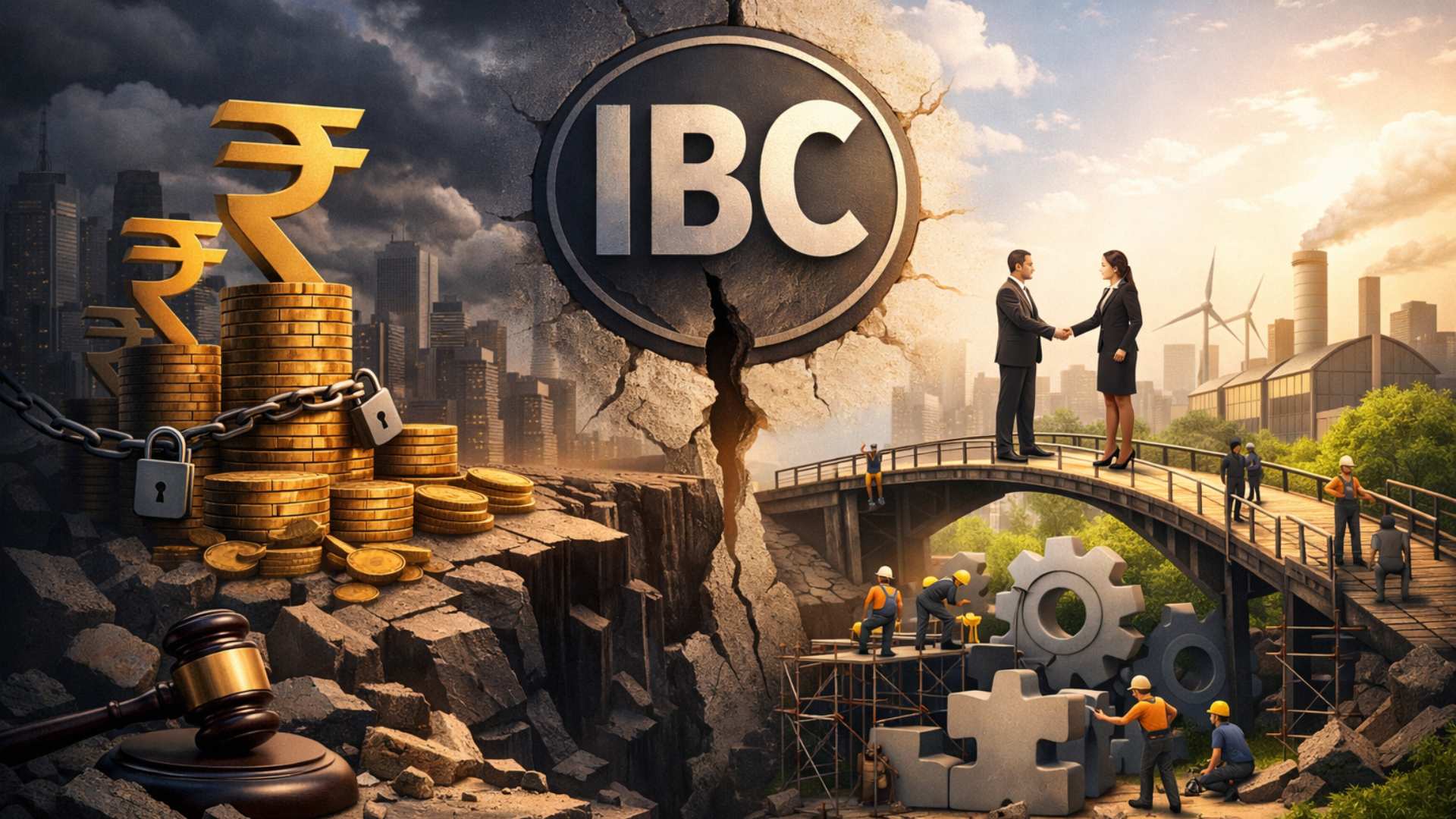
The Insolvency and Bankruptcy Code (IBC), 2016 marked a major reform in India’s financial architecture, aimed at time-bound resolution of stressed assets and improving ease of doing business. It has delivered relatively higher recoveries (~37% in 2024–25) compared to other mechanisms, contributing ~52% of total bank recoveries. However, a growing concern is that the IBC is increasingly being used as a debt recovery tool rather than a resolution framework, deviating from its original objective.
Background & Objectives of IBC
-
Based on Bankruptcy Law Reforms Committee (BLRC) recommendations.
-
Key objectives:
- Resolution of insolvency
- Maximisation of asset value
- Time-bound process (180–330 days)
- Balancing stakeholder interests
-
Key feature:
- Moratorium on recovery actions during proceedings
- Shift from individual enforcement → collective resolution
Performance of IBC vs Other Mechanisms
| Mechanism | Recovery Rate (2024–25) |
|---|---|
| IBC | ~37% |
| SARFAESI | ~32% |
| DRTs | ~10% |
| Lok Adalats | ~2% |
-
IBC dominates recovery landscape but:
- Only ~1,300 cases resolved out of 8,659 admitted
- ~30,000 cases withdrawn pre-admission (₹14 trillion debt)
Key Issue: Shift from Resolution to Recovery
Conceptual Difference
| Aspect | Resolution (Intended) | Recovery (Observed) |
|---|---|---|
| Objective | Revive firm | Maximise creditor returns |
| Approach | Collective restructuring | Coercive repayment |
| Outcome | Going concern | Asset liquidation/extraction |
Legal & Judicial Position
-
Swiss Ribbons v. Union of India (2019):
IBC is a “beneficial legislation” aimed at revival.
-
HPCL Bio-Fuels Ltd (2024):
Recovery is incidental, not the primary objective.
-
Section 65, IBC:
- Penalises misuse for recovery purposes
-
UNCITRAL Framework:
- Insolvency law is not a debt enforcement tool
Reasons for Distortion
1. Section 29A (Promoter Ineligibility)
-
Bars defaulting promoters from bidding
-
Creates fear of losing control
-
Leads to:
- Pre-admission settlements (“shadow settlements”)
- Use of IBC as a pressure tactic
2. Creditor Behaviour (CoC)
-
Preference for:
- Upfront cash recovery
- Short-term gains
-
Limited focus on:
- Long-term business revival
- Value maximisation
3. Strategic Use of IBC
-
“File first, negotiate later” approach
-
Insolvency threat used for:
- Faster settlements
- Avoiding lengthy restructuring
4. Data Misinterpretation
-
Focus on:
- Recovery rates under resolution plans
-
Ignoring:
- Low recoveries in liquidation
- Poor outcomes for operational creditors
Implications
Positive
- Improved credit discipline
- Faster recovery compared to earlier regime
- Strengthened banking sector balance sheets
Negative
-
Undermines resolution objective
-
Leads to:
- Premature insolvency triggers
- Value destruction of viable firms
-
Encourages race to enforcement
-
Weak protection for operational creditors
Case Insight
-
Glas Trust Company LLC (2024):
- SC criticised misuse of private settlements bypassing IBC process
-
Reflects trend of:
- Using IBC as negotiation leverage
Systemic Concerns
- Solvent firms dragged into insolvency for minor defaults
- Deeply distressed firms ignored (low recovery potential)
- Institutionalisation of recovery-centric culture
Way Forward
1. Reorient Towards Resolution
- Reinforce IBC’s core objective
- Discourage misuse through stricter enforcement of Section 65
2. Reform Section 29A
- Calibrate without weakening deterrence
3. Strengthen Institutional Framework
-
Improve:
- Role of Insolvency Professionals
- Efficiency of NCLT
4. Promote Alternative Mechanisms
- Pre-pack insolvency
- Out-of-court restructuring frameworks
5. Incentivise Long-term Value Maximisation
-
Encourage:
- Deferred payments
- Performance-linked recoveries
Expert Insight
“Insolvency regimes are designed to preserve value through collective action, not to facilitate individual enforcement.” — UNCITRAL Legislative Guide
Conclusion
The IBC remains a landmark reform in India’s economic governance, but its increasing use as a recovery mechanism risks undermining its foundational purpose. A shift in creditor mindset, supported by judicial vigilance and regulatory clarity, is essential to restore its role as a true resolution framework. The future of India’s credit ecosystem hinges on balancing efficiency with sustainability.
Attribution
Original content sources and authors
Syllabus classification
How this article maps to GS papers
Main syllabus
GS3BankingQuick Q&A
What was the original objective of the Insolvency and Bankruptcy Code (IBC), 2016, and how has its implementation diverged from this vision?
However, over time, its implementation has diverged significantly. The IBC is increasingly being perceived as a debt recovery tool, with emphasis on recovery rates and creditor returns. Public discourse often highlights metrics such as "haircuts" and recovery percentages, overshadowing the core objective of business revival. For instance, while the IBC shows a 37% recovery rate, this figure is often compared with mechanisms whose primary purpose is recovery, creating a misleading narrative.
This divergence reflects a deeper institutional shift, where stakeholders—especially creditors—prioritize immediate financial recovery over long-term value maximization. As a result, the Code risks losing its identity as a restructuring mechanism and instead becoming an efficient, but narrow, recovery instrument.
Why is the current focus on recovery rates under the IBC considered misleading and problematic?
This framing is problematic for several reasons:
- Cherry-picked data: Emphasis is placed on successful resolution cases, while poor recoveries in liquidation are often ignored.
- Neglect of operational creditors: Financial creditors dominate recovery outcomes, while operational creditors receive minimal returns.
- Misaligned incentives: Stakeholders begin prioritizing quick recovery over sustainable business revival.
For example, highlighting a 37% recovery rate without accounting for liquidation losses or failed resolutions presents an incomplete picture.
This narrative shift risks institutionalizing a short-term, extraction-oriented mindset, undermining the Code’s ability to preserve enterprise value and address systemic financial stress effectively.
How do provisions like Section 29A and creditor behavior contribute to the transformation of the IBC into a recovery tool?
Its impact can be seen in two ways:
- Pre-admission settlements: Promoters often settle dues before insolvency admission to avoid losing control, leading to a large number of case withdrawals.
- Leverage for creditors: Creditors use the threat of insolvency as a bargaining tool to extract payments.
Data shows that nearly 30,000 cases were withdrawn before admission, compared to only about 1,300 successful resolutions, highlighting this trend.
Additionally, financial creditors in the Committee of Creditors (CoC) prefer upfront cash recovery rather than long-term restructuring. This bias towards immediate returns reinforces the recovery-oriented approach.
Thus, while Section 29A serves a legitimate purpose, its interaction with creditor incentives has led to the weaponisation of the IBC as a tool for coercive recovery rather than collaborative resolution.
What explains the high number of withdrawals and low resolution rates under the IBC framework?
Key reasons include:
- Strategic filings: Creditors file insolvency petitions to pressure debtors into settlement.
- Fear of loss of control: Promoters settle quickly to avoid insolvency admission and disqualification under Section 29A.
- Inefficiencies in resolution: Complex procedures and delays discourage genuine restructuring efforts.
For instance, for every one case resolved through a plan, nearly 25 are withdrawn at the pre-admission stage. This indicates that the IBC is being used more as a threat mechanism than as a resolution framework.
This trend undermines the collective nature of insolvency resolution and encourages individualistic, short-term settlements, which may not maximize overall economic value.
Critically analyze the systemic implications of treating the IBC as a debt recovery mechanism rather than a resolution framework.
Negative implications include:
- Destruction of enterprise value: Premature insolvency filings can disrupt viable businesses.
- Race to enforcement: Creditors compete to recover dues individually, defeating the collective resolution process.
- Distortion of credit markets: Lending decisions may become overly cautious, affecting credit availability.
For example, solvent firms facing temporary liquidity issues may be dragged into insolvency, while deeply distressed firms are ignored due to low recovery prospects.
However, some positive aspects exist:
- Improved credit discipline: The threat of insolvency encourages timely repayments.
- Faster recoveries: Compared to earlier mechanisms, the IBC is more efficient.
Overall, the costs outweigh the benefits if this trend continues. The IBC risks becoming an extraction tool rather than a mechanism for economic revival, necessitating a recalibration of stakeholder behavior.
Using recent judicial interpretations, examine how the Supreme Court has clarified the purpose of the IBC and its implications for practice.
Similarly, in M/s HPCL Bio-Fuels Ltd (2024), the Court reiterated that insolvency proceedings are not meant for debt enforcement. In Glas Trust Company LLC (2024), it criticized attempts to bypass statutory procedures through private settlements.
Implications of these rulings include:
- Reinforcement of legislative intent: Courts have consistently upheld resolution as the primary objective.
- Check on misuse: Judicial scrutiny aims to prevent the IBC from being used as a coercive recovery tool.
- Guidance for stakeholders: These rulings provide clarity for creditors, promoters, and insolvency professionals.
However, despite judicial guidance, ground-level practices continue to diverge, indicating a gap between legal principles and operational reality.
This highlights the need for not just legal clarity but also a shift in stakeholder behavior to align practice with the Code’s foundational objectives.
Practice questions
1 question for mains preparation