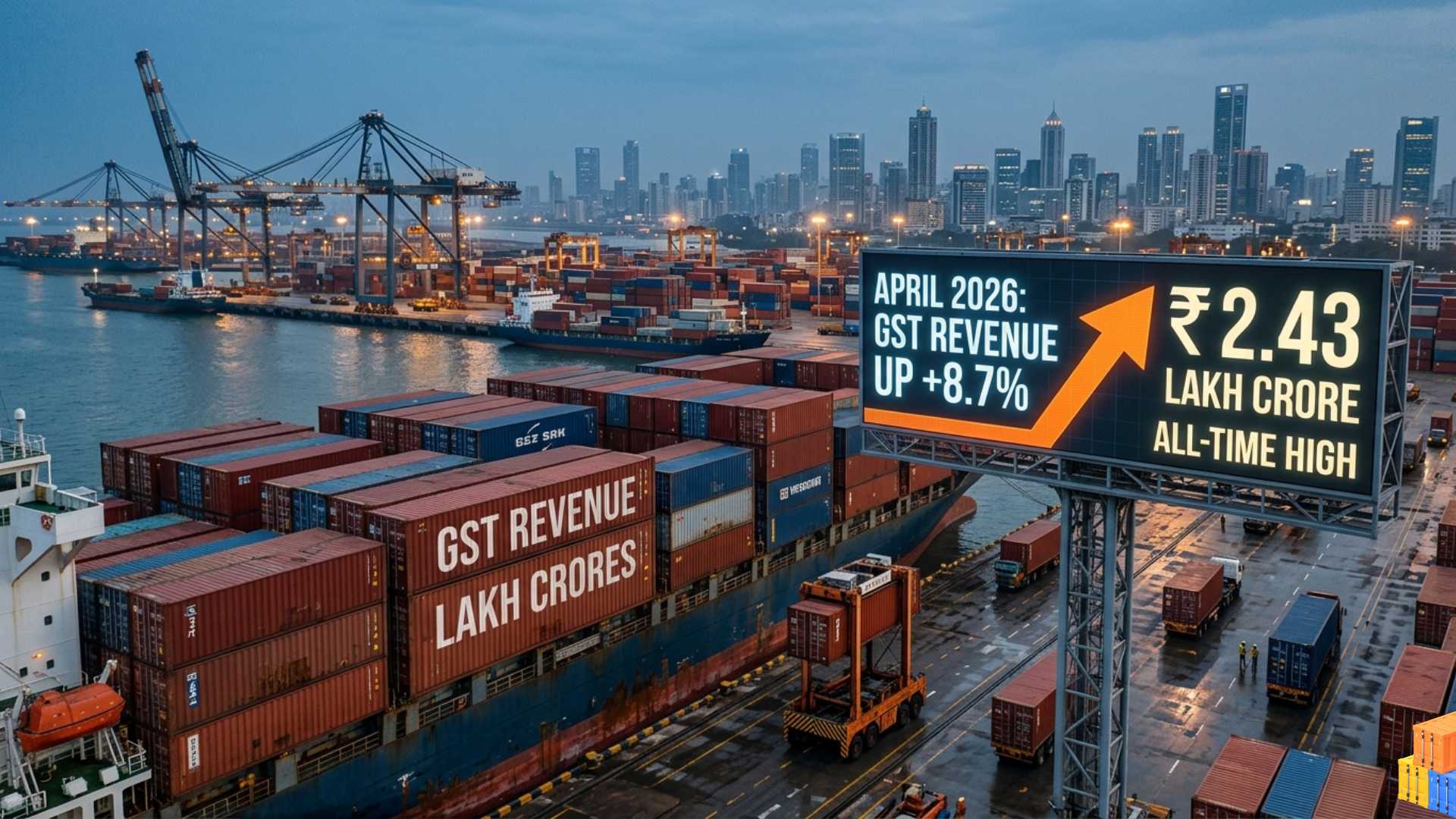
GST Revenue Reaches Record High of Rs 2.43 Lakh Crore in April 2026

Introduction
-
India's GST collections hit an all-time high of ₹2.43 lakh crore in April 2026, growing 8.7% YoY — capping a resilient FY2025-26 despite global geopolitical headwinds.
-
Since its 2017 rollout, GST has unified India's fragmented indirect tax regime into a single destination-based consumption tax.
"April 2026 GST collections cap off a resilient FY26, despite continued global uncertainty and West Asia-related geopolitical headwinds." — Mahesh Jaising, Deloitte India
Key Data
| Indicator | Figure |
|---|---|
| Gross collections (April 2026) | ₹2.43 lakh crore (+8.7% YoY) |
| Net collections (after refunds) | ₹2.11 lakh crore (+7.3% YoY) |
| Import GST growth | ₹57,580 crore (+26%) |
| Domestic GST growth | ₹1.85 lakh crore (+4.3%) |
Background
GST Architecture: Introduced via 101st Constitutional Amendment (2017), subsuming 17 taxes. Dual structure — CGST + SGST (domestic) and IGST (inter-state + imports).
April Effect: Every April since 2017 has been the fiscal year's highest collection month (except April 2020 — COVID). Driven by year-end compliance push and tax administration targets — not a reliable full-year trend indicator.
Key Concepts
Gross vs Net Collections Net = Gross minus refunds. The ₹32,000 crore gap reflects pending refund outflows, primarily to exporters — the more meaningful fiscal metric.
Import vs Domestic Growth Gap
| Source | Growth | Signal |
|---|---|---|
| Import GST | +26% | Strong trade flows, supply chain normalisation |
| Domestic GST | +4.3% | Consumption softness, discretionary spending moderation |
GST 2.0 Ongoing rate rationalisation — fewer slabs, correcting inverted duty structures — showing early signs of supporting consumption without eroding the tax base.
Analytical Implications
-
Consumption Signal: Slower domestic growth amid headline buoyancy points to a possible K-shaped pattern — upper-income spending healthy, mass consumption moderating.
-
The divergence may reflect a K-shaped pattern — upper-income discretionary spending healthy while mass consumption moderates.
-
Fiscal Federalism: Strong GST revenues reduce States' dependence on compensation grants (ended June 2022), strengthening their own revenue base.
-
Strong GST revenues reduce States' dependence on compensation grants (ended June 2022) — a critical fiscal federalism dividend.
-
Geopolitical Risk: Import GST's 26% surge reflects supply chain normalisation — but also India's import dependency. Any global trade contraction could sharply reverse this gain.
"April's record figures reflect the year-end push — anticipate a sequential dip as the market recalibrates." — Saurabh Agarwal, EY India
Persistent Challenges
- Petroleum, alcohol, real estate remain outside GST — narrowing the base
- Multiple rate slabs create classification disputes
- Fake ITC fraud remains a structural vulnerability despite e-invoicing
- Frequent rate changes create compliance fatigue for MSMEs
- IGST settlement formula remains a Centre-State friction point
Way Forward
- Include petroleum in GST — highest-impact single reform
- Move toward a two-rate structure to reduce litigation
- AI-driven ITC reconciliation to plug credit fraud
- Stabilise GST Council decisions to reduce business uncertainty
Conclusion
April 2026's record is a marker of GST's institutional maturation — yet the import-domestic divergence is a subtle warning that headline numbers can mask underlying consumption stress. India's fiscal strategy must look beyond revenue records toward what GST data reveals about the quality of economic growth — ensuring the architecture serves not just collection targets but a competitive, formally documented economy.
Attribution
Original content sources and authors


Syllabus classification
How this article maps to GS papers
Main syllabus
GS3Indian-EconomyQuick Q&A
What explains the record-high GST collections in April 2026, and how should such figures be interpreted?
- Year-end economic activity: April collections correspond to March transactions, when businesses accelerate production and sales to meet financial targets.
- Administrative push: Tax authorities intensify compliance and enforcement efforts at the close of the fiscal year.
- Import-led growth: A significant rise in import-related GST collections boosted overall revenue.
However, interpretation requires caution. Historically, April has consistently recorded peak GST collections since 2017 (except during COVID-19 in 2020), indicating a predictable seasonal spike rather than an extraordinary surge in economic fundamentals.
From a policy perspective, such data must be contextualized within broader trends. For instance, steady year-on-year growth (8.7%) suggests resilience in the tax system, but the reliance on imports raises questions about domestic demand strength. Thus, April figures should be seen as a culmination of fiscal-year dynamics rather than a standalone indicator of sustained economic momentum.
Why is the dominance of import-led GST revenue growth a matter of concern for the Indian economy?
- Weak domestic consumption: Slower growth in domestic GST collections may indicate subdued consumer demand, particularly in discretionary spending.
- External dependence: Increased reliance on imports can widen the trade deficit and expose the economy to global shocks.
- Uneven growth patterns: A divergence between import and domestic activity may signal structural imbalances.
At the same time, this trend is not entirely negative. It may reflect resilient supply chains and strong external trade linkages, especially in sectors reliant on imported inputs like electronics and manufacturing.
For policymakers, the challenge lies in ensuring that domestic consumption and production keep pace with import growth. A balanced GST revenue structure is crucial for sustainable economic expansion, as overdependence on imports could undermine long-term fiscal and industrial stability.
How does GST 2.0 contribute to stabilizing revenue growth and supporting economic activity?
- Rate rationalization: Streamlining tax slabs reduces complexity and compliance burdens for businesses.
- Improved compliance mechanisms: Enhanced digital systems and e-invoicing reduce tax evasion and increase transparency.
- Ease of doing business: Simplified procedures encourage formalization of the economy.
These reforms have led to a steady 7–8% growth trajectory in GST revenues, indicating predictability and stability in the tax system. Importantly, they support consumption without significantly eroding the tax base, which is critical for fiscal sustainability.
For example, the integration of e-invoicing and data analytics has enabled better tracking of transactions, thereby boosting revenue collection efficiency. Overall, GST 2.0 acts as a stabilizing force by aligning tax policy with economic realities while fostering compliance and growth.
What are the underlying reasons for the expected moderation in GST collections in the coming months?
- End of fiscal-year push: Both businesses and tax authorities intensify efforts in March, leading to inflated April figures.
- Market recalibration: After the financial year closes, economic activity normalizes, resulting in lower transaction volumes.
- Seasonal trends: Historically, GST collections decline sequentially after April peaks.
Additionally, external factors such as geopolitical uncertainties and inflationary pressures may dampen consumer sentiment and spending, further impacting tax collections.
For instance, similar patterns have been observed in previous years where April highs were followed by gradual stabilization. This underscores the importance of analyzing trends over multiple months rather than relying on a single data point. Policymakers must therefore focus on sustaining consistent growth rather than short-term spikes.
Critically analyze the implications of steady GST growth for India’s fiscal health and economic resilience.
- Revenue predictability: Stable growth enables better fiscal planning and budget management.
- Broadening tax base: Increased formalization enhances long-term revenue sustainability.
- Economic resilience: Consistent collections despite global uncertainties indicate underlying economic strength.
However, certain challenges persist. The reliance on import-driven growth raises concerns about domestic demand, while moderate consumption growth may signal underlying economic weaknesses. Additionally, GST still faces structural issues such as multiple tax slabs and compliance complexities.
From a critical standpoint, while steady growth is desirable, it must be accompanied by balanced sectoral contributions and robust domestic demand. Thus, GST performance should be evaluated alongside broader macroeconomic indicators to assess true economic resilience.
Using April 2026 GST data as a case study, what lessons can policymakers derive for improving tax administration and economic policy?
- Importance of compliance measures: Enhanced monitoring and digital tools can significantly boost revenue collection.
- Need for demand stimulation: Slower domestic growth highlights the necessity of policies that encourage consumption.
- Balancing trade dynamics: Heavy reliance on import-based revenue calls for strengthening domestic manufacturing.
For example, the success of e-invoicing and data analytics demonstrates how technology can improve tax efficiency. At the same time, the divergence between import and domestic collections signals the need for targeted fiscal interventions, such as tax incentives or subsidies for domestic industries.
In conclusion, policymakers should adopt a holistic approach that combines administrative efficiency with economic reforms. The case underscores that robust tax collection is not merely a function of enforcement, but also of underlying economic vitality.
Practice questions
2 questions for mains preparation