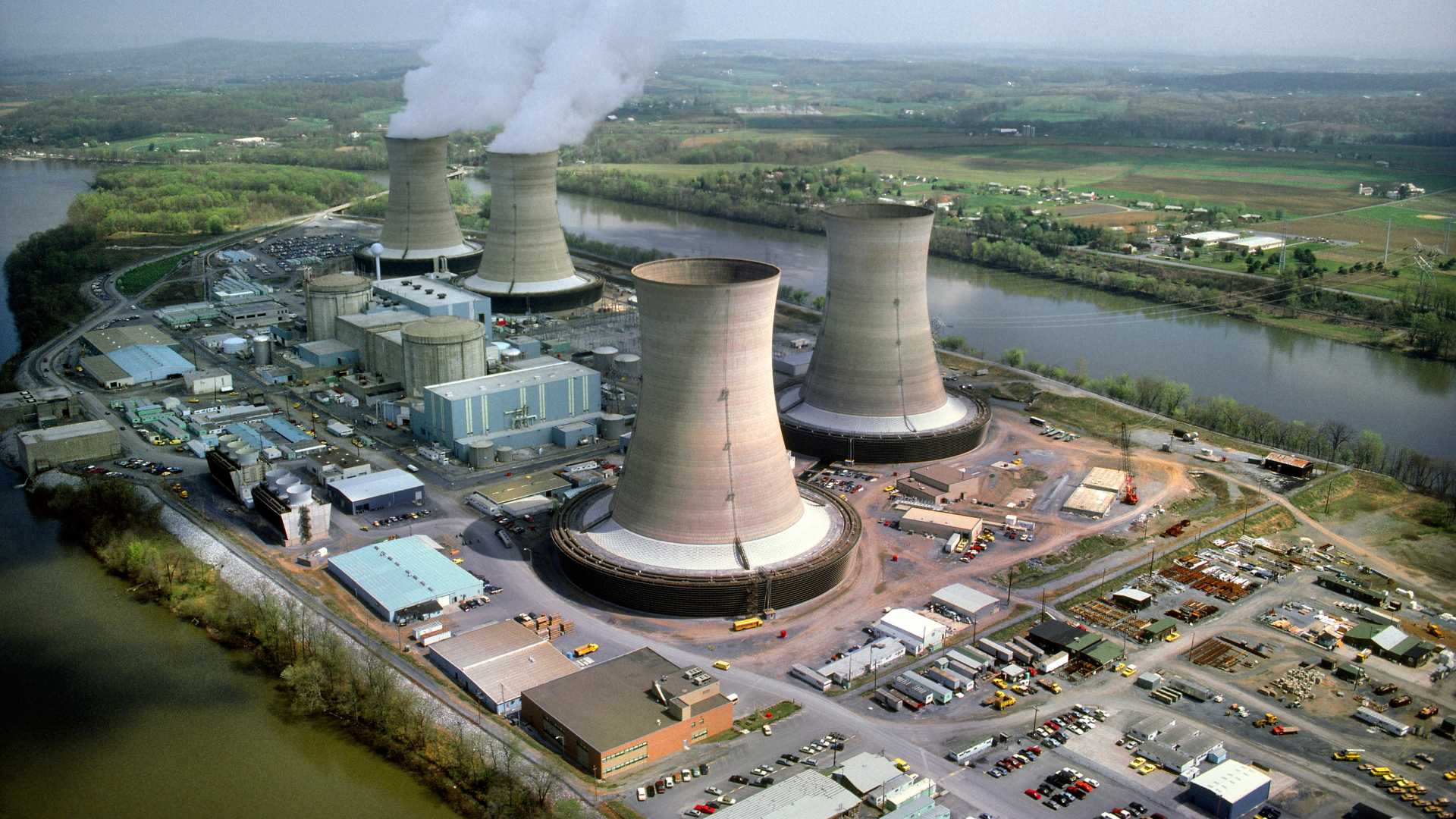
SHANTI Act and India's Nuclear Energy Expansion

"No one can fudge the half-life of a radioisotope. If it is 30 years, it remains 30 years." — Ravi Grover, Member, Atomic Energy Commission
India's installed nuclear capacity stands at just 8.7 GW — less than 3% of total electricity generation — against a target of 100 GW by 2047. The SHANTI Act, 2025, marks a historic structural shift: for the first time, private companies can own and operate nuclear power plants in India, ending NPCIL's half-century monopoly. Whether this ambition translates into reality depends on resolving deep tensions between commercial viability, lifetime safety obligations, and technological sovereignty.
| Indicator | Data |
|---|---|
| Current nuclear installed capacity | 8.7 GW |
| Target capacity by 2047 | 100 GW |
| Indigenous reactor options | 220 MW (outdated) / 700 MW PHWR (preferred) |
| India's nuclear plant construction cost | ~$1,000–1,200/kW |
| France / USA construction cost | $1,800+/kW |
| SMR designs globally | 58 designs — none commercially built |
| Periodic safety review cycle | Every 10 years (mandated under SHANTI Act) |
Background & Context
Pre-SHANTI architecture: India's nuclear sector operated under the Atomic Energy Act, 1962, which restricted nuclear power entirely to the public sector under the Department of Atomic Energy (DAE). NPCIL was the sole operator, with regulation, operation, and policy all sitting within the same governmental ecosystem — a structure that worked when all players were state entities but became inadequate as India sought rapid capacity expansion.
Why SHANTI now? India's energy transition targets — net zero by 2070, 500 GW non-fossil capacity by 2030 — require reliable baseload clean power. Solar and wind are intermittent; nuclear provides firm, dispatchable, low-carbon electricity. Achieving 100 GW requires capital and execution capacity far beyond what the public sector alone can mobilise.
Key Provisions of the SHANTI Act, 2025
Full form: Sustainable Harnessing and Advancement of Nuclear Energy for Transforming India
1. Private Participation: Private companies — domestic and foreign-funded — can now apply for licences to construct and operate nuclear power plants.
2. Unified Legal Framework: Separates control regulation (what can be built and where) from safety regulation (how it must be operated) — a clarity previously implicit only because all players were within DAE.
3. Licensee Liability: Section 10 places primary responsibility for safety, security, and safeguards squarely on the licensee — public or private. This includes waste management, radiation claim settlements, and plant decommissioning.
4. Lifetime Design Support: Licensees must maintain design support throughout the facility's operational life — a uniquely demanding requirement given nuclear plants operate for 40–60 years.
5. Periodic Safety Review: Every 10 years, operators must demonstrate compliance with current safety standards — meaning safety obligations escalate over time, not diminish.
Technology Choice — The Central Decision
Option 1: 220 MW Indigenous PHWR
        ↓
Design finalised 15 years ago
        ↓
Needs substantial rework for current safety benchmarks
        ↓
Not recommended for large-scale deployment

Option 2: 700 MW Indigenous PHWR (Preferred)
        ↓
Current NPCIL fleet-mode deployment plan
        ↓
Tariff comparable to / lower than coal
        ↓
Natural choice for private sector entry

Option 3: Foreign Reactors
        ↓
Prohibitive costs + 2–3 year design validation for Indian conditions
        ↓
Long-term design support arrangements uncertain
        ↓
Risk of dependence without technological sovereignty

Option 4: Small Modular Reactors (SMR)
        ↓
58 designs globally — none commercially operational
        ↓
Costs unknown, unproven at scale
        ↓
Risk of India becoming testing ground for Western technology
Key Challenges for Private Participation
1. LIFETIME FINANCIAL COMMITMENT
─────────────────────────────────────────
Nuclear ≠ Conventional Power Investment

Private sector horizon  →  10–15 years
Nuclear liability window →  60–80 years
        ↓
Must provision for:
  • Waste management
  • Radiation liability claims
  • Plant decommissioning
        ↓
Financial security mechanisms non-negotiable
2. SITE SELECTION COMPLEXITY
─────────────────────────────────────────
Beyond land + water availability
        ↓
Requires assessment of:
  • Geological stability
  • Seismic risk
  • Hydrological conditions
  • Population density criteria
        ↓
Multiple agency approvals → Extended timelines
3. DESIGN INTEGRITY OVER PLANT LIFETIME
─────────────────────────────────────────
Modification to one system
        ↓
Cascades adversely through other systems
        ↓
Foreign reactor imported without
long-term design support agreement
        ↓
Cannot incorporate mandatory safety upgrades
during 10-year periodic reviews
        ↓
Fatal commercial + safety vulnerability
4. TARIFF VIABILITY
─────────────────────────────────────────
LCOE must account for:
  • Land + fuel + operations
  • Waste management
  • Decommissioning costs
        ↓
NPCIL tariff ≈ comparable to coal ✓
        ↓
Private operators must match this
WHILE bearing extra liability costs
        ↓
Commercially viable only with
right technology + long-term financing
5. PUBLIC CONFIDENCE
─────────────────────────────────────────
Nuclear's social licence =
transparent safety performance
        ↓
Any fudging or concealment
        ↓
Latent failures compound
        ↓
Fukushima-scale event →
irreversible loss of public trust
        ↓
Honest reporting = non-negotiable
INDIA'S COMPETITIVE ADVANTAGE
─────────────────────────────────────────
Nuclear plant construction cost (per kW):

India   →  $1,000–1,200  ✓ Cheapest
France  →  $1,800
USA     →  $2,000+  (no new plant in 30–40 years)
        ↓
Advantage built through decades of
indigenous NPCIL engineering
        ↓
Private participation must BUILD on this
— not replace it with foreign technology
India's Competitive Advantage — An Underacknowledged Reality
India builds nuclear power plants at approximately **1,800/kW in France and significantly higher in the United States. This cost advantage, built over decades of indigenous engineering under NPCIL, is the foundation on which private participation must build — not replace with expensive foreign technology.
Way Forward
- Scale the 700 MW indigenous PHWR programme in fleet mode — following France's 1970s standardisation model — to drive down costs through replication
- Government-backed long-term debt at fixed rates for 25–30 years to make nuclear financing commercially viable for private players
- Pre-identified sites using public resources — geological surveys, clearances — to reduce private entry barriers and timelines
- Mandatory long-term design support contracts as a licensing pre-condition for any foreign reactor imports
- Financial security provisioning norms — mandatory escrow or insurance mechanisms for waste management and decommissioning liabilities
- Transparent safety reporting framework with independent third-party verification to build and sustain public confidence
- Avoid SMR dependency until at least one design achieves commercial operational scale globally
Conclusion
The SHANTI Act is a necessary and overdue reform — India cannot reach 100 GW of nuclear capacity through public sector investment alone. However, nuclear energy's unique characteristics — generational liability windows, cascading safety interdependencies, and irreversible consequences of failure — demand that private participation be structured with far greater rigour than other infrastructure sectors. India's advantage lies not in importing Western technology but in scaling what it has already mastered. The path to 100 GW runs through indigenous engineering, long-term financing architecture, and an uncompromising safety culture — not through SMR mirages or foreign reactor dependencies.
Attribution
Original content sources and authors


Syllabus classification
How this article maps to GS papers
Main syllabus
GS3InfrastructureQuick Q&A
What are the key features and objectives of the SHANTI Act, 2025 in India's nuclear energy sector?
Key Provisions:
- Clear delineation of liability and safety responsibility on the licensee (operator)
- Provision for private and foreign investment in nuclear power generation
- Mandatory periodic safety reviews and lifetime design support
- Separation of regulatory oversight and operational control
Significance: The Act introduces transparency and accountability, particularly important with private sector entry. It ensures that safety, waste management, and decommissioning responsibilities are legally binding.
Conclusion: The SHANTI Act aims to transform India’s nuclear sector into a more dynamic, investment-friendly ecosystem while maintaining stringent safety and regulatory standards.
Why is nuclear power described as a “lifetime commitment”, and what are its implications for private participation?
Implications for Private Players: Private companies entering this sector must ensure long-term financial security and technical capability. The SHANTI Act mandates that operators maintain design support throughout the plant’s lifecycle and conduct periodic safety reviews. This creates high entry barriers, as companies must be prepared for decades-long commitments rather than short-term profits.
Risk and Responsibility: Unlike thermal or renewable plants, failures in nuclear facilities can have catastrophic consequences, as seen in Fukushima. Therefore, accountability and transparency are critical, with no scope for regulatory manipulation.
Conclusion: The ‘lifetime commitment’ nature of nuclear energy ensures that only serious, well-capitalized, and technically सक्षम players can participate, thereby safeguarding public safety and long-term sustainability.
How does the SHANTI Act address concerns related to nuclear safety, regulation, and accountability in a liberalized sector?
Safety Mechanisms:
- Primary responsibility for safety lies with the licensee
- Mandatory periodic safety reviews every 10 years
- Requirement for continuous design support and integrity
- Strict adherence to scientific parameters (e.g., radioactive half-life cannot be altered)
Accountability Measures: The Act emphasizes honest reporting and transparency, discouraging concealment of risks. This is crucial to prevent disasters similar to Fukushima, where systemic failures escalated due to lack of transparency.
Conclusion: By embedding safety and accountability into the legal framework, the SHANTI Act ensures that liberalization does not compromise regulatory rigor, thereby maintaining public trust in nuclear energy.
Critically analyze the challenges and opportunities associated with private sector participation in India's nuclear energy sector.
Challenges: However, the sector presents significant challenges:
- High capital costs and long gestation periods
- Complex regulatory and safety requirements
- Need for long-term design and technical support
- Public perception and trust issues
Critical Concerns: Experts caution against adopting untested technologies like Small Modular Reactors (SMRs), which may expose India to financial and technological risks. Ensuring tariff viability is also crucial, as electricity costs impact industrial competitiveness.
Conclusion: While private participation offers significant benefits, it must be carefully regulated and aligned with national priorities to avoid risks related to safety, cost, and technological dependence.
What lessons can India learn from global and domestic experiences in scaling up nuclear energy capacity?
India’s Strengths: India has developed indigenous technologies like the 700 MW Pressurised Heavy Water Reactor (PHWR), which is cost-effective and suited to local conditions. Experts highlight that India builds nuclear plants at significantly lower costs compared to global counterparts.
Key Lessons:
- Adopt standardized designs for scalability
- Ensure long-term financing with government support
- Avoid premature adoption of untested technologies like SMRs
- Strengthen domestic capabilities to reduce dependence on imports
Conclusion: By leveraging its indigenous strengths and learning from global experiences, India can achieve sustainable and cost-effective nuclear expansion.
As an energy policymaker, how would you ensure the successful implementation of the SHANTI Act while balancing safety, affordability, and public trust?
Strategic Measures:
- Promote indigenous technologies like the 700 MW PHWR for cost efficiency
- Provide long-term financing and incentives to private players
- Strengthen regulatory institutions to ensure independence and accountability
- Invest in public awareness campaigns to build trust in nuclear energy
Risk Mitigation: Avoid reliance on untested technologies and ensure that all operators have access to long-term design support. Establish robust mechanisms for waste management and emergency response.
Conclusion: Successful implementation of the SHANTI Act requires a holistic approach that integrates economic, technical, and social dimensions, ensuring that nuclear energy contributes effectively to India’s sustainable development goals.
Practice questions
1 question for mains preparation