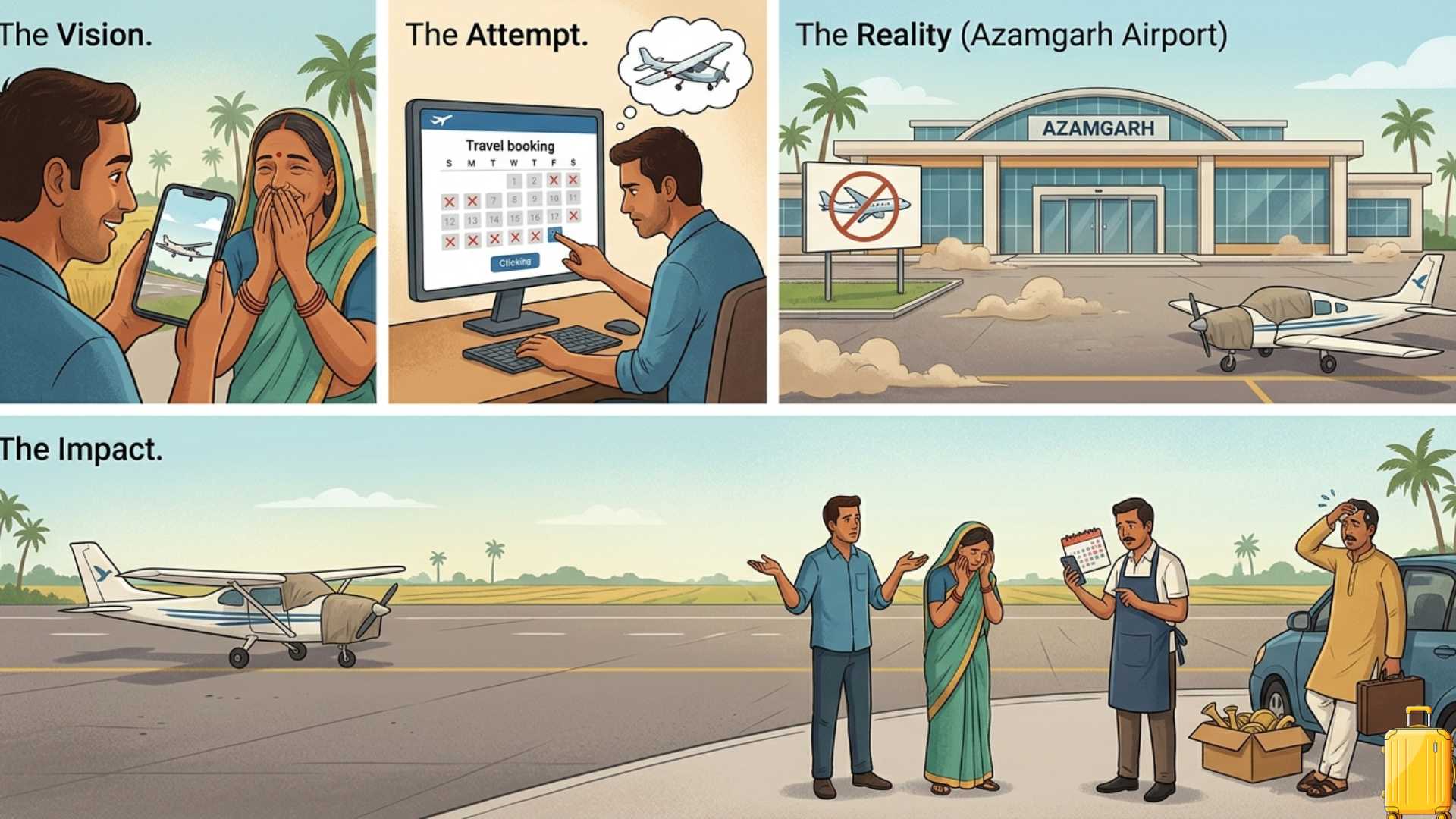
UDAN Scheme — Regional Air Connectivity and Implementation Gaps

"Aviation infrastructure alone does not guarantee connectivity. The State suffers from a lack of realistic planning, route-viability analysis, and airline engagement at smaller locations." — Samajwadi Party Spokesperson, Nasser Salim
India has one of the world's fastest-growing aviation markets, yet tier-2 and tier-3 cities remain poorly connected. The UDAN scheme, launched in 2016 to democratise air travel, has seen significant infrastructure investment — yet in Uttar Pradesh alone, 8 of 17 technically operational airports have zero scheduled traffic, exposing a deep gap between inauguration optics and functional connectivity.
| Indicator | Data |
|---|---|
| UDAN scheme launch year | 2016 |
| Capped fare (RCS routes) | ₹2,500 per flight hour |
| Subsidised seat share | 50% of seats per flight |
| UP airports — technically operational | 17 |
| UP airports — closed to traffic | 8 |
| Kushinagar Airport cost | ₹300+ crore |
| Saharanpur Airport cost | ₹46.86 crore |
| Shravasti Airport cost | ₹32.84 crore |
| UP air passenger growth (Apr–Aug 2025 YoY) | 14.6% |
Background & Context
The Regional Connectivity Scheme (RCS) – UDAN (Ude Desh Ka Aam Nagrik) was launched to fulfil a simple promise: make air travel affordable and accessible to ordinary citizens in underserved cities. The scheme operates through:
- Competitive bidding — airlines bid for routes connecting tier-2/3 cities
- Viability Gap Funding (VGF) — government subsidy to airlines covering the revenue shortfall on unviable routes
- Fare caps — 50% of seats capped at ₹2,500 per flight hour
- Exclusive 3-year contracts — to encourage airline commitment on awarded routes
Despite this architecture, the scheme has struggled to sustain operations beyond inauguration in several states, with Uttar Pradesh emerging as the most prominent case study in implementation failure.
Key Failures
1. Route Viability Misjudgement
No demand assessment done
        ↓
Routes awarded to cities with limited business/tourism traffic
        ↓
Strong road/rail alternatives already exist
        ↓
Passengers never materialise → Airlines exit
2. Operational Dependencies Ignored
All UDAN routes linked to single hub (Lucknow Airport)
        ↓
Lucknow runway closed for resurfacing / poor visibility
        ↓
Entire regional network shuts down simultaneously
        ↓
Foreseeable risk — never mitigated in route planning
3. Airline Fragility
Multiple critical routes awarded to single airline (FlyBig)
        ↓
Small fleet + weak financials = systemic concentration risk
        ↓
FlyBig ceases operations (December 2025)
        ↓
All dependent routes collapse together
4. Infrastructure Without Ecosystem
Airport built → Runway, terminal, equipment installed
        ↓
High-cost maintenance continues regardless of traffic
        ↓
Zero flights → Zero revenue → Pure fiscal drain
        ↓
Public money spent with no connectivity outcome
5. Political Inauguration Over Functional Planning
Election cycle approaches
        ↓
Airport inaugurated → Optics of development created
        ↓
Flights operate briefly (Kushinagar: 52 ops in 10 days)
        ↓
Elections conclude → Flights stop → Airport goes dormant
Governance and Policy Gaps
| Gap | Consequence |
|---|---|
| No demand assessment before route award | Routes unviable from day one |
| Dependence on single fragile airline | Network collapses when airline fails |
| Hub airport vulnerabilities not mitigated | Downstream airports shut during Lucknow disruptions |
| No performance benchmarks post-inauguration | Airports count as "operational" with zero traffic |
| Misleading social media around closed airports | Citizens make travel plans based on non-existent services |
| Public money spent without accountability | ₹300+ crore Kushinagar; ₹46.86 crore Saharanpur — underutilised |
What Is Working
It would be analytically incomplete to dismiss UDAN entirely. Uttar Pradesh recorded 60 lakh air passengers between April–August 2025, with 14.6% YoY growth. Gorakhpur and Agra airports recorded ~63% growth — demonstrating that where genuine demand exists, regional connectivity can succeed. The scheme's architecture — VGF, fare caps, exclusive contracts — is broadly sound. The failure is in implementation quality, not conceptual design.
Way Forward
- Mandatory demand feasibility study before any airport development under UDAN — including passenger origin-destination surveys and modal competition analysis
- Multi-airline bidding requirement on routes above a minimum traffic threshold — preventing single-airline dependency
- Performance-linked VGF disbursement — funding tied to actual flight operations and passenger numbers, not just route award
- Hub resilience planning — backup routing protocols when hub airports face disruption
- Transparent public dashboard on UDAN route status — operational, suspended, or discontinued — to prevent misinformation
- Sunset review mechanism — routes with sustained low demand should trigger a formal review rather than silent abandonment
Conclusion
The UDAN scheme embodies a genuinely inclusive vision — air travel for the common citizen, not just the elite. Its failure in several UP cities is not a failure of intent but of execution discipline: airports built without demand assessment, routes awarded to fragile airlines, and inaugurations timed to political cycles rather than operational readiness. Public money — hundreds of crores — has been spent on airports that serve no passengers. A scheme designed to democratise aviation cannot achieve that goal through infrastructure alone; it requires realistic planning, accountable implementation, and honest assessment of where air connectivity is genuinely viable. The lesson from UP is not that regional aviation cannot work — it is that it cannot be wished into existence by ribbon-cutting alone.
Attribution
Original content sources and authors


Syllabus classification
How this article maps to GS papers
Main syllabus
GS3InfrastructureQuick Q&A
What is the UDAN (Ude Desh Ka Aam Nagrik) scheme, and how does it aim to improve regional connectivity in India?
Key Features:
- 50% seats offered at subsidized fares capped at ₹2,500 per hour of flight
- VGF funded through a levy on non-RCS routes
- Exclusive rights to airlines on specific routes for a limited period
- Focus on developing smaller airports and regional infrastructure
Relevance to the Article: Airports like Azamgarh, Moradabad, and Shravasti were developed under UDAN to connect smaller towns with major hubs like Lucknow. However, despite infrastructure creation, many of these airports lack sustained operations, highlighting challenges in implementation.
Conclusion: While UDAN has improved accessibility and reduced regional disparities in aviation, its success depends on long-term commercial viability, infrastructure readiness, and consistent airline participation.
Why are several airports developed under the UDAN scheme facing operational challenges despite significant public investment?
Operational Constraints: Factors such as poor visibility, inadequate infrastructure, and temporary runway closures (as seen in Lucknow airport resurfacing) have disrupted operations. Additionally, maintaining cost-intensive infrastructure like navigation systems and communication equipment adds financial strain.
Policy and Planning Gaps: Experts and political leaders have pointed out the absence of realistic planning and route viability analysis. Airports were sometimes inaugurated without ensuring airline commitment or demand assessment. Misleading public perception through social media further complicates the issue.
Conclusion: The challenges indicate that infrastructure creation alone is insufficient. Sustainable operations require integrated planning, stakeholder coordination, and demand-driven route allocation.
How does the concept of Viability Gap Funding (VGF) work in the UDAN scheme, and what are its limitations?
Benefits:
- Encourages airlines to operate in low-demand regions
- Reduces airfare, making air travel accessible to common citizens
- Promotes regional economic development and connectivity
Limitations: Despite its intent, VGF has limitations. It is a temporary support mechanism, and routes often become unsustainable once subsidies are reduced or withdrawn. Airlines may exit after the exclusive contract period, as seen with FlyBig. Additionally, VGF does not address structural issues like low demand or inadequate infrastructure.
Conclusion: While VGF is crucial for initial market creation, long-term sustainability requires improving demand, infrastructure, and operational efficiency beyond subsidies.
Critically analyze the effectiveness of regional airport development as a tool for economic growth and connectivity.
Challenges and Limitations: However, the article highlights that infrastructure alone does not guarantee success. Many airports remain underutilized due to poor planning, lack of airline participation, and insufficient demand. The phenomenon of ‘operational yet shut’ airports reflects inefficiencies in resource allocation.
Governance Concerns: Allegations of political optics and rushed inaugurations raise questions about accountability and transparency. The abrupt entry and exit of airlines like FlyBig further undermine public trust.
Conclusion: Regional airport development is a valuable policy tool but must be complemented by realistic demand assessment, stakeholder engagement, and long-term planning. Without these, it risks becoming a case of underutilized public investment.
What lessons can be drawn from the experience of underutilized airports in Uttar Pradesh for future infrastructure planning?
Importance of Stakeholder Coordination: Successful implementation requires coordination between government agencies, airlines, and local businesses. The failure of FlyBig operations underscores the need for reliable airline partnerships and contingency planning.
Need for Phased Development: Instead of building multiple airports simultaneously, a phased approach focusing on high-potential locations can ensure better utilization. For instance, airports in Gorakhpur and Agra have shown higher growth due to better demand alignment.
Conclusion: Future infrastructure planning must prioritize sustainability, accountability, and efficiency. Incorporating feedback mechanisms and periodic evaluations can help avoid the pitfalls observed in the current scenario.
As a policymaker, how would you address the issue of non-operational airports under the UDAN scheme?
Policy Interventions:
- Enhance incentives for airlines, including extended VGF support and tax benefits
- Encourage public-private partnerships for airport management
- Promote tourism and local industries to generate demand
- Improve last-mile connectivity to airports
Long-Term Strategy: Focus on integrating regional airports into broader economic plans, such as industrial corridors and tourism circuits. Digital marketing and transparent communication can prevent misinformation about operational status.
Conclusion: A holistic approach combining economic, infrastructural, and policy measures is essential to revive these airports. The goal should be not just operationalization, but sustainable and meaningful connectivity.
Practice questions
1 question for mains preparation